5 American-Made Tack Brands Still Worth Trusting
The biggest names selling horse tack are putting their logos on gear that rolled off overseas factory floors, while a handful of family-owned shops quietly build the only tack you can stake your horse’s back on. The people who ride for a living already know which names those are.
Here is the context most riders miss. This industry pulls the majority of its leather and hardware from two countries hit hardest by current tariffs — India and China. Those tariffs have already pushed a $99 paddock boot to $150 at retail. Tack stores are closing. Quality is slipping.
Buried in that noise are five brands still making gear on American soil. Ranked from rock solid to genuinely unshakable.
5. Classic Equine — the protection specialist
Founded in 1996 with a single obsession: keeping equine athletes sound. Leg protection was not an accessory line, it was the entire mission. Nearly three decades on one thing.
Their Legacy boots use 100% virgin perforated neoprene that lets heat escape so the leg stays cooler under stress. The patented Cradle Fetlock System delivers support at the joint where injuries end careers, and box-stitched hook-and-loop closures keep them in place through hard stops and sliding turns.
How to use it: if you are roping, running barrels or hauling long distances, start with the Legacy series and step up to their competition boots for show days. Match the boot to the discipline, not the color.
Nobody posts splint boots on social media. But anyone who has had a horse come up lame knows protection is the foundation everything else rides on.
4. Five Star Equine — the all-natural pad builder
Out of Hatfield, Arkansas, Five Star has handcrafted saddle pads since 1998 — every one from 100% pure wool felt. No synthetics, no blended fillers.
Vern and Laurel Wells founded the company on natural materials and real customer service. Vern passed away not long after launch and Laurel carried the shared plan forward. In 2012 Terry Moore, a third-generation logger and horseman, toured the operation, called it the best-kept secret in the industry, and took ownership.
Their wool felt wicks moisture, absorbs pressure, resists heat buildup and conforms to the horse’s back over time. That is not marketing language — that is what wool does when you do not dilute it.
How to use it: match the thickness to your saddle’s fit. A Five Star pad is not a bandage for a badly fitting saddle — and as we cover in the research on saddle fit, extra pad thickness can actively make a bad fit worse. It is the final layer between good fit and great comfort, not a substitute for the first.
3. Weaver Leather — the quiet powerhouse
When Harry Weaver crafted his first leather halter in 1973 out of a twenty-by-forty-foot workshop in Mount Hope, Ohio, he was not building a brand. He wanted gear that lasted, that he could stand behind with his name on it.
Today that workshop is a 330,000 square foot facility employing 380 people, many of them Amish craftsmen. One employee, Myron Stutzman, started at seventeen. That was forty-four years ago. He is still there.
Weaver hit fifty years in business in 2023, and the majority of their products are still made at Mount Hope — halters, headstalls, reins, breast collars, cinches, training gear. They also acquired Troxel, a leading provider of certified equestrian helmets. The range is deep enough to outfit a horse from halter to heel with one brand.
Weaver gets overlooked because they do not chase trends or rebrand every season. They just keep making tack the same way, in the same town, with the same people.
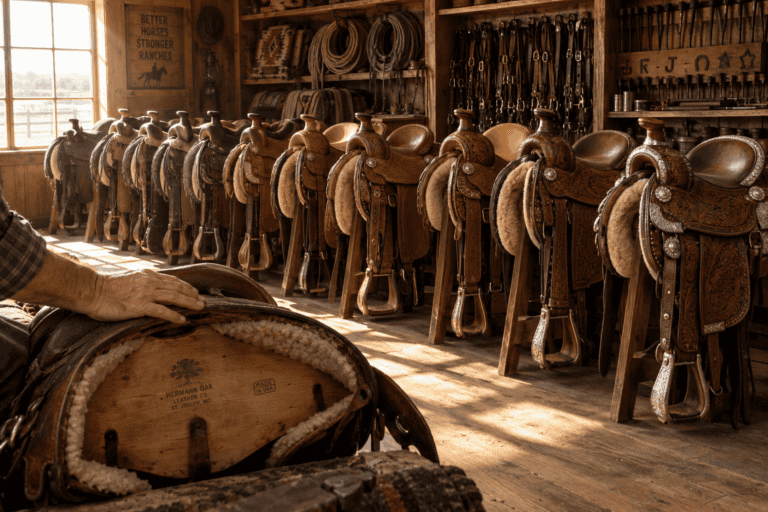
2. Circle Y — the Texas saddlery that came back
Circle Y began in 1960 when Leland Tucker set up shop in Yoakum, Texas with one aim: build the finest western saddle possible. Sixty years later the road to keep that alive has been anything but smooth.
In 2021, owner Steve Tucker was killed in a plane crash — a devastating loss for Yoakum and for the brand. In 2023, Kaspar Companies, a fifth-generation Texas family business marking its own 125th anniversary, purchased Circle Y. In 2024 they repurchased the historic Tex Tan name, reuniting two legendary Yoakum saddleries under one roof.
Circle Y owns their own tree company, so they control the foundation of every saddle from raw material to finished product. About eighty employees handcraft saddles that riders like Martha Josey and Julie Goodnight use.
How to use it: get a proper tree fit for your horse’s conformation first. Their trees are built for modern horse builds, not the narrower frames of fifty years ago. Match the tree to the horse, then choose your tooling.
People hear about the ownership changes and assume the quality shifted. Same craftsmen, same facility, same Texas town.
1. Genuine Billy Cook — read the maker’s mark
Billy Cook came home from the Army in 1953 and opened a saddle shop in Greenville, Texas. That first year he built seventy-five saddles by hand. By the end of the decade, twelve hundred a year. The quality was undeniable enough that the PRCA named it their official saddle, a designation it still holds.
Here is the part most riders never hear. In the early eighties, Billy Cook’s name got tangled up in a deal with Potts-Longhorn, and for nearly thirty years two completely different product lines carried some version of his name. One handmade in Sulphur, Oklahoma. One mass-produced in Greenville, Texas. The difference was night and day.
The real ones are stamped “Billy Cook Maker USA Genuine Sulphur, OK.” As the people in Sulphur put it: if it does not say Maker, it is a faker.
Today craftsmen like Jody Ramer, building Billy Cook saddles since 1991, hand-tool every saddle on rawhide-covered trees using American skirting leather. On materials, tree construction, leather quality and balance, this is our pick for the strongest western saddle brand you can buy heading into 2026.
How to use it: look for the Maker stamp. Verify Sulphur, Oklahoma. If you are ordering custom, go direct rather than through a reseller who might be stocking the Greenville line.
The real Billy Cook gets overlooked because for three decades the knockoff muddied the waters so badly that riders stopped trusting the name at all — the best thing that ever happened to mass-produced saddle companies, and the worst thing that ever happened to a master craftsman’s legacy.
The pattern underneath
In a twelve-billion-dollar industry flooded with imports and tariff-inflated prices, these five are still doing it the hard way, with their own hands, in their own towns. If your interest is value rather than country of origin, our companion piece on underrated brands that cost less than you would expect covers a different set entirely. For western saddles in particular, which brands are actually made in the USA checks the claim brand by brand.
The best tack is rarely in the glossy catalogue or the overseas warehouse. It is in a small-town shop in Oklahoma or Ohio or Arkansas, waiting for you to trust the maker’s mark over the marketing.