White Label Saddle Pads: Why a $30 Pad and a $150 Pad Share a Factory
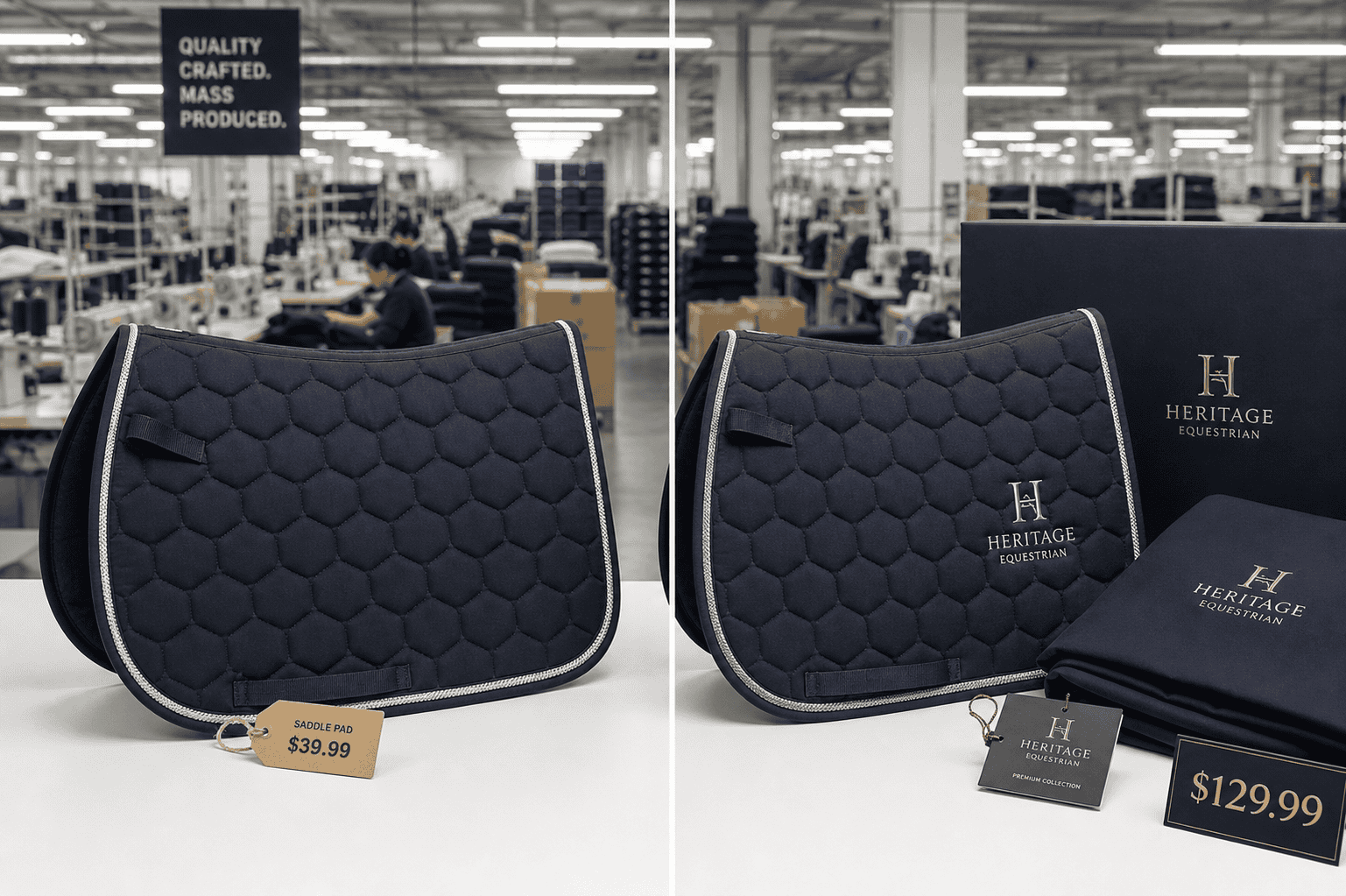
That saddle pad costs thirty dollars. This one costs a hundred and fifty. In a significant number of cases they came from the same factory, and the only difference between them is a logo and a story.
In the equestrian industry, the gap between what something costs to make and what you pay at checkout is wider than most riders would guess. Once you understand how it works, you will not look at a branded saddle pad the same way again.
What white labelling actually is
A white-label product is a generic, already-designed item that a manufacturer produces in volume and sells to multiple retailers. Each retailer adds their own brand name, their own logo, their own packaging. The underlying product is identical across every buyer. Only the label changes.
This is not a fringe practice. It is the backbone of modern consumer goods. The cosmetics industry calls them dupes, and you can buy the same lipstick, made at the same factory, under six brand names at six wildly different prices. The sunglasses trade is arguably worse: virtually all designer sunglasses come from the same handful of factories, and a three-hundred-dollar pair with an Italian name on the temple may have cost about five dollars to manufacture.
The equestrian world has its own version, and it is substantial.
Eighty-nine suppliers, thousands of labels
There are 89 major saddle pad suppliers globally, mainly concentrated in Asia. China accounts for 57% of production, Pakistan handles 26%, and India covers 15%. These factories do not make one brand’s products. They make everyone’s.
A single facility like Equifactory in China has developed over 300,000 customised products for distributors, equestrian supply stores and international brands, maintaining long-term partnerships with more than 2,000 international labels across Europe, the United States and beyond. Their minimum order quantity is a hundred pieces — which means even a tiny startup brand can access the same manufacturing capability as the biggest names in the sport.
The markup, tier by tier
At factory level, a well-made pad — quality materials, proper stitching, decent foam or fill — runs roughly $20 to $30. Now look at retail:
- Basic synthetic pad, no-name brand: $20 to $40
- Mid-range branded, e.g. Ogilvy: $54 to $80
- LeMieux territory: $90 to $150
- ThinLine: around $245
- Custom MATTES: potentially over $1,000
That is a four to five times markup on a product that, in many cases, rolled off the same production line as the budget option.
Where the premium is genuinely earned
To be fair, not every expensive saddle pad is a rebadged generic. Some brands genuinely invest in research, proprietary materials, ergonomic design and rigorous testing. ThinLine uses specific shock-absorbing technology. MATTES builds custom pads fitted to individual horses. These are products where the price premium reflects real engineering.
But a significant portion of the market is the label doing the heavy lifting, not the product.
LeMieux as a case study
Founded in 2004 by Olympic event rider Robert Lemieux and his wife Lisa, LeMieux has become arguably the most recognisable equestrian brand in the world. They have grown 30% year after year since 2008, and by 2021 were pulling in €26 million in revenue. Estimates now put annual revenue near $30 million, sold through over 500 retailers across 69 countries.
In 2021, private equity firm LDC invested in the company, with Robert Lemieux saying they knew the time was right to accelerate their rate and scale of growth. They have since launched collaborations with Stella McCartney.
Here is the thing. LeMieux makes good products. Their quality control is genuinely solid and their designs are attractive. But the question is not whether the product is nice. The question is whether it is four times nicer than a thirty-dollar pad from the same regional manufacturing base — and the honest answer, in many cases, is no.
Why the economics push this way
Brands save approximately $27 to $45 per unit when partnering with Asian manufacturers, and total cost savings often exceed 50% once you factor in reduced inventory risk and faster market entry. European facilities require 16 to 20 weeks from concept to delivery; Asian partners complete the same process in 8 to 12 weeks.
This is an industry optimised for speed and margin, not for the end user’s wallet.
E-commerce has accelerated it dramatically. Online retail now represents nearly 24% of total equestrian equipment sales, against about 32% through specialty stores. Social media has turbocharged white-label brands: someone with a following and a logo can partner with a factory, order a hundred units of a pre-designed pad, add branding, and be selling within weeks. LeMieux itself has seen 38% year-over-year revenue growth from paid social campaigns targeting American riders alone.
The global equestrian equipment market sits somewhere between $10 and $13 billion in 2025, projected to reach $12 to $19 billion by the early 2030s. That is a lot of saddle pads, a lot of markups, and a lot of logos on otherwise identical products.
Is it unethical?
Critics call white labelling flat-out unethical, and there is a case. When a brand takes a generic product, wraps it in aspirational marketing and charges ten times manufacturing cost, the consumer is paying for a feeling, not a feature. You are buying the idea of being a certain kind of rider, not a meaningfully better piece of equipment.
Defenders push back, and they are not wrong either. Brand value is not imaginary. An established company provides consistent sizing, reliable customer service, curated design, and a quality standard a random marketplace listing does not guarantee. You are buying trust and accountability — someone to call when it goes wrong. That is worth something.
The real issue is not that branded products exist. It is that the markup is invisible. Consumers do not know that a $150 pad and a $30 pad might share a factory floor. They do not know that labels are frequently sewn on at an entirely different facility from where the item was made — apparel manufacturers have made labels separately from garments for decades because it is cheaper. The label literally arrives from a different company.
What to do with this
- Stop assuming price maps linearly to quality. A pad that costs twice as much is not twice as good.
- On a budget, read the materials and construction, not the logo.
- Recognise that some premium products genuinely earn their price through proprietary technology or custom fitting.
- Understand that when you pay for a brand, you are paying for a brand. That is a choice, not a crime. Just make it with your eyes open.
The equestrian industry is changing. Smart boots with biometric sensors are reaching market, and sustainable materials are reshaping production. But the oldest trick in retail — making the same thing, putting a different name on it, and charging more — is not going anywhere.
That pad on your horse right now? There is a good chance its twin is sitting in a warehouse somewhere, wearing a different label, at a very different price. The only question is which label you are paying for.
Related on Hoof & Honest: the five levels of saddle pad · the seven levels of tack spending · what a saddle is actually worth