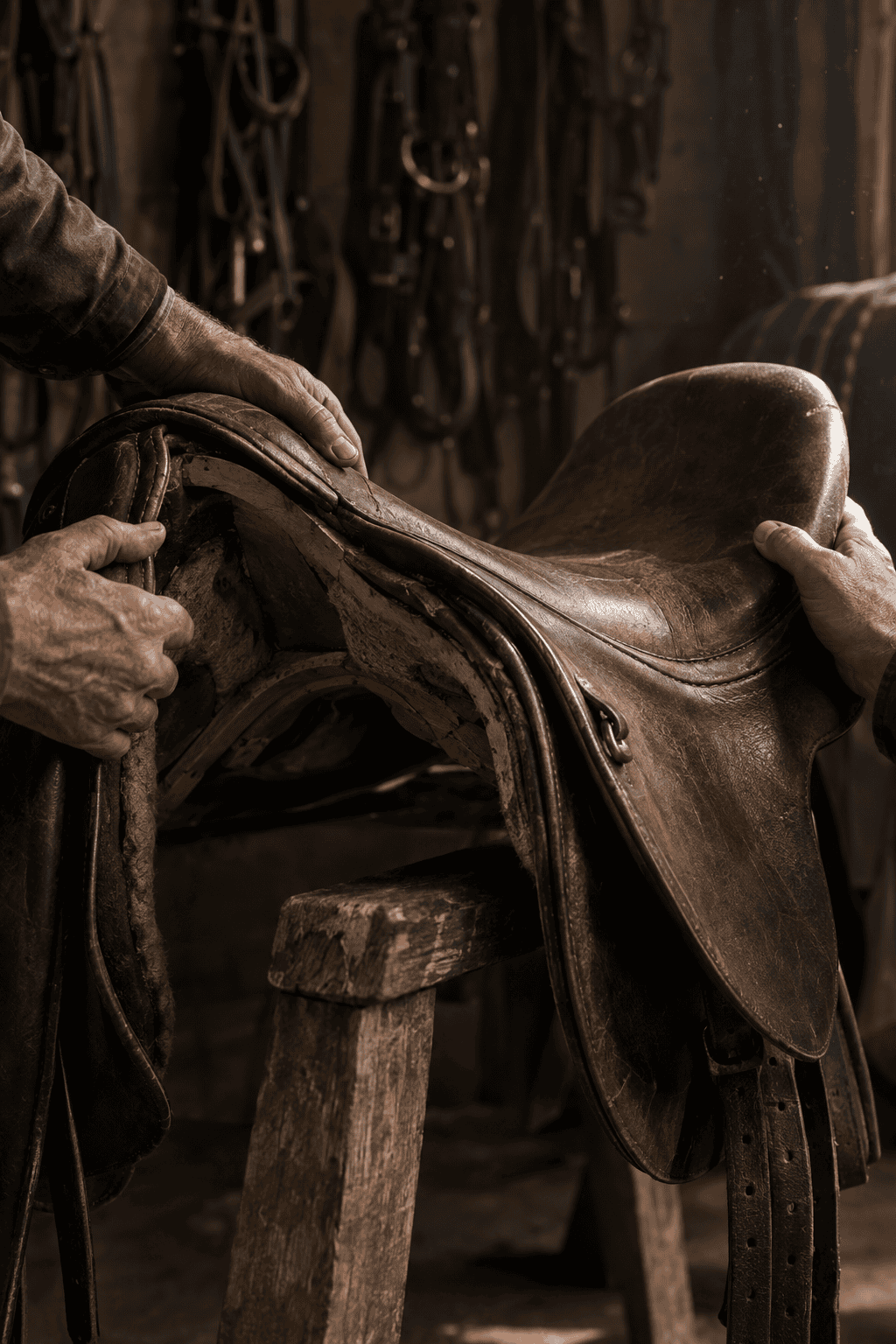
How Old Is Too Old for a Saddle? The Tree Check Most Riders Skip
Hoof & Honest was not paid by anyone for this article, and it contains no affiliate links. Research completed October 2026.
A saddle can be twenty years old, supple and shiny, and still be safe to ride in. Another can be three years old and may already be finished, because a horse rolled in it once and nothing on the outside shows it. The difference is a part you cannot see: the tree, the frame the whole saddle is built on. Utah State University’s extension service states that a broken tree can do serious damage to a horse’s back, and the Society of Master Saddlers says broken or cracked trees can be difficult to detect.
So how old is too old? None of the sources we checked sets an age limit. They give ranges that always come with a condition (cared for, stored well, properly looked after), and they agree on one point of failure: a broken tree is not repairable. Our verdict is that a saddle is too old on the day its tree fails the check below, and not before. This article covers what the sources say about lifespan, what actually wears out, how a tree gets damaged, a two-minute test for English and western saddles, and how often a professional should look.
What the sources say about saddle lifespan
The figures below are opinions from writers, retailers and an interviewee, not measurements from a study. We found no published data on how long saddles last on average. What the answers share is the condition attached to each.
| Source | What it says | Condition attached |
|---|---|---|
| Equine Ink (Liz Goldsmith, 2008) | A well-made saddle will last 25 years or more | If it has been cared for and stored well |
| Saddles Online (UK second-hand saddle retailer) | A well-crafted saddle can easily last 15 to 20 years, or even longer | Depends on quality, usage and care |
| Dressage Today (interview with Yvonne Bryant) | Saddles can last a lifetime | As long as they are properly cared for |
What actually wears out: three parts
| Part | What to check | Source |
|---|---|---|
| Leather, stitching and fittings | Cracked panel leather, worn billet straps, stitching that has come undone, metal fittings | Utah State University Extension; Equine Ink |
| Flocking (panel stuffing) | Lumpy or uneven panels. Ideally a complete reflock every two years, per master saddler Laurence Pearman. Irregular, uneven or lumpy flocking can cause pressure points that may seriously damage the horse’s back, per the Society of Master Saddlers | The Horse; Horse & Country; HQ Magazine |
| Tree | Flex, noise, twist. Not repairable once broken | EQUUS; SmartPak; The Horse; Equine Ink |
The tree is the one that goes unchecked. EQUUS describes it as the wooden or fiberglass interior frame that determines fit for both rider and horse, and SmartPak’s saddle fitting guide notes that it is encased within the leather itself, which makes it challenging to know whether it is broken. Equine Ink says the tree keeps the rider’s weight from creating pressure spots on the horse’s spine, and SmartPak adds that riding in a saddle with a broken tree can change your balance and damage your horse’s back over time.
How a tree gets damaged
In The Horse magazine, UK master saddler Laurence Pearman lists the ways a tree breaks or twists. None of them is a date on a calendar:
- A horse rolls over with the saddle on.
- The metal in the tree becomes fatigued from constant flexing.
- Rivet heads go missing, which lets the tree flex and crack.
- A tree can twist if a horse falls or rolls over it.
Metal fatigue comes from use, so that is the closest thing to age on the list. Pearman says a broken tree may show itself as the saddle suddenly dropping down at the front with little or no clearance over the withers, a squeaking noise, or movement in the saddle.
The Society of Master Saddlers advises asking a saddler to check the saddle if your horse falls, and if the saddle falls from its rack or is dropped, because broken or cracked trees can be difficult to detect.
The two-minute tree check for an English saddle
EQUUS magazine gives a three-step test. You need no tools.
- Support the front of the saddle against one thigh, press one hand on the seat, and with the other hand grasp the cantle and pull it toward you. An intact tree does not give under that pressure. A broken one does.
- Reverse the saddle so the cantle rests on your thigh, grasp the front edges just under the pommel, and pull outward and upward. Movement or noises can signal a compromised tree.
- Turn the saddle over to expose the gullet and picture a line from the center of the pommel to the center of the cantle. If the centerline deviates from straight, the tree is twisted or broken.
Pearman adds a check for twisting. View the saddle from behind. If the nail heads and piping do not line up evenly on both sides, and it is not a simple nail placement error, you need a new tree or a new saddle.
One caution: Equine Ink says most saddles today have a spring tree, which is narrower and more flexible than the older, rigid style, so a slight amount of give is normal. Equine Ink adds that this design is particularly useful for young horses or horses being brought back into work, because their bodies change in ways that affect saddle fit.
The check for a western saddle
Utah State University Extension’s fact sheet (Evans, Miller and Lewis, 2008) describes this version:
- Rest the saddle on the ground on its pommel, or horn.
- Place both hands on the cantle and push down. This will show a break across the seat.
- Turn the saddle on its side so the horn is parallel to the ground.
- Place both hands or a knee on the side and push hard. This will show a break down the length of the saddle.
How to read what you see and hear
| What you notice | What the source says it means | Source |
|---|---|---|
| Some flexion, saddle does not fold | Good; normal for a spring tree | SmartPak; Equine Ink |
| Saddle bends in half | Tree is likely broken somewhere near the twist | SmartPak (Kate Ballard) |
| Pommel points pull apart with a great deal of movement, or squeaking | Tree is broken near the gullet | SmartPak (Kate Ballard) |
| Cracking or popping, or excessive movement | Tree is damaged or broken | Equine Ink |
| Centerline not straight | Tree is twisted or broken | EQUUS |
| Nail heads and piping uneven when viewed from behind | Tree is twisted; new tree or saddle needed | The Horse (Pearman) |
| Saddle drops at the front, little withers clearance | Possible broken tree | The Horse (Pearman) |
If the saddle fails the check
The sources we read agree on this. SmartPak says broken saddle trees are not repairable and you must buy a new saddle. EQUUS says a broken tree is not repairable and that additional saddle pads will not make up for its deficiencies. Pearman says never to repair or weld a broken tree, because you are likely to end up with another break, hard ridges or asymmetries. Equine Ink calls repair almost impossible and says that even if you can get it done, it costs more than a saddle is generally worth.
Buying used: the year on the listing tells you little
This part is our reading, not a study’s finding. Because the sources tie lifespan to care and tie failure to events such as falls and rolls, the year on a listing says little about the tree. Utah State’s guide says that, especially when purchasing a used saddle, you should check to make sure the tree is not broken. Equine Ink lists the tree first among the things to consider in an older saddle, followed by the panels, the stitching and the leather. For a full buying checklist, see our guide to checking the tree of a used saddle online and in person.
How often should a professional look?
| Source | Recommendation |
|---|---|
| Horse & Rider UK | Check the saddle every six months unless your saddle fitter recommends otherwise, because horses change shape with workload, diet and season |
| Petplan Equine (fitter Antonia Wills, Society of Master Saddlers registered) | Aim for six-monthly if you can, at least annually; six-month checks are especially important for young horses |
| Your Horse (fitter Di Fisher, Society of Master Saddlers) | New saddles within three to six months, because the flocking settles |
| The Horse (Laurence Pearman) | Ideally a complete reflock every two years |
What the Dyson research does and does not show
Your Horse magazine reported research by equine vet Dr. Sue Dyson in April 2021. Of 193 saddles, 78 percent had the potential to compromise the horse’s performance, 67 percent had tree points that were too tight, 21 percent had the pommel sitting too low on the withers, and 14 percent bridged, meaning pressure concentrated at the front and back instead of spreading evenly. Of the riders, 55 percent had not had their saddle fit checked in more than six months.
That study measured fit, not age. A new saddle can fit badly, and an old one can fit well. It does show how rarely saddles get looked at. For how fit is judged, see our five levels of saddle fit, and for what poor tree fit can look like in a cheap saddle, why the tree you can’t see decides everything. If a tree does not suit your horse’s shape at all, our guide to saddles for hard-to-fit horses covers options.
Frequently asked questions
How long does a saddle last?
The sources we checked give 15 to 20 years or more, 25 years or more, and a lifetime, each on the condition that the saddle is cared for and stored well. None gives a fixed expiry.
Can a broken saddle tree be repaired?
SmartPak and EQUUS say no. Pearman warns against repairing or welding one. Equine Ink calls repair almost impossible and generally not worth the cost.
How do I know if my saddle tree is broken?
Run the English or western test above. Cracking or popping, excessive movement, a saddle that folds, or a crooked centerline are the warning signs the sources describe. If you are unsure, a saddler or qualified saddle fitter can assess it.
What should I do after a fall or a dropped saddle?
The Society of Master Saddlers advises having a saddler check it, because broken or cracked trees can be difficult to detect.
What we could not verify
- We found no published age limit and no data on how often trees fail by age. The lifespan figures above are opinions.
- Your Horse does not name the journal or publication year of the Dyson study. We cite it as reported on 27 April 2021. Check the original paper before relying on the exact percentages.
- The EQUUS, SmartPak and Equine Ink pages are guidance articles, not peer-reviewed research. Utah State University Extension’s fact sheet is the only peer-reviewed publication among the testing sources.
References
- The Horse: Seven Common Saddle Faults (Alexandra Beckstett, 2015, quoting Laurence Pearman)
- EQUUS: Testing your saddle tree
- SmartPak: How to Tell if a Saddle Tree is Broken (Kate Ballard)
- Equine Ink: Tips for Buying a Used Saddle (Liz Goldsmith, 2008)
- Utah State University Extension: Inspecting and Buying a New or Used Saddle (Evans, Miller and Lewis, 2008)
- Horse & Country: Essential saddlery advice from the Society of Master Saddlers
- Your Horse: Alarming statistics show high number of riders are using saddles that don’t fit (Dr. Sue Dyson research, 2021)
- Your Horse: How often should I have my saddle checked?
- Horse & Rider UK: 15 things to know about saddlery and tack fitting
- Petplan Equine: Does your horse’s saddle fit?
- HQ Magazine: AskHQ Saddle Flocking
- Saddles Online: How Long Should a Saddle Last?
- Dressage Today: Get the most out of your tack and riding equipment
Disclosure: Hoof & Honest was not paid by any publication, retailer or brand named in this article. Claims trace to the published sources above, and claims we could not verify were left out or flagged.