Don’t Buy a Used Saddle Until You Check the Tree: 8 Online Checks and 5 Hands-On Tests
A used saddle can look flawless in every photo of a listing and still be broken inside. The damage sits in the tree, the frame buried under the leather, wool and foam, and it is the one part of a saddle that polish, good lighting and a clean stand cannot show you. Utah State University Extension’s guide to buying saddles puts the consequence plainly: a broken tree can do serious damage to a horse’s back and should never be used.
It also can’t be fixed. EQUUS and SmartPak’s saddle fitting guide both state that a broken tree is not repairable. NRS, a western retailer that sells used saddles, says the cost of repairing or replacing a tree is never worth it. At a 2015 Society of Master Saddlers fitting course, the British master saddler Laurence Pearman went further: never repair or weld a broken tree, because the likely result is another break, hard ridges or asymmetries.
This guide pulls together what extension services, master saddlers and saddle retailers have published about catching a damaged tree before you pay for it. It covers eight things to get from an online seller and five hands-on checks for English saddles, plus two floor tests for western saddles. The verdict across every source is the same: a saddle that fails these checks is a walk-away, not a repair project, and a saddle that passes still needs a fitter before it goes on your horse.
What the saddle tree is, and why it decides everything
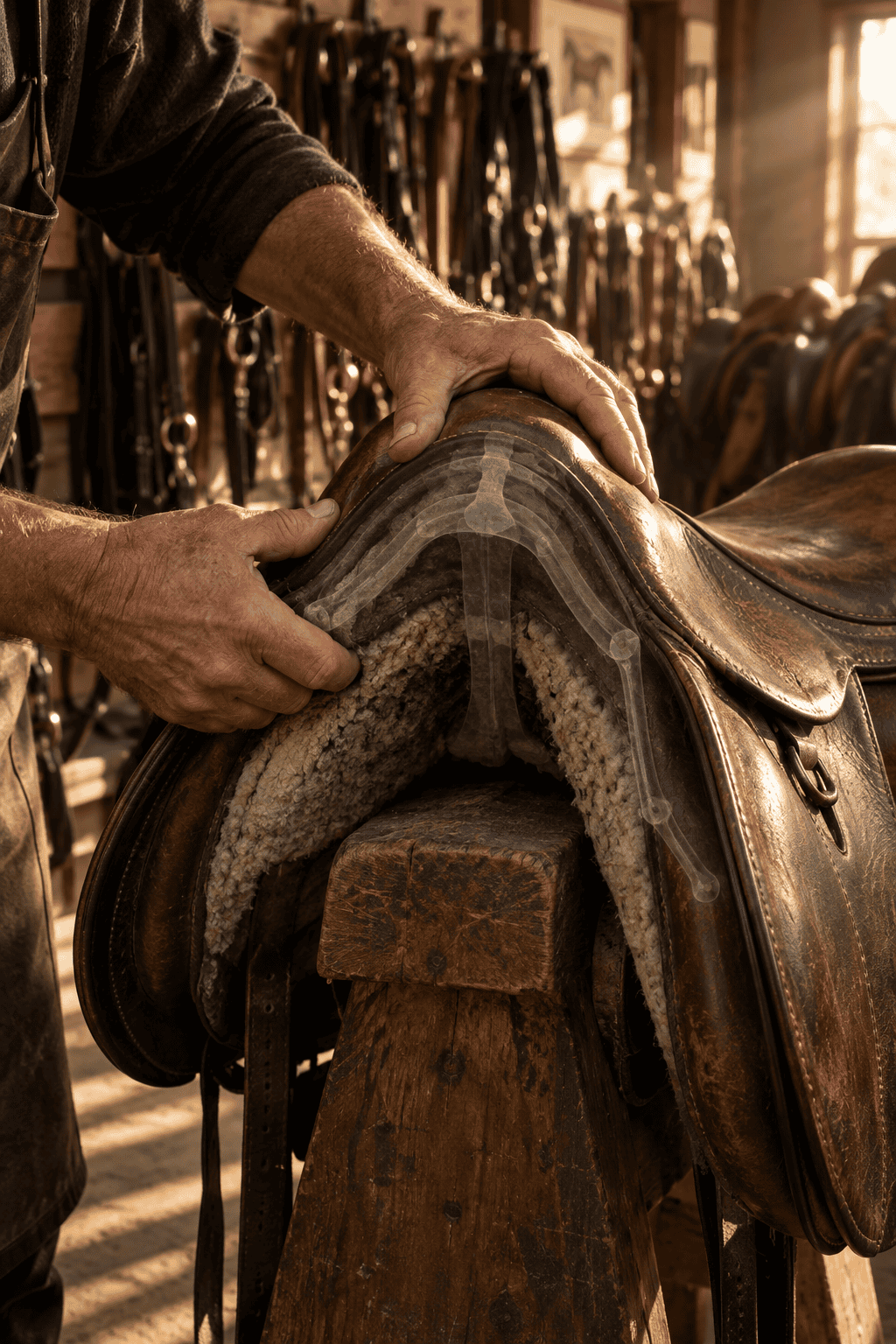
The tree is the skeleton of the saddle. Utah State describes it as the part that gives the saddle its form, supports the rider’s weight and distributes that weight evenly over the horse’s back. A channel down the middle, the gullet, keeps the load off the spine. Trees are built from wood, fiberglass, or fiberglass-covered injection molding, and some modern trees use polyurethane.
The parts that matter for an inspection:
- Front arch (under the pommel): its shape dictates the width of the gullet. Some saddles carry a metal gullet plate here.
- Bars: the two long sides of the tree that run along the horse’s back.
- Twist (or waist): the narrower section between the seat and the pommel.
- Points: the front edges of the tree, which sit behind the shoulder blade.
If you want the longer version of why this hidden frame matters more than the leather on top, we covered it in why the tree you can’t see decides how a saddle fits.
Rigid tree vs. spring tree: what “normal” movement looks like
Every flex test below depends on knowing which kind of tree you are holding, because some movement is designed in.
| Tree type | How it is built | Normal behavior | Warning sign | Source |
|---|---|---|---|---|
| Rigid (fixed) tree | Solid frame with no designed flex | No motion at all | Any give under pressure | Utah State University Extension |
| Spring tree | Spring steel running from front to back between the bars | Slight flex, equal on both sides | Excessive give, or more give on one side than the other | Utah State; Society of Master Saddlers |
| Western tree | Tested separately, on the floor | Frame holds its shape under body weight | Movement across the seat or along its length | Utah State University Extension |
The Society of Master Saddlers puts the spring-tree rule simply: a sound tree will flex a little, and an excessive amount of give suggests a broken tree. Utah State adds the detail that matters most in a tack shop. The movement should be slight, and it should be equal from side to side.
How a sound tree ends up broken
At the Society of Master Saddlers Introduction to Saddle Fitting Course in Hagerstown, Maryland, in May 2015, Laurence Pearman walked through seven common faults in English saddles, including these causes of broken and twisted trees:
- A horse rolls over on the saddle.
- The metal fatigues from constant flexing.
- Missing rivet heads let the frame flex and crack.
- A horse falls or rolls over on it, which can twist a perfectly good tree.
None of this has to happen while a buyer is watching. A saddle can take a fall, go back on the rack, and turn up years later in a listing described as gently used, with the seller honestly unaware.
The horse doesn’t always make it obvious either. A veterinary continuing education course taught by a Society of Master Saddlers master saddle fitter warns that broken trees are surprisingly common, that many saddles aren’t straight through the tree or the panels, and that either problem can lead to lameness under saddle that may contrast sharply with how the horse moves in hand or on the lunge. One rider’s account on the Chronicle of the Horse forum describes a horse that was “not quite right” in how he held his back for several weeks before the tree gave two loud pops and a saddle fitter confirmed it was broken. That is one owner’s experience, not a study, but it matches the pattern the course describes.
Buying online: what photos can and can’t tell you
NRS states in its own used-saddle buying guide that you can’t be entirely sure of a tree’s condition from photos. That’s a company selling used saddles saying it outright. The realistic goal with an online listing is to rule out the obviously damaged saddles and to make the seller show you what only an honest seller will happily show.
The 8 things to get from an online seller before you pay
- A straight-on photo from directly behind the saddle. Horse Nation’s guide to buying saddles online says this view should be perfectly symmetrical, and if it isn’t, the tree may be twisted.
- A photo of the underside, looking straight down the gullet. EQUUS describes imagining a line from the center of the pommel to the center of the cantle. If the saddle’s center line deviates from it, the tree is twisted or broken. Both panels should sit the same distance from that line.
- A short video of the seller flexing the tree. University of Georgia Extension recommends asking for a video showing the saddle from different angles or flexing the tree, which also proves the saddle is real and in the seller’s possession. The same guide suggests reverse image searching the listing photos.
- A seat measurement with the tape in the frame. Horse Canada describes measuring from the saddle nail diagonally to the center of the cantle.
- A tree-width measurement with the tape in the frame. Horse Canada describes a tape held across the front of the saddle from the felt dots on the panels. A rider who wrote about an eBay saddle that didn’t match its listing advises always asking for the distance between the points of the tree. Labels alone mislead: Horse Nation notes that a medium tree from one brand can be a narrow in another.
- The serial number and any paperwork. Horse Canada notes that reputable brands use serial numbers, and the Society of Master Saddlers suggests getting copies of serial numbers or paperwork to help date the saddle.
- The saddle’s history. Ask how many owners it has had and whether a fitter adapted it from its original specifications for a particular horse; Horse Canada points out that more owners mean a greater chance of unknown alterations to the tree or panels. NRS adds what it was used for, how often, and how and where it was stored. Because falls and rolls are exactly how trees get damaged, it’s worth asking directly whether a horse has ever fallen or rolled while wearing it.
- A way back. The Society of Master Saddlers does not recommend buying a saddle without seeing it, and suggests asking whether the seller will take it back and refund you if it’s unsuitable. Horse Nation suggests a written trial agreement, paying through PayPal for buyer protection, and making sure the seller ships with a tracking number.
Horse Nation’s guide also makes the point that matters most here: an honest seller will be happy to answer any questions you have.
Photo warning signs
| What you see | What it can indicate | Source |
|---|---|---|
| Creases, ripples or wrinkles across the seat | A weakened, broken or compromised tree; a bigger warning when paired with loose stitching | Society of Master Saddlers; NRS; Horse Canada |
| Asymmetry from behind or underneath | A twisted tree; NRS calls asymmetry an indicator of severe damage, noting falls or misuse can cause it | NRS; Horse Nation; EQUUS |
| Signs of repair | Ask the seller why and when it was done | Society of Master Saddlers |
| Leather that looks too shiny | A fresh coat of oil or lacquer may be hiding flaws | NRS |
| Saddle photographed lying on the ground or on a wooden gate | The seller likely hasn’t taken proper care of it | NRS |
A caution that cuts both ways: riders on the Chronicle of the Horse forum point out that a crooked camera angle or a saddle sitting off-center on its stand can make a sound saddle look twisted, and that a tree can be broken and still look straight. A symmetrical photo is a reason to keep talking to the seller. It is not proof.
Buying in person: 5 hands-on checks (no tools needed)
In person, a tree gives itself away through movement and sound rather than sight. Posters on the Leatherworker.net forum note that a broken tree is usually hard to see just by looking under the jockeys, and that seeing the damage means taking the saddle apart quite a long way. These checks rely on your hands and ears instead.
| Check | What it targets | Sound result | Warning sign | Source |
|---|---|---|---|---|
| 1. Front arch squeeze and pull | Head of the tree / gullet | Little or no movement, no noise | Squeaking or a great deal of movement | Utah State; SmartPak; EQUUS |
| 2. Lengthways flex | Twist / waist | Rigid: no give. Spring: some flexion | Bends too much or folds in half | Utah State; SmartPak; EQUUS |
| 3. Side-to-side cantle pull | Symmetry of a spring tree | Slight movement, equal on both sides | One side gives noticeably more | Utah State |
| 4. Sightline and rear view | Twist in the tree or panels | Straight center line, panels equidistant | Anything that isn’t symmetrical | EQUUS; Horse Nation |
| 5. Hand over the seat | Damage under the seat | Smooth, even surface | Lumps, bumps, uneven areas, clicking or cracking sounds | Saddles Online |
1. The front arch
- Rest the cantle against your thigh or stomach and take hold of the front of the saddle on either side of the pommel.
- Press the two sides together (Utah State’s method).
- Pull the two points of the pommel away from each other (SmartPak’s method, featuring master saddler Kate Ballard). If you hear squeaking or see a great deal of movement, that guide says the tree is broken near the gullet.
- Pull outward and upward on the front edges just under the pommel. EQUUS says movement or noises could signal a compromised tree.
This is the area Laurence Pearman flagged: a broken tree can show itself when the saddle suddenly drops down in front with little or no clearance over the withers, sometimes with a squeaking noise or movement in the saddle.
2. The lengthways flex
Utah State’s version: pommel against your abdomen, one hand on the cantle, the other in the middle of the seat, then pull the cantle forward while pushing down on the seat. On a rigid tree there should not be any give. SmartPak’s guide reverses it, with the cantle under your ribs and the pommel pulled back toward you. Some flexion is fine on a spring tree, but a saddle that bends too much or folds in half likely has a tree broken somewhere near the twist. EQUUS describes the principle: an intact tree doesn’t give to this pressure, and a broken tree does.
3. The side-to-side comparison
With both hands on the cantle, alternately pull one side forward, then the other. This is where Utah State’s spring-tree rule applies: movement should be slight and equal on both sides. A side that gives noticeably more than the other is a reason to get a professional opinion before going any further.
4. The sightline and rear view
Repeat the underside check from the online section with your own eyes: look down the gullet from pommel to cantle, confirm the center line is straight and both panels sit the same distance from it. Then set the saddle on a level stand and look at it from directly behind.
5. The hand over the seat
Saddles Online, a British secondhand saddle dealer, suggests feeling under the seat for lumps, bumps or uneven areas that indicate tree damage, and lists clicking, cracking sounds or visible asymmetry as red flags. Look again for creases and ripples in the seat, now in real light rather than a phone photo.
Western saddles: the two floor tests
Utah State University Extension describes testing a western tree on the ground:
- Rest the saddle on its horn, place both hands on the cantle and push down. This shows a break across the seat.
- Turn the saddle on its side so the horn is parallel to the ground, then push hard on the upper side with both hands or a knee. This shows a break down the length of the saddle.
Adjustable and interchangeable gullets
If the saddle has a gullet plate that can be swapped or adjusted, ask how often it has been changed. One saddle fitting article from the retailer HorseHaus warns that a gullet plate can’t keep being changed back and forth without wearing out the surrounding elements. That is one retailer’s view rather than a published study, but the question costs nothing.
If the saddle fails, or passes
If it fails: EQUUS says to stop using a saddle that fails these tests immediately, and that additional saddle pads won’t make up for it. NRS says to always avoid a saddle with a broken, twisted or otherwise damaged tree. When you’re unsure, EQUUS and NRS both point to a professional, a saddle-fitting specialist or a trusted saddle maker, for an in-person inspection.
If it passes: a sound tree means the saddle is worth fitting, not that it fits. The Society of Master Saddlers notes that a saddle used on another horse will have adapted and settled into that horse’s shape, and recommends always having it fitted by a qualified saddle fitter once it’s bought. Our breakdown of what separates a basic saddle check from a proper fitting covers what that appointment should include.
Buying used remains one of the better ways to get a quality saddle for less. Some premium saddles sell secondhand for around half their new price within a few years, as we laid out in what a saddle is actually worth at each price tier. The checks above are how you keep that discount from turning into a saddle nobody can repair.
What this guide can’t tell you
- No outside check confirms a tree is sound. The only certain inspection is a qualified saddler examining the tree itself, which can mean taking the saddle apart.
- Photos can make a sound saddle look twisted and a broken one look straight. Use them to rule saddles out, never to rule them in.
- The forum accounts cited here are individual experiences, not studies, and are labeled that way.
- The adjustable-gullet wear warning comes from a single retailer’s article, not from published testing.
- Most of the flex tests published by these sources were written for English saddles. Western saddles follow Utah State’s separate floor tests.
Related on Hoof & Honest: 12 western saddle brands ranked worst to best · 12 English saddle brands ranked worst to best
Disclosure
Hoof & Honest was not paid for this article, and no brand, retailer or saddler was given advance sight of it. This article contains no affiliate links. Every claim traces to a published source listed below, and claims we could not verify were left out.
References
- Evans, P. A., Miller, R., & Lewis, R. (July 2008). Inspecting and Buying a New or Used Saddle. Utah State University Extension, peer-reviewed fact sheet.
- EQUUS. Testing your saddle tree.
- Society of Master Saddlers. Advice on buying second-hand saddles and bridles.
- Society of Master Saddlers. Saddler or saddle fitter.
- The Horse. Seven Common Saddle Faults (Laurence Pearman, SMS Introduction to Saddle Fitting Course, Hagerstown, Maryland, May 1–2, 2015).
- SmartPak. How to Tell if a Saddle Tree is Broken, featuring Kate Ballard (updated July 7, 2023).
- Wellington The Magazine. Master Saddler Kate Ballard Helps Riders Get The Perfect Fit.
- NRS. How to Buy Used Saddles Online (September 27, 2021).
- Best, A. University of Georgia Extension. 4 Tips for Confidently Buying a Used Saddle Online (March 2025).
- Horse Nation. How to Buy a Saddle Online.
- Horse Canada. Shop smart: buying used saddles.
- Equine Ink. When an eBay saddle doesn’t live up to expectations (January 2010).
- VetPD. Fitting Saddles: Q&A and Case Discussions, Module 1.
- Chronicle of the Horse forum. Broken saddle tree (owner account).
- Chronicle of the Horse forum. Is this tree broken? (photo-angle discussion).
- Leatherworker.net forum. Checking a saddle tree.
- Saddles Online. How to Buy a Second Hand Saddle: Complete Guide.
- HorseHaus. Saddle Fit 101: Are Adjustable Saddles Good?
- ACTRA. Saddle Fitting Notes.
- Wikipedia. English saddle (tree anatomy terminology).
Related on Hoof & Honest: how old is too old for a saddle, and how to check the tree