Saddles for Hard-to-Fit Horses: 5 That Are Worth the Money
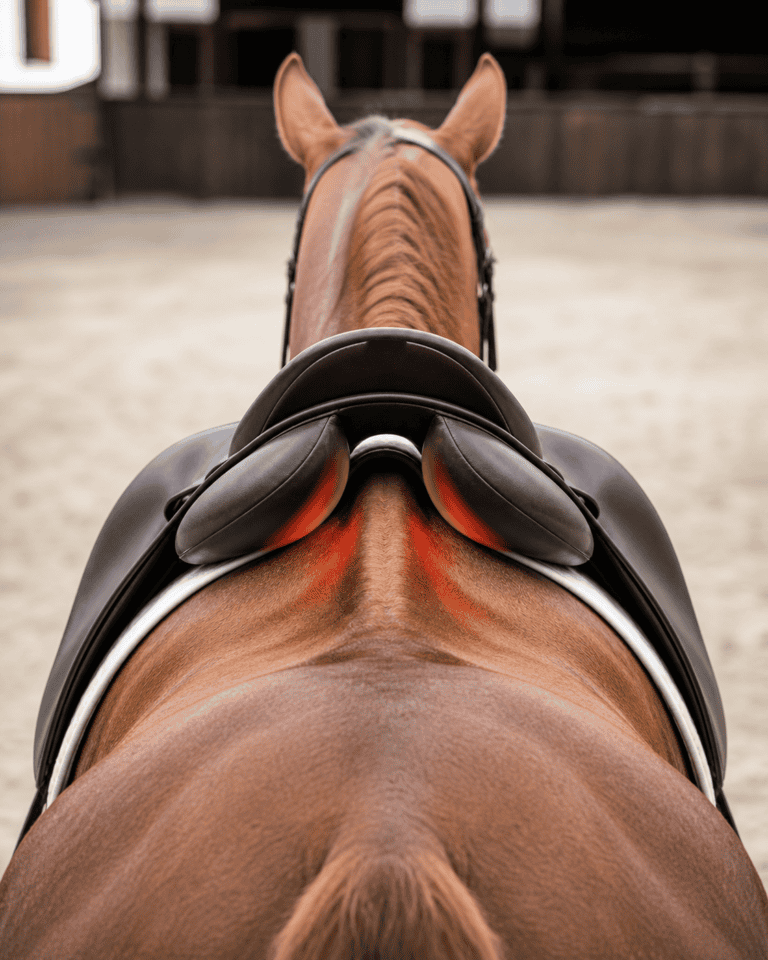
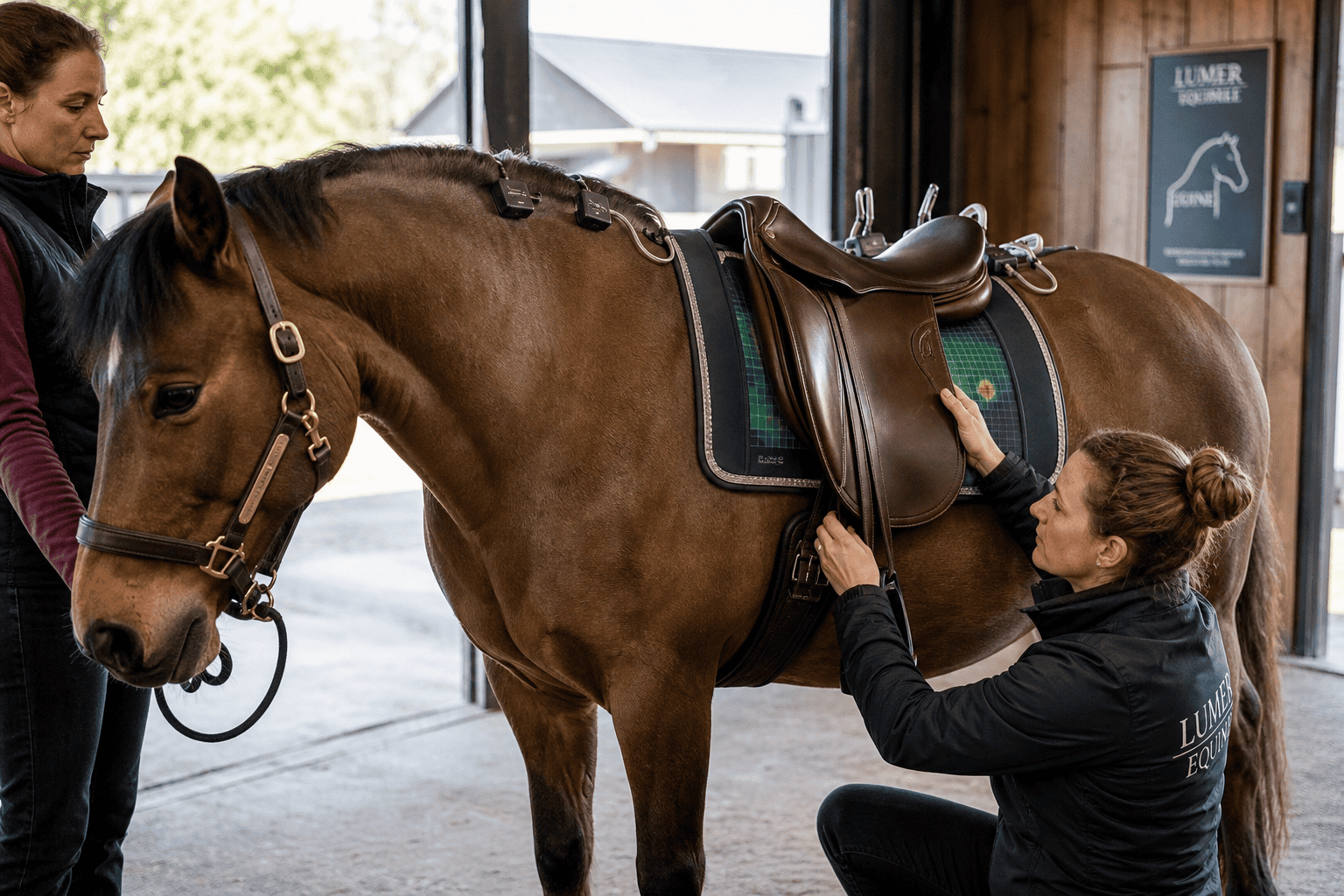
In 2019, a research team working with the Royal Veterinary College took 14 sound sports horses and had each one fitted with a saddle by a qualified Society of Master Saddlers fitter. Then they changed a single variable. Each horse was put back in the same saddle one width wider, and then one width narrower, with a pressure mat underneath and motion sensors on its back.
One width too wide raised peak pressure under the front of the saddle by roughly 8.5% at trot. The horse’s back muscle profile at the thirteenth thoracic vertebra measured 14% smaller afterwards, and the sideways range of motion at that same vertebra dropped 6%. One width too narrow moved the problem backwards instead, raising peak pressure under the rear of the saddle by 14% and reducing mediolateral movement at T13 by 8%.
These were not bad saddles being compared against good ones. Every saddle in the study had been correctly fitted by a professional first, then moved one size in one direction. That was enough to measurably change how the horse used its back inside a single session.
The standard advice given to anyone with a hard-to-fit horse is to go wider.
What “hard to fit” actually means
The phrase gets used loosely, but in practice it covers a handful of specific geometries.
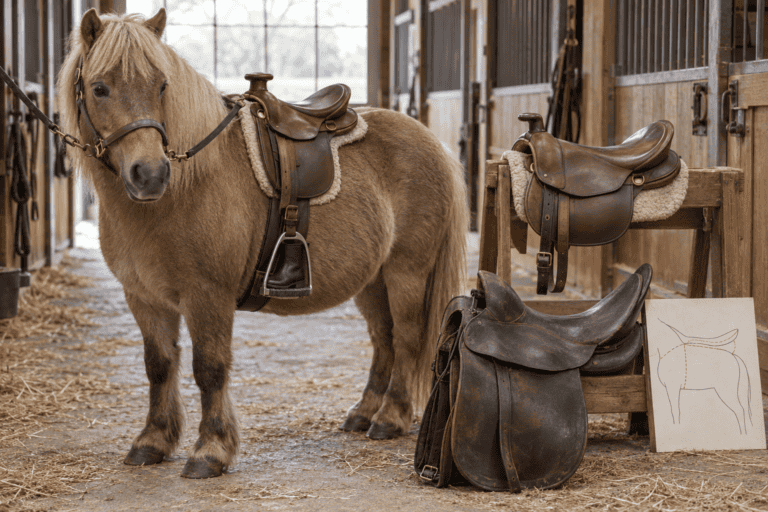
There is the round, barrel-shaped horse with almost no wither to speak of — most cobs, Haflingers, Fjords, draft crosses and a good number of Quarter Horses. There is the opposite problem: the sharp, high, narrow wither with an angular back, common in Thoroughbreds coming off the track and in older horses that have lost topline. There is the short back, where the distance between the shoulder and the last rib leaves very little weight-bearing surface to work with, which is the Arabian, Icelandic and Fell pony situation. And there is asymmetry, where one shoulder sits fuller than the other — which describes most horses to some degree, and which can pull a saddle out of balance within a few months of a change in workload.
What all four have in common is that they are shape problems, not size problems. That distinction is the entire subject of this article, because the market sells width and the horse needs shape.
So when we ask whether a saddle is worth the money for a difficult horse, the question is not about leather grade or brand heritage. It is whether the object is shaped correctly for that specific back, and whether it can be reshaped when the back changes. Five things earn their price on that basis.
1. The adjustable-gullet leather saddle
Kent & Masters and Thorowgood dominate this category, and they are built on the same underlying system. Both use the SimaTree, both use wool-flocked panels, and both let you unbolt the metal gullet plate at the head of the tree and slot in a wider or narrower one. Fairfax, from the same family of brands, uses the same bars.
The plates cost around $40 each. A saddle you can re-width for $40 is a saddle that survives a horse coming back into work after a layoff, or dropping condition over a winter, without a fresh four-figure purchase. Given how much back shape moves over a year, that is not a convenience feature. It is the difference between a saddle that stays correct and a saddle that quietly stops being correct in March.
There is a trap in it, and it catches buyers constantly. Wintec and Bates run a completely separate plate system. Their gullets do not fit a Thorowgood, a Kent & Masters or a Fairfax, and both manufacturers are explicit that the two systems must never be crossed. Secondhand listings frequently ship with the wrong bar, or with no spare bars at all. If you are buying used, confirm which bar system the saddle takes — Thorowgood and Kent & Masters use an S-bar for pony, cob and flat-back models and a longer R-bar for general purpose and dressage trees — and budget for two spare widths on either side of your current fit.
One limitation to be honest about: changing a gullet plate changes the width at the head of the tree. It does not change the tree’s overall shape, the curve of the rails, or the panel configuration. On a horse whose problem is genuinely shape rather than width, the widest plate in the box will not solve it.
2. The hoop tree
Which brings us to the second category. Duett is the clearest example — their Rondo all-purpose model sells for $2,995, comes in widths from 32cm to 40cm, and is flocked with British wool. Black Country’s Quantum X sits in the same territory.
That price only makes sense once you understand that a wide standard tree and a wide hoop tree are not the same object. British saddle widths describe the angle of the pommel arch, not a measurement taken across the horse’s back. A standard tree is an inverted “V” — it can be built very wide indeed while still coming to a point at the top. A hoop tree is a “U”, open and broad across the head, with tree points that run more parallel to the horse’s sides rather than angling inwards.
On a round, low-withered, table-backed horse, that V-shaped head perches on top of the barrel and slides sideways no matter how wide it was ordered, because the problem was never width. It was shape. Fitters who work with broad horses will tell you that a hoop tree also sits closer to the withers than riders expect — you get “adequate” clearance rather than the textbook three fingers, and that is how the design is supposed to look.
If your saddle rolls, twists to one side, or needs to be girthed uncomfortably tight to stay put on a horse that is otherwise sound, tree shape is the first thing to investigate. We covered the mechanics of this in more detail in The Cheap Saddle Problem: Why the Tree You Can’t See Decides Everything.
3. The short tree
This is the category riders skip most often, because length is invisible in a way that width is not.
Thorowgood’s Compact models are built on their dressage tree, which is shorter than their general purpose tree and carries flatter panels, with the deepest part of the seat sitting closer to the horse. Kent & Masters produce a low-wither dressage saddle intended for flat-backed conformations regardless of width, including short-backed types.
The reason this matters is anatomical. The thoracic spine has a ribcage beneath it to help carry load. The lumbar spine does not. If the panel runs past the last rib, the rider’s weight is being carried by the one section of the back with no structural support underneath it. No gullet plate, no pad and no amount of width correction fixes a saddle that is simply too long for the horse standing in front of you.
4. Wool flocking (which is not a saddle at all)
The fourth item on this list is a decision rather than a product: buy wool-flocked panels rather than foam or sealed air panels, on any brand, at any price point, including secondhand.
Wool can be added to, taken out of, and rebalanced side to side by a fitter standing in your yard. It can be adjusted asymmetrically to accommodate the horse that carries one shoulder fuller than the other. Foam cannot, and a sealed air panel offers only the adjustment the manufacturer designed into it.
The evidence for prioritising this is strong. In a longitudinal study of 104 sports horses tracked over a year, professionally assisted saddle fitting was positively associated with changes in the horse’s thoracolumbar dimensions, both at two months and across the full year. Rider skill level was not. The saddle fitter did more for the horse’s back than the rider did.
Which leads to the most useful budgeting advice in this article: a $400 secondhand wool-flocked saddle plus a $150 fitting appointment will do more for a difficult back than a $3,000 saddle that nobody ever adjusts. If you are working out where your money actually goes in this market, our breakdown of saddle price tiers covers what each bracket buys.
5. The treeless saddle — but only one kind
Treeless saddles are marketed almost exclusively at owners of hard-to-fit horses, on the reasoning that a saddle with no rigid structure must conform to any back. The research is less flattering than the marketing.
In a 2012 study of eight horses ridden at sitting trot, the conventional treed saddle distributed the rider’s weight over a larger area, with lower mean pressure, lower maximum pressure, and fewer sensors recording above 11 kPa than the treeless saddle. A tree exists to spread load. Take it out and the load concentrates under the rider’s seat bones. Similar concentration effects have been reported in racing saddles and in saddles used on Icelandic horses.
The exception is a treeless saddle built with proper defined panels and a real gullet channel down the middle. When that design was measured against a conventional dressage saddle with a beechwood spring tree, the front-to-middle-to-rear force distribution came out at 38:42:20, against 41:39:20 for the treed saddle — close enough to be meaningful.
Two caveats belong with that finding. The high-pressure areas under the panelled treeless saddle still appeared in locations that did not correspond to where the rider was sitting, which the researchers attributed to the shape and slope of the panels themselves. And a panelled treeless design is a solution for the horse that nothing else fits, not a default starting point for a horse that simply has not been fitted properly yet.
The argument nobody in the trade has settled
There is one genuine disagreement worth knowing about before you walk into a tack shop.
Fitters are split on whether you can deliberately buy a saddle wider than the horse measures and shim the front up with a pad. One camp treats a too-wide saddle padded up as no better than a saddle that is too narrow, and considers the practice a way of selling saddles that do not fit. The other argues that the extra tree width gives the horse’s shoulders room to move while the shims simply rebalance the rider on top, and that this is preferable to any degree of pinching.
Both positions come from qualified people who fit saddles for a living. Our own view is that the RVC tree width data makes deliberate over-widening hard to defend as a first choice, since a single width too wide measurably increased pressure at the front of the saddle and reduced back muscle profile — but that is an interpretation, not a settled fact, and you should hear both cases before someone sells you a corrective pad. If you are heading down the shimming route, our guide to saddle pads covers which ones actually redistribute load and which ones just add bulk.
How to check whether it worked
None of these five will fit your horse because it appeared on a list. Each one solves a specific geometric problem, and the point of naming them is that you can then check whether the problem was solved.
Look for the saddle staying centred without excessive girth tension. Look for even sweat patterns after work, with no dry spots where a panel has been pressing hard enough to shut down the sweat glands. Look for a back that fills out rather than hollowing behind the withers over a season. And book the fitter back after roughly 20 to 30 hours of riding on a new wool-flocked saddle, once the flocking has settled, then annually after that.
If you want a structured way to assess where your current setup actually stands, The 5 Levels of Saddle Fit walks through it stage by stage.
What changed those 14 horses at the Royal Veterinary College was not a brand and not a price. It was one size.
Sources
- MacKechnie-Guire R, MacKechnie-Guire E, Fairfax V, Fisher D, Fisher M, Pfau T. (2019). The Effect of Tree Width on Thoracolumbar and Limb Kinematics, Saddle Pressure Distribution, and Thoracolumbar Dimensions in Sports Horses in Trot and Canter. Animals, 9(10):842.
- Belock B, Kaiser LJ, Lavagnino M, Clayton HM. (2012). Comparison of pressure distribution under a conventional saddle and a treeless saddle at sitting trot. The Veterinary Journal, 193(1):87–91.
- Clayton HM et al. (2013). Force and pressure distribution beneath a conventional dressage saddle and a treeless dressage saddle with panels.
- Greve L, Dyson S. (2015). A longitudinal study of back dimension changes over 1 year in sports horses. The Veterinary Journal, 203(1):65–73.
- Latif SN et al. (2010). Saddle pressure patterns of three different training saddles (normal tree, flexible tree, treeless) in Thoroughbred racehorses at trot and gallop.
- Ramseier LC et al. (2013). Saddle pressure distributions of three saddles used for Icelandic horses.
- Duett Saddles — Rondo Wide All Purpose Saddle product listing (price and width range).
- Thorowgood and Kent & Masters — SimaTree gullet bar specifications and cross-brand compatibility warnings.
- EQUUS — Saddles for the Hard-to-Fit Horse (fitter disagreement on shimming a too-wide tree).
Hoof & Honest takes no sponsorships and no brand deals. Brands are named here because they make a specific product relevant to a specific fitting problem, not because anyone paid for the mention. Prices were accurate at the time of writing and are subject to change.
This article is for general information only and is not veterinary advice. If your horse is showing signs of back pain, muscle atrophy, behavioural changes under saddle or lameness, consult your veterinarian. Saddle fitting should be carried out by a qualified fitter.
Related on Hoof & Honest: synthetic vs leather saddles · checking a saddle’s age and tree · signs your horse doesn’t like your gear · saddles for kids and ponies