5 Horse Bits Your Horse Secretly Hates (And 5 They’ll Thank You For)
Your horse cannot tell you, in words, that its bit hurts. It tells you in the smaller signals instead: the head that flings up the moment you take a contact, the mouth that gapes, the tongue that slides over the bit or lolls to one side, the reluctance to stand still to be bridled. It is tempting to file these under “bad manners” or “training problems.” Often they are something else entirely.
The evidence that bit discomfort is widespread is hard to look away from. When veterinary researcher Dr. W. Robert Cook examined 66 domestic horse skulls held in natural history museum collections, 62% showed bone spurs on the bars of the mouth — the toothless ridge of gum and bone where the bit sits — and 88% showed either bone spurs or dental damage. Among the 12 wild-horse skulls he examined for comparison, he found neither.[1]
This is not an article about cruel owners. It is an article about hardware — five bits whose design tends to work against the horse, and five that tend to work with it. But before the list, one rule that reframes everything.
It is not cheap versus expensive
The most common myth in bitting is that cheap bits are cruel and expensive bits are kind. Mouths do not work that way. Three things decide whether a bit is comfortable: the shape of the mouthpiece, whether it fits, and the hands on the reins. A 2025 analysis compared the rein tensions reported in equestrian research to the pressures at which a human first registers pain. Reported rein tensions ranged from roughly 91 kilopascals at the lightest to over 4,000 at the highest, while the human pain threshold for the face is about 232 kilopascals — meaning only the very lightest contact would be pain-free by human standards, while average-to-hard contact would register as strong or severe pain.[2]
No bit on this list is safe in rough hands, and none is a villain in soft, educated ones. With that said:
5 Horse Bits to Reconsider
1. The twisted or corkscrew wire snaffle
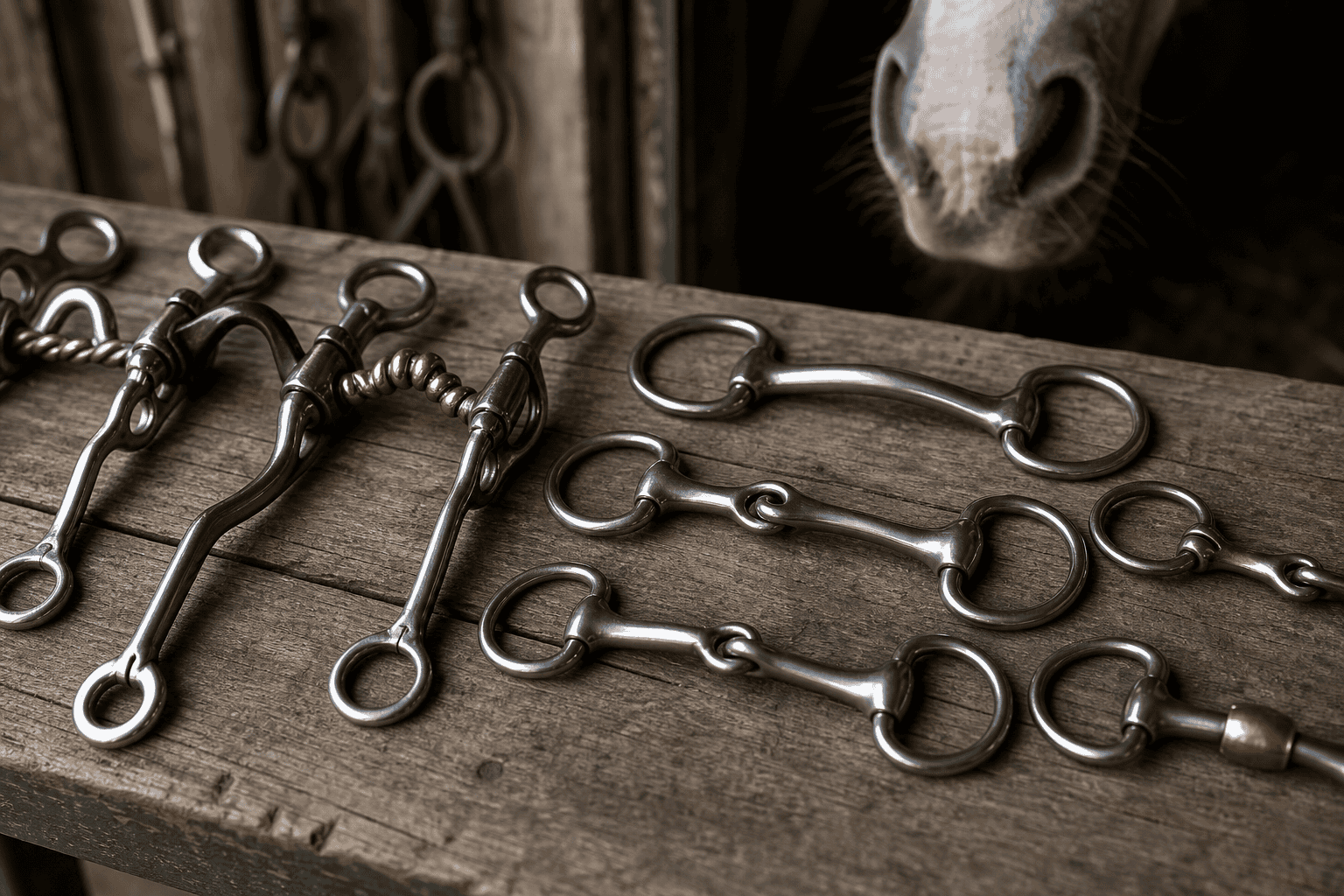
A thin, twisted, single-jointed mouthpiece is the harshest combination in common use. Thinness concentrates force onto a small strip of tongue and bar; the twist turns that strip into a row of edges; the single joint folds in the middle. Because both overly thin and overly thick mouthpieces have been linked to a higher risk of moderate-to-severe oral lesions in competition horses, “thin equals sharper aids” is a trade the horse pays for in its mouth.[3][5]
2. The high-port curb
A curb bit already applies leverage to three areas at once — tongue, chin (through the curb chain) and poll. Add a tall port and, under rein pressure, that arch can rotate up toward the palate. In a study of Icelandic competition horses, lesions on the bars of the mouth rose from 8% to 31% over the course of competition, and were strongly associated with the use of ported curb bits.[4]
3. The long-shanked curb
The longer the shank, the more it multiplies the force of your hand — which is exactly why many disciplines cap shank length. Light rein pressure becomes a firm signal the horse cannot escape, spread across mouth, chin and poll at once. Given how far ordinary rein tensions already sit above the human pain threshold, multiplying them mechanically deserves real caution.[2]
4. The Tom Thumb (jointed mouthpiece on shanks)
Often sold as a gentle “step up” from a snaffle to a curb, this design combines the nutcracker action of a single joint with the leverage of a shank — and the shank can pinch the cheek as it rotates. Horses in these bits commonly toss their heads, resist going forward, and develop sores at the corners of the mouth. It is one of the most misunderstood bits on the shelf.
5. The thin single-jointed snaffle
The bit nearly every rider starts with is not automatically kind. A single joint creates the “nutcracker” effect, folding onto the bars while the joint rises toward the palate. And most horses have, on average, room for only a 14 mm-thick mouthpiece before the tongue is compressed — yet ill-fitting bits, too thin or too thick, are extremely common.[5]
5 Bits Your Horse Will Thank You For
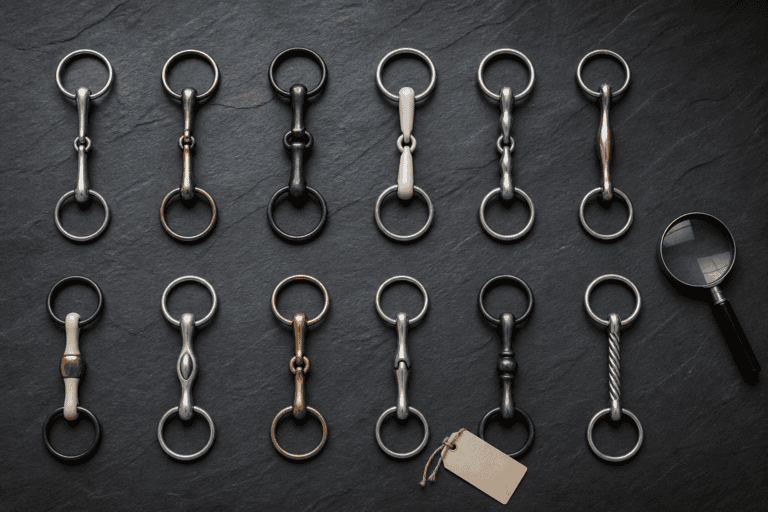
1. The lozenge (barrel) double-jointed snaffle
Rounding the central link into a smooth lozenge lets the mouthpiece follow the shape of the mouth — over the tongue, away from the palate — without the nutcracker action and without catching the sensitive edges of the tongue the way a flat plate can.
2. The French link
A mild, widely used double joint. Its flat central plate softens the single-joint nutcracker and spreads pressure more evenly. If you are choosing between this and the lozenge, the rounded lozenge is the gentler of the two.
3. The mullen mouth
A smooth, gently curved bar with no joint at all — nothing to fold or pinch — spreading pressure evenly across the tongue. About as mild as a metal mouthpiece gets, with the honest caveat that “mild by design” still is not “harmless in hard hands.”
4. A tongue-relief / Myler-style comfort mouthpiece
Bits shaped to free the tongue aim to avoid the rolling, folding action of a jointed snaffle. In a cadaver study that applied equal rein force to several bits, the single-jointed snaffle moved and angled the most against the mouth, while non-hinged comfort designs stayed more stable.[6] Worth noting for balance: at least one behavioural study found no difference in intra-oral behaviour between single-jointed, double-jointed and Myler comfort snaffles — the mouthpiece helps, but it is not magic.[7]
5. A correctly fitted, smooth snaffle
The single biggest welfare upgrade most riders can make is not a fancier mouthpiece — it is the right size, smooth, and well fitted. With the average horse having room for roughly a 14 mm bit, “measured to this horse” beats “expensive” every time.[5]
How do I know if my horse’s bit is hurting it? (FAQ)
What is the most severe horse bit?
Among bits in common use, a thin twisted-wire snaffle is generally considered the harshest, because it combines thinness, edges and a single joint. Severity, though, is always a product of design, fit and rein pressure together.
What is the gentlest horse bit?
There is no single answer, but a smooth, correctly sized mullen mouth or a rounded lozenge double-joint are among the mildest by design. Fit and hands matter as much as the mouthpiece itself.
Does a thicker bit hurt less?
Not necessarily. Very thin bits concentrate pressure, but a bit that is too thick for the horse’s mouth compresses the tongue. Research on 554 horses found room, on average, for about a 14 mm mouthpiece — the right thickness is the one that fits that particular horse.[5]
What are the signs a bit hurts?
Head tossing, gaping the mouth, putting the tongue over the bit, leaning on or backing off the contact, and reluctance to be bridled are common signs — as are sores at the corners of the lips. If you see them, have the teeth checked and the bit fit assessed before changing mouthpieces.
Where to find the five worth trying
These link to the mouthpiece shape rather than to a brand, because shape, fit and hands are what the research measures and no brand name predicted anything. Measure your horse before ordering: the average mouth has room for roughly fourteen millimetres, and the right thickness is the one that fits that particular horse. Only the five mouthpieces recommended above are linked. Nothing from the list of bits to reconsider appears here. These are affiliate links, and a purchase through one earns us a small commission at no extra cost to you.
- Lozenge or barrel double-jointed snaffles — the rounded central link, gentler than a flat plate
- French link snaffles — mild and widely used, with a flat central plate
- Mullen mouth bits — no joint at all, so nothing to fold or pinch
- Tongue-relief and Myler-style comfort mouthpieces — more stable under equal rein force in the cadaver work, though one behavioural study found no difference
- Plain smooth snaffles — the single biggest welfare upgrade available to most riders is the correct size, smooth and well fitted
Before buying any of them: have the teeth checked and the fit of the current bit assessed. A new mouthpiece bought to solve a problem that is dental, or a problem that is in the rider’s hands, changes nothing.
The half of the story nobody sells you
Every bit here comes back to the same truth: the mouthpiece is only half the story. A kind bit in heavy hands is still hard on a horse, and a plain snaffle in soft, patient hands can be a conversation. If your horse fights the contact, resist the urge to simply swap metal — get the teeth checked, get the fit checked, and be honest about the hands. Your horse has been telling you something. This is just about learning to read it.
Sources
- Cook, W. R. “Damage by the bit to the equine interdental space and second lower premolar,” Equine Veterinary Education (2011). Summaries: TheHorse.com, HolisticHorse.com.
- Musial, F. & Weiss, T. “What if Horses Were Humans? Comparing Rein Tension and Bit Pressures to Human Pressure Pain Thresholds,” Animals (2025). Full text (PMC).
- Tuomola, K. et al. “Bit-Related Lesions in Event Horses After a Cross-Country Test,” Frontiers in Veterinary Science (2021). Full text.
- Björnsdóttir, S. et al. “Bit-related lesions in Icelandic competition horses,” Acta Veterinaria Scandinavica (2014). Full text.
- Pärn, M. et al. “Oral Dimensions Related to Bit Size in Adult Horses and Ponies,” Frontiers in Veterinary Science (2022). Full text.
- Manfredi, J., Clayton, H. M., et al. “Radiographic study of bit position within the horse’s oral cavity,” Equine and Comparative Exercise Physiology (2005).
- “Bit type exerts an influence on self-controlled rein tension in unridden horses,” Scientific Reports (2020). Full text.
This article is for educational purposes and reflects Hoof & Honest’s opinion alongside published research. It is not veterinary advice. Always consult a qualified vet, equine dentist or bit-fitting professional for your individual horse. Hoof & Honest was not paid for this article. No manufacturer paid for a mention here, supplied a product, or saw a draft before publication. Some links on this page are affiliate links, and a purchase made through one earns us a small commission at no extra cost to you. As an Amazon Associate we earn from qualifying purchases.