The 5 Levels of Stable Air Quality (Most Stabled Horses Never Get Past 2)
The cough is the last thing to arrive. By the time a horse coughs twice at the start of every ride, and everyone at the barn has quietly agreed that it is just something he does, the process underneath it has been running for years. In severe equine asthma the airway walls thicken, smooth muscle multiplies along them, and collagen lays down in the small airways.
Mathilde Leclere’s group at the Université de Montréal took horses with established disease and gave them a full year of strict antigen avoidance combined with inhaled corticosteroids. The airway smooth muscle mass came down. It did not return to normal. Twelve months of doing everything right, and those were still not the lungs the horse started with.
So the stake in a conversation about bedding is not a cough and not one bad winter. It is a ceiling on the animal’s capacity that drops a little further every season and that nothing later fully lifts. And air is the only input a horse takes continuously, every minute it is alive, that nobody in the barn measures.
This article sorts stable air management into five levels, using published measurements rather than product pages. Each level had to clear one test to make the list: it has to change what the horse measurably inhales in its own breathing zone, not what the stall looks like from the aisle. The short verdict is that most stabled horses stop at level two, that the single biggest measured improvement comes at level three and costs money, and that the level with the largest effect of all — level five — is the one nobody writes about, because there is nothing to sell there.
The measurements underneath all five levels
Nearly everything below rests on one field study. Emma-Jane Auger and Meriel Moore-Colyer, publishing in the Journal of Equine Veterinary Science in 2017, measured airborne respirable dust across two stable designs and several management regimes. They took readings in two places: the general stable zone, and the breathing zone, meaning the air immediately around the horse’s nostrils. Respirable particles are those under roughly five microns — small enough to travel past the upper airway and reach the deep lung.
Two building types were compared. The study uses the British term “American barn” for the enclosed layout where stalls open onto a shared interior aisle; in the US this is usually just called a center-aisle barn. The comparison group was individual stalls each opening directly to the outside, closer to a shedrow.
| Bedding and forage regime | Building type | Stable zone (RP/L) | Breathing zone (RP/L) |
|---|---|---|---|
| Straw + dry hay | Center-aisle barn | 6,250 | 5,079 |
| Straw + dry hay | Individual outside-door stalls | 2,901 | 942 |
| Shavings + steamed hay | Both types | <360 | <360 |
Two things fall out of that table immediately. The building matters — more than five-fold at the horse’s nose, on identical bedding and forage. And the building stops mattering once the forage is treated. A horse in a center-aisle barn on steamed hay and shavings was breathing cleaner air than a horse in a private stall with its own outside door on dry hay and straw. Architecture sets the floor. Forage sets the ceiling.
One number for scale before the levels start: dust concentration in a stabled environment runs at roughly ten times what the same horse breathes at pasture.
Level 1: The default stall
Straw or wood shavings on the floor, a haynet of dry hay, and a door that gets closed when the weather turns. Nobody chooses this. It is what a barn does when nobody has thought about it, and by the measurements above it puts a horse’s nose in air carrying somewhere between 942 and 5,079 respirable particles per liter depending entirely on the building.
There is a second contaminant at level one that nobody measures, because it announces itself instead. Horse urine contains urea, and bacteria in the bedding and the floor beneath it release an enzyme that breaks urea down into ammonia. A University of Kentucky study in 2000 tracked foaling stalls bedded in straw and cleaned every single day. Floor-level ammonia began at 2.5 ppm. After two weeks of daily mucking out it measured 228 ppm.
Ten parts per million is the figure usually cited as the point of concern. People begin to smell ammonia somewhere between 5 and 30 ppm, which means that by the time you notice the stable smell as you slide the bolt, you arrived long after your horse did. Ammonia is heavier than air and pools low, and a horse’s head spends most of its day down at that level, eating off the floor or lying in it.
The cheapest intervention that exists at this level is a zeolite stall powder applied to the stripped floor under fresh bedding. Zeolite binds ammonium ions rather than masking odor, which is the difference between a product that works and a product that smells like it does. Zeolite stall powders such as Sweet PDZ run a few dollars per stall per month and are the only item in this entire article that costs less than a bag of feed.
Level 2: The bedding swap (where most horses stop)
The straw comes out and dust-extracted large-flake shavings go in. Sometimes wood pellets, sometimes chopped cardboard, occasionally peat. This is a real improvement and not a placebo. In the Auger data, shavings produced less dust than straw in the general stable zone across both building types. A Finnish comparison of bedding materials found ammonia either undetectable or below 0.25 ppm in stalls bedded with peat, against 1.5 to 7 ppm in the same barn on wood shavings; the horses on peat recovered to their starting respiratory scores while the horses on shavings stayed symptomatic through the trial.
So level two works. The ceiling is simply far lower than the effort suggests, and the reason is uncomfortable.
The bedding is not the biggest source of respirable dust in a stall. The hay is.
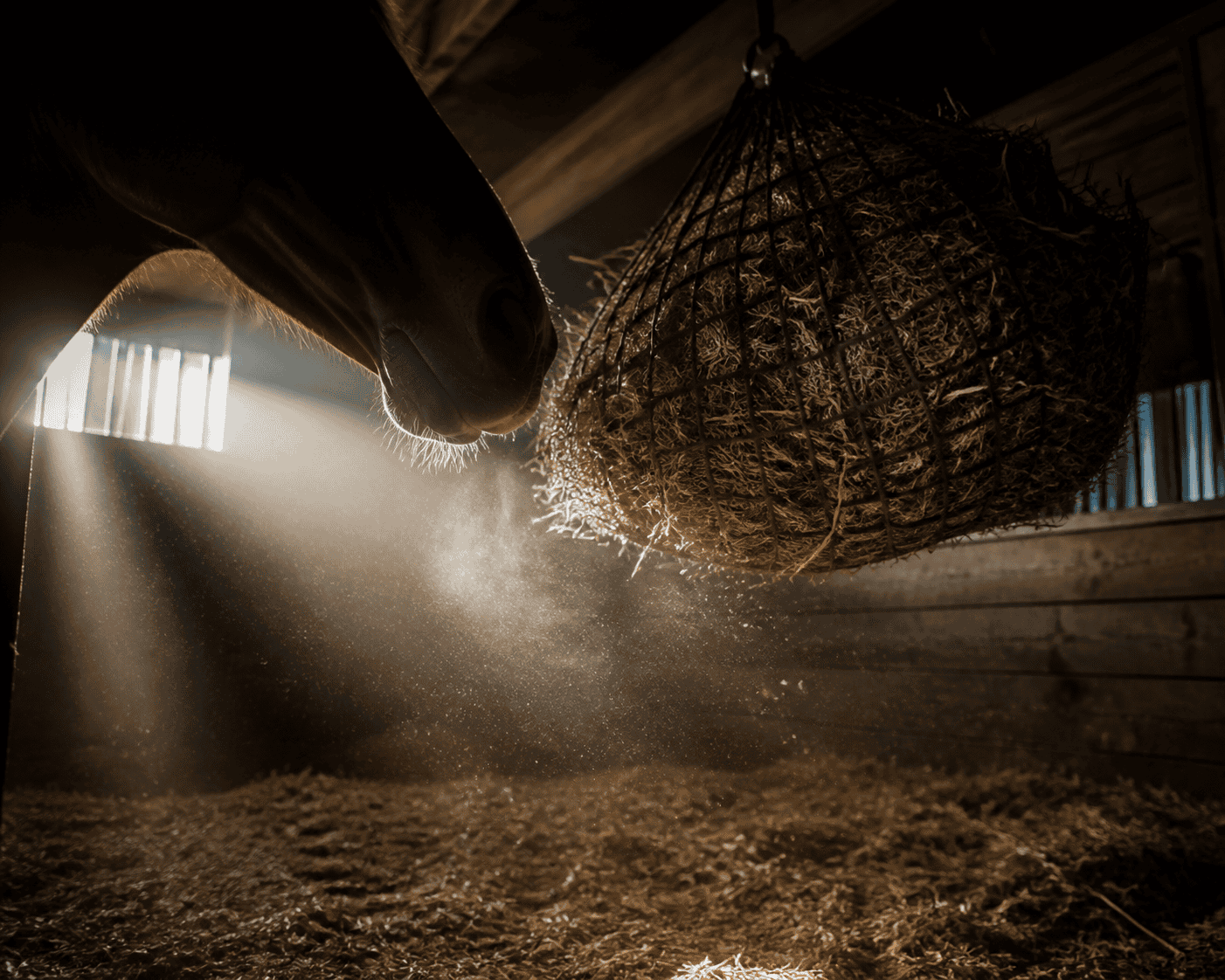
Bedding sits on the floor and mostly stays there. Hay gets shaken out, hung at head height, and pulled at repeatedly by an animal with its face buried in it for six or seven hours. Every pull releases particles straight into the breathing zone. A horse on a haynet is running a continuous aerosol generator two inches from its own nostrils. In the Auger measurements, the dry-hay regimes stayed in the thousands of particles per liter in the breathing zone regardless of what was underneath the horse, while the regimes that treated the forage dropped by an order of magnitude.
There is one more thing about level two that gets missed, and it is about timing rather than materials. In one set of measurements, 81% of the elevated respirable dust readings taken in a stable occurred during mucking out — including mucking out of the stall next door. Skipping a bed lifts everything that settled over the previous twenty-four hours back into the air at head height.
Which means a barn can do everything right on materials and still hand its horses their heaviest dust exposure of the day, every day, at seven in the morning, because that is when the horses are in and the beds get done. The fix is a schedule change and it costs nothing. Horses out first, beds second. Almost nowhere runs it that way, because it is less convenient for the people who write the schedule.
This is the same pattern that shows up everywhere in tack and equipment: the visible purchase substitutes for the invisible variable. It is the reason a noseband can carry three times more pressure than the strap everyone actually checks without anyone noticing for years.
Level 3: Treating the forage
This is where the ladder stops being housekeeping and starts being equipment, and it is the single largest measured improvement available to a horse that has to live inside.
You can wet hay or you can steam it. They are not the same intervention, and the industry has been slow to say so out loud.
| Soaking (full immersion, ~10 min) | High-temperature steaming | |
|---|---|---|
| Respirable particle reduction | ~90% | Up to 99% reported; ~90% in the most conservative study |
| Bacterial content | Increases | Reduced (spores, yeast, bacteria killed) |
| Minerals and soluble protein | Leached (P, K, Mg, Na, Cu) | Preserved |
| Palatability | Eaten more slowly; least preferred | Preferred, comparable to dry hay |
| Water use | High | Low |
| Equipment cost | A tub | Four figures |
Hosing hay down rather than immersing it is much weaker, around 43%, because you wet the outside of a wedge and leave the middle dry. If you are soaking, submerge it. A soaking net or bag and a muck tub is the entire capital requirement.
Note the direction of the bacterial finding, because it gets stated backwards constantly. Cold water and organic material sitting together for half an hour is a growth medium. Soaking reduces what the horse inhales and increases what it swallows. If you are soaking for laminitis or metabolic reasons, the leaching is the point and the diet gets planned around it. If you are soaking purely for dust, you are paying a nutritional price you probably have not budgeted for.
Steaming works by a different mechanism: saturating the forage above 80°C binds particles down and kills mold spores rather than feeding them. The Haygain HG-600 is the most common unit in this category. It holds roughly half a small bale and runs a sixty-minute cycle.
An honest note on the evidence: a significant portion of the steaming literature involves researchers who have worked with or been funded by the steamer manufacturers. That does not make the findings wrong, and the effect has been replicated by independent groups in more than one country, which is more than can be said for most claims made about horse equipment. It is the reason to plan on 90% rather than 99%. This is the same distinction that separates the handful of boot brands that publish independent lab testing from the rest of the rack.
The free part of level three
Feeding hay at or near ground level rather than from a net at head height costs nothing and helps in two ways. A horse’s airway clears by moving mucus up the trachea, and that works with gravity when the head is down; hold the head elevated for hours and secretions pool in the lower airway instead of draining. Transport studies show measurable tracheal contamination in horses tied with heads up, resolving when they can lower them. Second, a dust plume released at floor level falls away from the nostrils rather than into them.
The tradeoffs are real. On sandy footing, ground feeding is a sand colic risk serious enough to override the airway benefit. Hay on soiled bedding picks up manure and parasite eggs. The practical middle is a ground-level tub or slow-feeder box that gets the head-down posture without putting hay directly onto bedding or sand.
Level 4: Air movement
Almost nobody reaches level four, because it is not something you can buy for your own horse. It belongs to the building.
Ventilation is measured in air changes per hour — how many times the entire volume of air in a space is replaced in sixty minutes. Guidance for occupied stalls generally sits around eight to ten. In the barn Auger and Moore-Colyer describe, seven horses shared an airspace of about 39 square meters on a still day at 6.6 changes per hour. Below that threshold, ammonia and dust accumulate faster than passive airflow clears them, and the building stops being a shelter and starts being a container.
Two conditions have to hold:
- An inlet low and an outlet high. Air has to move through the zone where the horse actually stands. High windows on their own ventilate the rafters, and the horse is not in the rafters.
- The openings have to be open. They are routinely shut for exactly the months that matter most, when horses are in for the longest hours. People close doors because of the weather. The horse would rather be cold.
Where a barn genuinely cannot be opened up, mechanical air movement is the fallback. A properly agricultural-rated barn fan is not the same object as a household box fan; dust and chaff kill sealed domestic motors, and a fan that fails hot in a barn full of bedding is a different category of problem. Buy the rated one.
Then there is the finding that undoes everything above it. The benefit of a low-dust regime in one stall is lost unless the adjacent stalls are on the same regime. Your steamer does not create a bubble. If the horses on either side of yours are on straw and dry hay and the barn shares one airspace down a center aisle, you have bought a machine that treats a fraction of the air your horse breathes. This is the most expensive misunderstanding in the subject, and it is where the ladder stops being a personal decision and becomes a conversation with a barn manager.
Level 5: Hours outside
Everything in the first four levels reduces exposure. Only one thing removes it.
Berndt and colleagues measured endotoxin concentrations in the breathing zone of horses and found them higher in stables than at pasture, consistent with the ten-fold dust difference. So level five is hours: not a product, not a bedding, just the number of hours per day the horse is not inside a building. It is skipped in almost every article written on equine respiratory health, because there is nothing to sell at level five and no photograph to take of it.
For horses that can live out or stay out longer, the binding constraint is usually weather protection rather than the horse’s tolerance for cold. That is a solvable problem, and the turnout blanket brands that actually survive a season outside are a short list.
The scorecard
| Level | Cuts breathing-zone dust | Cuts ammonia | Cost | Needs barn cooperation | Verdict |
|---|---|---|---|---|---|
| 1. Default stall | — | — | None | No | Baseline |
| 2. Bedding swap | Partial (room, not nose) | Yes | Low | Sometimes | Real but plateaus |
| 3. Treated forage | Yes — largest single effect | No | Free to four figures | No | Highest leverage you control |
| 4. Ventilation | Yes | Yes | Varies | Yes | Gates everything below it |
| 5. Hours outside | Removes exposure | Removes exposure | None | Usually | The only real fix |
The awkward shape of that table is that the leverage sits at the bottom of the ladder and at the top, and barely at all in the expensive middle where the marketing is.
How to work out what level your barn is on
- Stand in the stall at the horse’s head height, not yours. Ammonia pools low. Crouch to where the muzzle sits when the horse is eating off the floor.
- Go in first thing, before the doors are opened. Overnight, with the barn shut, is the worst-case reading and the one that matters. A barn assessed at two in the afternoon with everything open tells you nothing.
- Measure rather than smell. Human ammonia detection starts somewhere between 5 and 30 ppm, well past the 10 ppm concern threshold. A handheld ammonia meter or NH3 detector removes the guesswork for less than a single farrier visit.
- Watch what happens during mucking out. If the horses are in while beds are stripped, that is the heaviest exposure of their day and no bedding choice offsets it.
- Look at where the hay hangs and what has been done to it. This is the variable with the largest measured effect and it is the one most barns have never touched.
- Count the openings and check whether they are open. Low inlet, high outlet, and both actually unblocked in winter.
What we could not verify
- Current US retail pricing on hay steamers could not be confirmed against a live manufacturer or retailer listing at the time of writing (August 2026), so no figure is quoted above beyond the category being four figures.
- The Claussen 2018 reduction figure and the 43% hosing figure reached us through secondary summaries rather than the primary papers. Both are presented as approximate.
- The adjacent-stall finding is cited within Auger & Moore-Colyer as established prior work rather than measured fresh in that study.
- Prevalence figures for severe equine asthma were excluded entirely; the commonly circulated percentage traces to a manufacturer blog rather than a primary review.
References
- Leclere M, Lavoie-Lamoureux A, Joubert P, et al. Corticosteroids and antigen avoidance decrease airway smooth muscle mass in an equine asthma model. Am J Respir Cell Mol Biol. 2012;47(5):589–596.
- Auger E-J, Moore-Colyer MJS. The effect of management regime on airborne respirable dust concentrations in two different types of horse stable design. J Equine Vet Sci. 2017;51:105–109.
- Moore-Colyer MJS, Taylor JL, James R. The effect of steaming and soaking on the respirable particle, bacteria, mould, and nutrient content in hay for horses. J Equine Vet Sci. 2016;39:62–68.
- Blackman M, Moore-Colyer MJS. Hay for horses: the effects of three different wetting treatments on dust and nutrient content. Anim Sci. 1998;66(3):745–750.
- Clements JM, Pirie RS. Respirable dust concentrations in equine stables. Part 2. Res Vet Sci. 2007;83:263–268.
- Berndt A, Derksen FJ, Robinson NE. Endotoxin concentrations within the breathing zone of horses are higher in stables than on pasture. Vet J. 2010;183(1):54–57.
- Airaksinen S, et al. Reducing respiratory health risks to horses and workers: a comparison of two stall bedding materials.
- University of Kentucky foaling stall ammonia measurements, 2000, as reported by The Horse.
- Haygain HG-600 published product specification.
Disclosure
Nobody paid for this article and no product mentioned in it was supplied to us. Claims are traced to published sources where those exist, and anything we could not verify is listed above rather than quietly omitted.
This article contains affiliate links. If you buy through one of them we may earn a commission at no additional cost to you. Affiliate links are placed only on products the article would recommend regardless, and no brand has paid for placement or influenced what appears here.