The Only 6 Turnout Blanket Brands You Can Still Trust (For Horses Living Out)
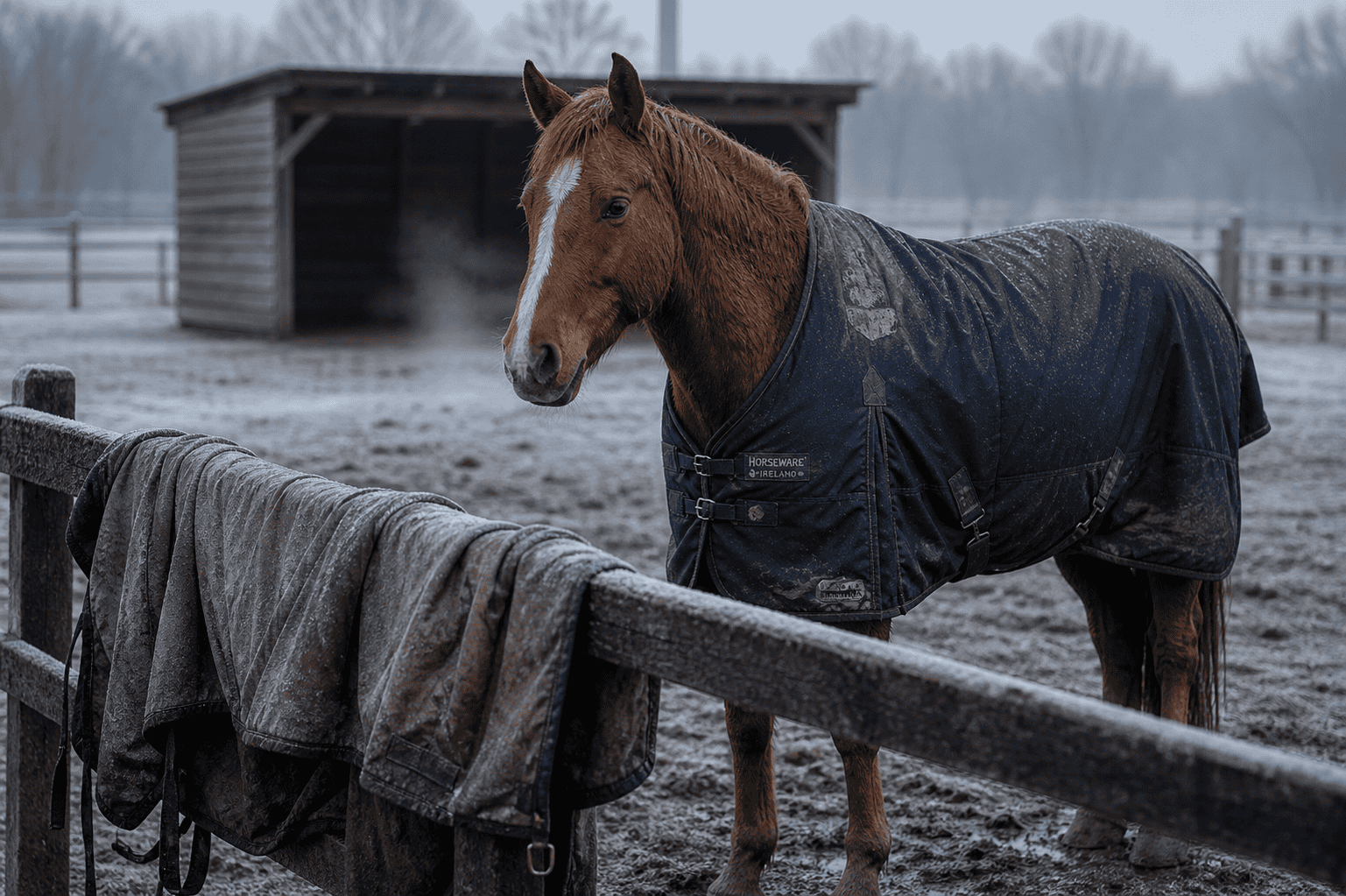
There are Rambo turnout blankets from 2009 still going out in the field this winter — patched at the shoulder, restitched at the point of the hip, leg straps replaced twice, and the shell underneath all that repair work still shedding water.
The same winter, somewhere else, a blanket bought in October is soaked through by December. Not torn. Soaked. And a wet horse under a wet blanket is worse off than a horse wearing nothing at all.
This guide puts eleven blanket brands against the same five questions. Six pass. Five don’t — and one of the five is a budget line sitting directly underneath a brand that finishes near the top.
Why a wet blanket is worse than no blanket
A horse in its own coat handles cold by raising the hairs and holding a layer of still air against the skin. The still air is the insulation; the coat is only the structure that holds it. A dry blanket adds a second layer of the same thing — trapped air held in polyfill — which is why grams of fill matter and thickness alone doesn’t.
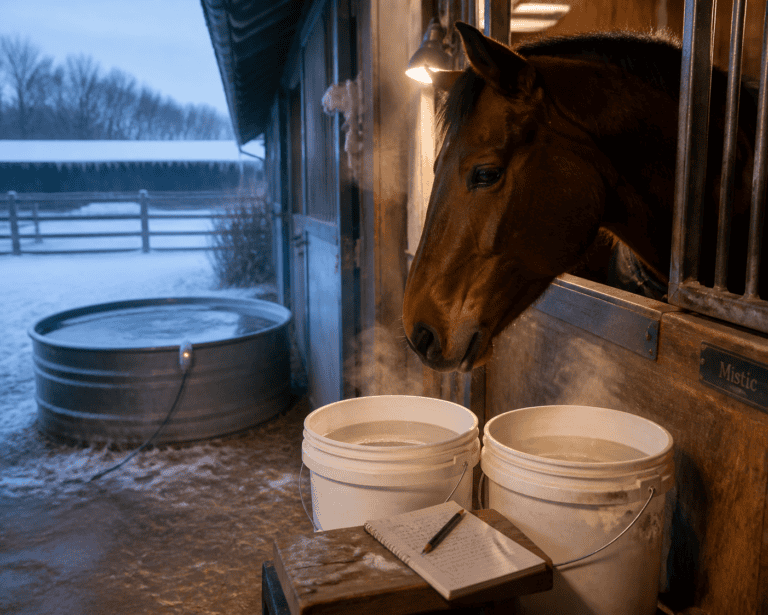
A wet blanket reverses all of it. Water displaces the air out of the fill, and water carries heat away from a body far faster than air does. The blanket also flattens the coat underneath, so the horse loses the insulation it grew for itself at the exact moment the thing you bought stops working. You’ve removed the horse’s own system and replaced it with a cold, wet layer it can’t shake off, in the dark, for eight or nine hours.
That’s the failure this guide is built around. Not tearing. Wetting through.
The five questions
1. Is the denier published?
Denier is thread thickness. If a company won’t print the number, that’s a decision, not an oversight.
| Denier | What it’s actually for |
|---|---|
| 600D | Stable sheet or light rain sheet. Sold as “turnout” more often than it should be. |
| 1200D | The working standard for a horse living out. |
| 1680D–2000D | Ballistic nylon. Rough company, playful horses, tight fencing. |
2. Is fill weight given in grams, not adjectives?
Grams of polyfill is the only number that means anything. “Warm,” “cozy” and “all season” are not measurements.
| Category | Fill weight |
|---|---|
| Sheet | 0g |
| Lightweight | 80–180g |
| Midweight | 200–300g |
| Heavyweight | 380–440g |
3. Can you buy the parts?
Leg straps go first, every time — they’re elastic under repeated load in mud, and they’re the part a hind foot finds. Then a surcingle, then the front buckles, then the shoulder seam. Almost none of those are shell failures.
A blanket where the shell is fine and the straps are gone is a blanket you throw away only because nobody will sell you eight dollars of webbing. The question isn’t whether the company calls it durable. It’s whether there’s a parts page, with part numbers, that you can order from in January.
4. Has the ownership stayed where it was?
Brands get bought. When they do, the specification tends to follow the new owner’s margin target within about two product cycles — and the name on the label keeps telling you the old story.
5. What actually happens in year two?
Not the marketing word on the tag. The written terms. This is where most of the category falls apart.
The scorecard
| Brand | Denier published | Fill in grams | Parts available | Ownership stable | Year-two warranty | Result |
|---|---|---|---|---|---|---|
| Schneiders | Yes | Yes | Yes | Yes | 1–10 yr, written | Pass |
| Horseware (Rambo) | Yes | Yes | Yes | Changed — see below | Yes | Pass, with a note |
| WeatherBeeta | Yes | Yes | Yes | Yes | Yes | Pass |
| Shires | Yes (2000D) | Yes | Yes | Yes | Yes | Pass |
| 5/A Baker | Yes (1500D) | Yes (400g) | Yes | Yes | Yes | Pass |
| Bucas | Yes | Yes | Yes | Yes | Yes | Pass |
| Kensington | Yes | Yes | Yes | Yes | 30 days | Fail |
| Tough-1 | Yes | Yes | Yes | Yes | Not published | Fail |
| TuffRider | Yes | Yes | Limited | Yes | Not published | Fail |
| SmartPak Classic | Yes (600D) | Yes | Limited | Yes | Retailer policy | Fail |
| Amigo | Yes | Yes | Yes | Yes | Yes | Fail — see below |
The word “lifetime” is doing a lot of work
Kensington Protective Products, in business since 1954, advertises a lifetime guarantee on its blankets. Read the published terms.
The actual manufacturer’s warranty against material defects and faulty workmanship runs for the first 30 days after purchase. The “lifetime” portion is the right, once, for the original purchaser to buy a replacement at 50% off current list price — and only if the product was registered within 30 days with the receipt attached.
That’s a discount coupon with a registration deadline. It isn’t a warranty, and Kensington fails this list on that basis alone. The blankets themselves are not badly made. The claim on the tag is what fails.
What it looks like when a company means it
Schneiders, out of Ohio, sorts its entire blanket range by warranty length and prints it on the product page:
- 1 year — horses that are easy on their gear
- 5 years — playful horses
- 7 and 10 years — the ArmorFlex lines
The written terms cover the outer shell, the lining, the straps, the surcingles, the assembly and the hardware, and guarantee the blanket stays waterproof and breathable for the full term. Denier is published. Fill is published in grams. Leg straps are sold separately.
The StormShield Blizzard heavyweight sits around $220 with a 1-year term; the ArmorFlex Warrior at 1680D ballistic nylon carries 10 years.
Where you buy can matter more than what you buy
Dover Saddlery publishes a policy extending the manufacturer’s defect warranty to a maximum of 24 months regardless of what the individual maker’s own policy says, and honoring anything longer up to its stated length.
If you’re buying a brand with a thin warranty, the retailer can be the thing standing between you and a $200 loss in month fourteen. Nobody advertises this. It’s in the returns page.
The price ladder, and what the extra hundred dollars buys
The spread in this category is narrower than the marketing implies. A 1200D midweight from a mainstream brand lands between roughly $180 and $230. Below that sits a band from $90 to $140. Above it, a band running past $350.
What the extra hundred dollars buys is not warmth. Warmth is grams, and grams are cheap. It buys shell denier, the membrane, hardware that doesn’t seize, and above all the warranty term and the parts.
Which means the honest comparison is never sticker price. It’s sticker price divided by winters. A $220 blanket with a five-year term and a parts page is cheaper per winter than a $130 blanket you replace in the third season — and much cheaper than one you replace in the second.
This is the same arithmetic that governs which saddle pads are worth buying, and it produces the same counterintuitive answer.
The failures
Tough-1
Made by JT International, found at Tractor Supply for around $200, and more honest than its reputation suggests. It publishes denier. It publishes fill in grams, and offers the same shell in 100g, 200g, 300g and 400g so you can actually choose. Leg straps are replaceable and sold separately.
That’s three of five. What it doesn’t publish is any waterproofing rating you can check, and it carries no stated warranty term at all. Two questions unanswered — and both are the ones that matter in year two.
TuffRider
From JPC Equestrian, same position for the same reasons. The Outer Armor midweight is 1200D with 200g fill, both printed. Waterproofing is described rather than measured, and the warranty position isn’t published where a buyer can find it before purchase.
Retailer house lines
SmartPak’s own Classic turnout is a 600D ripstop shell sold as a turnout blanket. On a horse living out with company — fence, run-in shed, other horses’ teeth — 600D is a consumable.
That isn’t a defect and it isn’t a scandal. It’s a price point doing what a price point does. The problem is that it sits next to 1200D blankets under the same word, turnout, and nothing on the shelf tells you which one you’re looking at.
Amigo — the one that matters
Amigo is Horseware’s budget line. Rambo is Horseware’s flagship. Same company, same catalog, same Irish name on the tag, and a price gap wide enough to drive a truck through.
That gap is real: shell denier, membrane quality, hardware, and how many seasons the thing survives before the seams start wicking. An Amigo is not a cheap Rambo. It’s a different product wearing the family resemblance, sold in the same aisle with the same heritage story attached.
If you’ve been buying Amigo because Rambo has the reputation, you’ve been paying for an association rather than a specification. It’s the same mechanism at work in white-label saddle pads, where a $30 pad and a $150 pad share a factory.
The six that pass
Schneiders
Passes on all five. Ohio-based, publishes everything, sells the parts, and puts the warranty term on the product page rather than in a PDF.
Horseware (Rambo) — pass, with a note
Rambo passes on the strength of the thing this article opened with: fifteen-year-old blankets still in service, repairable, with parts that exist.
But the ownership question has an honest answer the marketing doesn’t volunteer. Horseware Ireland was founded in 1985 by Tom MacGuinness in Dundalk. In March 2021, private equity firm Lonsdale Capital Partners took a significant stake. In early 2025, Horseware and EquiFit announced a merger. Manufacturing is in Ireland, Cambodia and China, with a US distribution center.
None of that is hidden and none of it is damning. It simply isn’t the small Irish family firm the founding story implies — and if you’re buying on heritage rather than specification, you should know which one you’re actually buying.
WeatherBeeta
The ownership answer runs the other way here. The WeatherBeeta Group is headquartered in Melbourne, has been going more than 45 years, and still runs as a family-owned business. It owns WeatherBeeta, Dublin, Roma, Saxon, Korsteel, Kincaid and Collegiate, and runs its own operation out of Easton, Pennsylvania rather than through a rotating cast of distributors.
Note that Saxon is the budget line inside that same group — so the Amigo logic applies there too, one shelf down.
Shires
Passes on shell specification. The StormCheeta uses 2000D ballistic nylon branded ShireTex, and the number is printed rather than implied. In a field with rough company, that’s the tier that survives.
5/A Baker
Making blankets since 1946 out of Somers, Connecticut. The heavyweight turnout runs 1500D ripstop with 400g fill, both published, under a waterproof breathable membrane. The Baker plaid is a fashion story and carries a fashion premium. The construction underneath it isn’t.
Bucas
Passes on the lining, which is the one genuine technical difference in this category. The stay-dry system is built to move moisture off the coat rather than trap it against the skin — which addresses the exact failure described at the top of this article. Verify current distribution before ordering, as that has moved around.
Two things the industry sells hardest that didn’t make the criteria
The attached neck cover
Genuinely useful in driving rain, and it genuinely reduces water getting in at the chest. It’s also the single most common place these blankets fail, because it’s the part the horse rubs against a fence post — and on most combo designs you can’t replace it separately.
A detachable neck on a repairable blanket beats an attached neck on a sealed one, every winter.
Breathability
Every blanket in this category claims it, in the same three words, on every product page. Almost none publish a number for it.
This matters more than it sounds. A horse that works up a sweat under a blanket on a mild afternoon and then stands in it at nightfall is wet from the inside — which produces exactly the same cold compress as a leaking shell.
Waterproof and breathable pull against each other as engineering problems. A company that publishes a waterproofing figure and stays silent on the moisture-vapor figure is quietly telling you which side it chose. Since almost nobody publishes either, breathability couldn’t be a pass criterion here. Treat it as an unverified marketing claim across the whole shelf until somebody prints a number — and in the meantime, treat overblanketing as the more common mistake, because it is.
How to check the blanket you already own
Before buying anything, check what’s in the tack room. A blanket usually fails quietly, and in stages, rather than all at once.
- Look at the inside, not the outside. Waterproofing goes from the inside out, at the seams and stress points, long before the shell looks worn.
- Run a hand along the inner face under the shoulder and along the spine. Cool and faintly damp when the outside is only wet means the membrane has started letting water through.
- Press the fill along the topline. If it’s packed flat and stayed flat where the rest still lofts, that section has stopped insulating whatever the label claims.
- Pull each leg strap through its clip and check where the elastic joins the webbing. That’s where they part.
- Check the surcingle elastic for slack. A slack surcingle lets the blanket rotate, and a rotating blanket rubs the point of the shoulder raw before you notice.
Four minutes, no cost, and it tells you more than any product page will. It’s the only assessment made on your horse rather than in a marketing department — the same principle behind assessing saddle fit on the horse in front of you rather than on the label.
The thing that beats every blanket on this list
A horse with a three-sided shed it can walk into beats every blanket here. It beats the ten-year warranty and the ballistic nylon and the stay-dry lining. A horse choosing its own shelter is regulating its own temperature, and no blanket does that.
The blanket is what you use when the shelter isn’t there, or isn’t enough, or the horse won’t use it. It’s a substitute for a field that works — not an upgrade on one.
Which raises the question worth sitting with before spending another $200 in October: is the blanket solving a weather problem, or is it solving a field problem?
Hoof & Honest takes no sponsorships and no brand deals. Every claim here traces to a published source — manufacturer specifications, warranty terms, and corporate filings — rather than to marketing copy. Where a claim couldn’t be verified, it was left out.
Related reading: bits your horse secretly hates · cheap grooming brands that beat the expensive ones