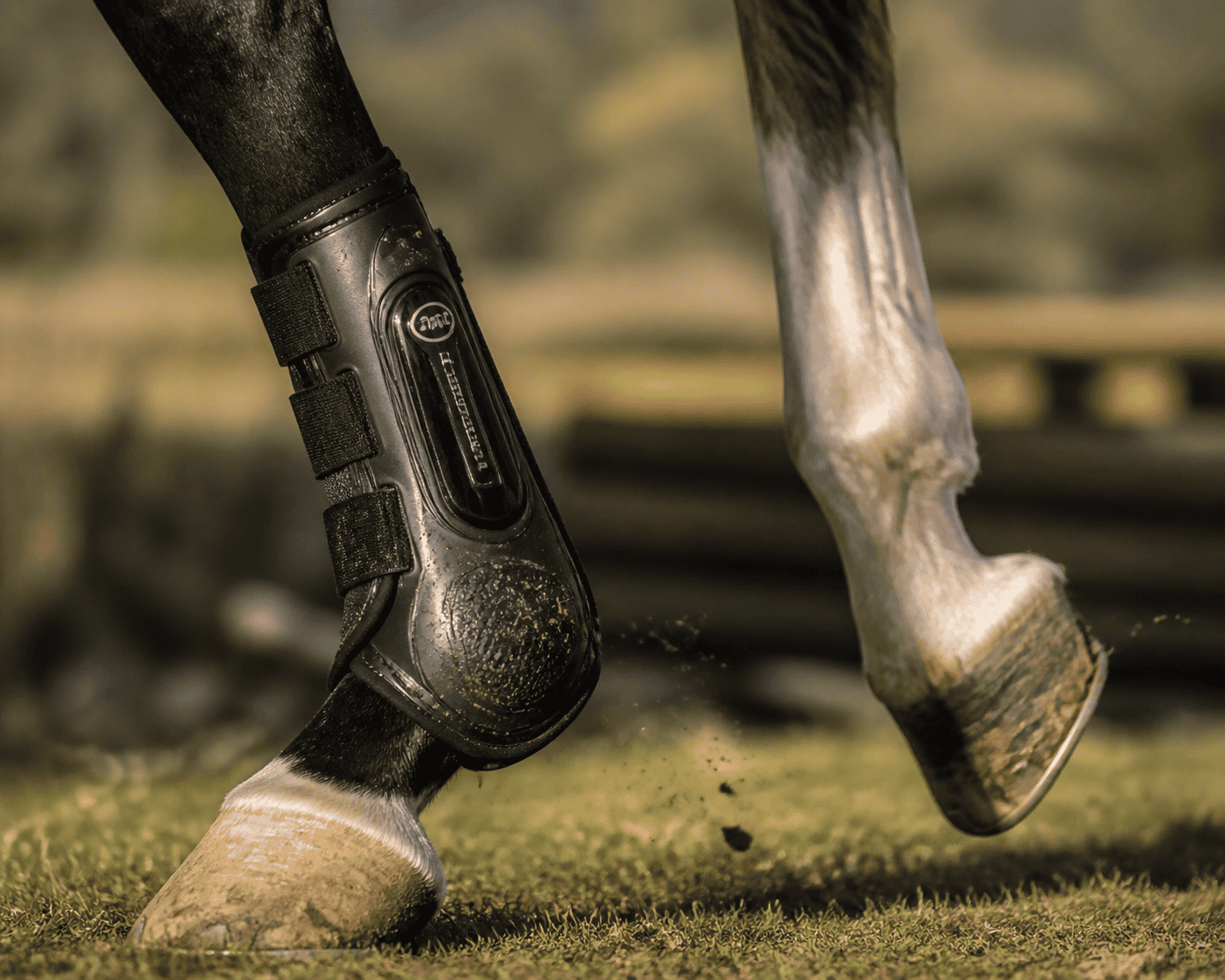
The 5 Levels of Leg Protection (Most Riders Never Get Past 2)
Equilibrium sends its cross-country boots to the same independent laboratory that tests riding hats and body protectors, and publishes what comes back. Almost nothing else hanging on the rack beside them has been tested by anyone at all. On a horse that catches a hind foot into its own front tendon at a gallop, that difference is the difference between a bruise you find at evening feed and a splint bone you find on an ultrasound.
If you jump, your horse wears boots on every ride. Schooling, warm-up, competition, hacking out. That is more hours in contact with your horse’s leg than any other piece of equipment you own, including the saddle. And the thing most riders say they are buying boots for is tendon support, which is the one thing there is no evidence that boots do.
What follows is a five-level ladder, from the boot that is purely decorative up to the boot that is actually matched to the thing that might hurt your horse. The verdict, stated before you read any further: no published research shows that leg protection prevents tendon strain. What boots demonstrably do is spread the force of a strike across a surface and cut peak pressure at the point of contact. That is a real job. It is not the job printed on the packaging. Every claim below is traced to a published study or a company’s own published test, and where the evidence is thin, it says so.
Level 1: The boot is decoration
This is the boot bought because it matched the saddle pad, or because it came in the barn’s color, or because every other horse at the show had a matched set and yours looked naked. There is nothing wrong with wanting your horse to look good. The problem is that at level one, nobody has asked what the boot is for, which means nobody has checked whether it is doing it.
What you find at this level is a soft neoprene shell with a fabric outer, no strike plate to speak of, sold four to a bag at a price that feels clever. It will stop a scrape from a rail. It will not do much else, and it will hold heat and moisture against the leg for the entire session.
The tell for level one is that you cannot answer three simple questions about your own boots. Which part of the leg does the strike plate cover? Where does the fetlock sit inside the boot? What is the boot made of underneath the outer fabric? If those questions feel unfair, that is the level.
Level 2: The boot fits and fastens
This is where most jumping riders live, and level two is not nothing. A correctly fitted boot that stays where you put it is genuinely better than an incorrectly fitted expensive one. Fit is the single biggest variable in whether a boot causes a problem.
The tightness question is the one people get wrong most often, and the honest answer is that there is no finger test for a boot the way there is for a noseband. Too loose and it rotates, which puts the strike plate on the outside of the leg where nothing is going to hit it while the soft back of the boot sits over the tendon. Too tight and you have a tourniquet on the structure you were trying to look after.
How to check a boot’s fit
- Check coverage at the fetlock. The boot should cover the joint without pressing into it. A boot that sits on the fetlock rather than around it will rub within a season.
- Check the top edge. It should sit below the point where the tendon starts to run free of the cannon bone, not across it.
- Check the strap direction. Straps should pull from the front of the leg toward the back, not the reverse. Fastened the wrong way, the pull works against the boot’s position every stride.
- Push it hard with your thumb. A correctly fitted boot does not move. If it rotates under thumb pressure, it will rotate at a gallop.
- Read the leg after the session. No ridges pressed into the coat, no pressure line, no bald patches starting at the boot’s edge.
- Size to this horse. Not to the size the last horse wore, and not to the brand’s chart alone. A boot that needs the straps a hole tighter every ride is the wrong shape for that leg, and no amount of tightening fixes shape.
That is real work and it takes a season to learn. But level two is not the top, because a boot can fit perfectly, stay perfectly in place, and still be doing nothing at all for the injury you are worried about while costing your horse something you cannot see.
Level 3: The protection is measured, not claimed
Almost every boot on the market makes some claim about impact. Shock absorbing. Impact dispersing. Protective strike zone. Those words are free. There is no mandatory standard for equine leg protection the way there is for riding hats and body protectors, no independent body certifying boots, and no legal requirement for anyone to test anything before it goes on the shelf.
Two companies publish real testing, and they are worth naming for that reason alone.
Equilibrium sends its Tri-Zone range through an independent laboratory of the same class that handles hats and body protectors, testing for concussion and penetration with force intended to represent a horse striking a solid fence or striking into itself, plus weight when wet, flexibility, and breathability. The breathability work was done with Dr. David Marlin, who has spent decades in equine exercise physiology, and the method is published on the company’s own site: a model leg was drilled, steam was fed through it, and moisture escaping the boot was measured in a sealed box with sensors and fans. You may or may not think that method represents a live horse well. That is a reasonable argument to have, and the point is that you can have it, because the method is written down where you can read it and disagree with it.
Majyk Equipe publishes the other one. The company took its hard-shell boots to an independent laboratory that specializes in testing protective armor for military use, and measured how much force passed through the boot to the surface underneath at two strike intensities, against two competitor boots. Their boots let the least force through. That test was commissioned and paid for by Majyk Equipe, the company chose which boots to test against, and there is no way to verify from outside that the comparators were representative. That is a real limitation. It is still a published number with a described method, which is more than the rest of the shelf offers.
What the shelf actually publishes
| Brand or range | Test result you can read | Method published | Who did the testing | Passes level 3 |
|---|---|---|---|---|
| Equilibrium Tri-Zone | Yes: concussion, penetration, weight when wet, breathability | Yes, including the breathability rig | Independent laboratory, same class as hats and body protectors | Pass |
| Majyk Equipe hard shell | Yes: force transmitted at two strike intensities | Yes, with named comparators | Independent armor laboratory, commissioned by the brand | Pass, with the sponsorship noted |
| Veredus (Olympus, Carbon Gel) | A percentage figure for impact dissipation appears in retail copy | No method or test conditions published | Not identified | Fail |
| LeMieux (MIMsafe XC, Impact Responsive) | No test data published; an engineering collaboration is described | No | Not identified | Fail |
| Woof Wear | No test data published; material specifications only | No | Not identified | Fail |
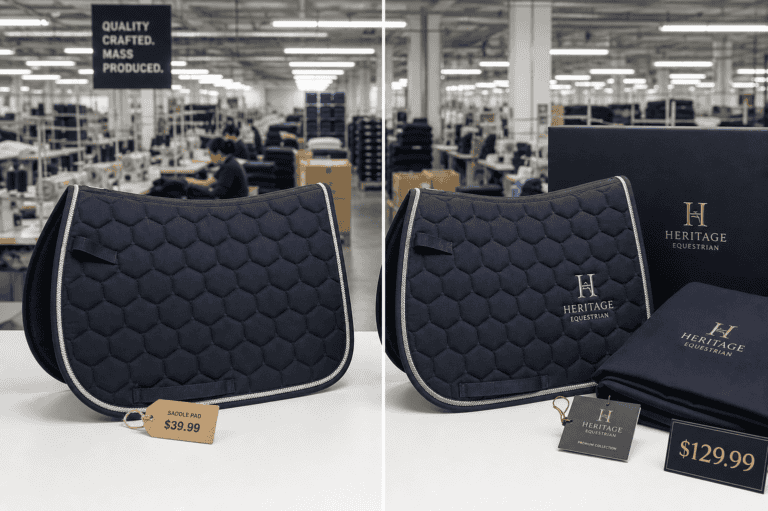
A fail in that last column means no published test result could be located as of August 2026. It is not proof that no testing was done. It is the point, though: a test nobody can read is indistinguishable, to a buyer, from a test that never happened. That gap between what a product claims and what anyone can verify runs through the whole tack trade, and it is the same gap that lets quietly built brands sell for less than the names you recognize.
What the impact evidence actually supports is also narrower than the marketing suggests. Work by Lars Roepstorff indicates that a boot takes a strike and spreads the force across its surface, cutting peak pressure at the point of contact, so a horse that would have come out of an interference injury with a wound can come out of it with very little. That is a real and worthwhile job. That is the job.
Level 4: The heat is understood
Here is the part that changes how you use boots, and the research is older than most of the boots on the market.
A tendon heats itself. Every stride it stores and returns energy, and it is not a perfect spring, so the difference comes out as heat in the middle of the tendon where the blood supply is poorest.
| Study | What was measured | Finding |
|---|---|---|
| Wilson & Goodship, 1994 | Temperature inside the superficial digital flexor tendon of live horses at gallop | Peak core temperatures of 43 to 45 degrees C (109 to 113 F), with the core averaging about 5 degrees hotter than the tendon surface |
| Birch, Wilson & Goodship, 1997 | Survival of tendon core fibroblasts after 10 minutes of heating | 91 percent survived at 45 C (113 F); survival collapsed to 22 percent at 48 C (118 F) |
| Brock & Spooner, 2021 (MTSU) | Skin surface temperature under six boot and wrap types, six horses, opposite foreleg bare as control | Bare limb cooled to about 28 C by minute 9; every booted or wrapped limb climbed to about 36 C by minute 15 and stayed there. Polo wrap reached 94 percent humidity inside. After three hours of recovery, no treatment had returned to its starting temperature |
| AJVR, 2014 | Thermography after 20 minutes on the lunge, ten horses | Bare metacarpus 14 C; the same leg in a tendon boot 20.6 C; in a bandage 24.8 C |
Two corrections belong here, because this research gets mangled in both directions.
First, the 1997 fibroblast finding is repeated across the equestrian press, by veterinary practices and by at least one major magazine, as a study out of Japan showing that 48 degrees kills 80 percent of tendon cells. It was not a Japanese study. It was done at the Royal Veterinary College in the United Kingdom, and the finding is 22 percent survival rather than 80 percent death, which is close but not the same number. If a claim has traveled for thirty years with the wrong country attached, that tells you how carefully it has been checked by the people repeating it.
Second, there is a finding in that same paper that cuts the other way, and the people quoting it never mention it: tendon fibroblasts proved significantly more resistant to heat than dermal fibroblasts, and more resistant than the rat kidney cell line they were compared against. Tendon cells are unusually tough. The picture is not that a warm leg cooks a tendon.
And 36 degrees on the skin is nowhere near 48 degrees inside a tendon. None of the boot studies measured tendon core temperature under a boot. Brock measured the surface of the leg. A veterinarian quoted on that study, Brad Hill, pointed out that most of his clients work in boots and he does not see a matching wave of tendon injuries in practice.
The mechanism that is actually supported is narrower and still worth acting on. A bare leg sheds heat by convection. A booted leg cannot. The tendon generates its own heat from the inside, and the boot has removed the route that heat normally takes out. That is a real cost. It is not the same claim as “boots cook tendons,” and the version circulating on social media usually is.
Level four is knowing that and letting it change three things:
- Boots come off when the work finishes, not at the end of the day.
- Cold hosing or cold water follows hard work, given that no treatment in the MTSU study had returned to baseline three hours later.
- Ambient temperature gets considered before anything goes on. A boot in July humidity is doing something different from the same boot in November.
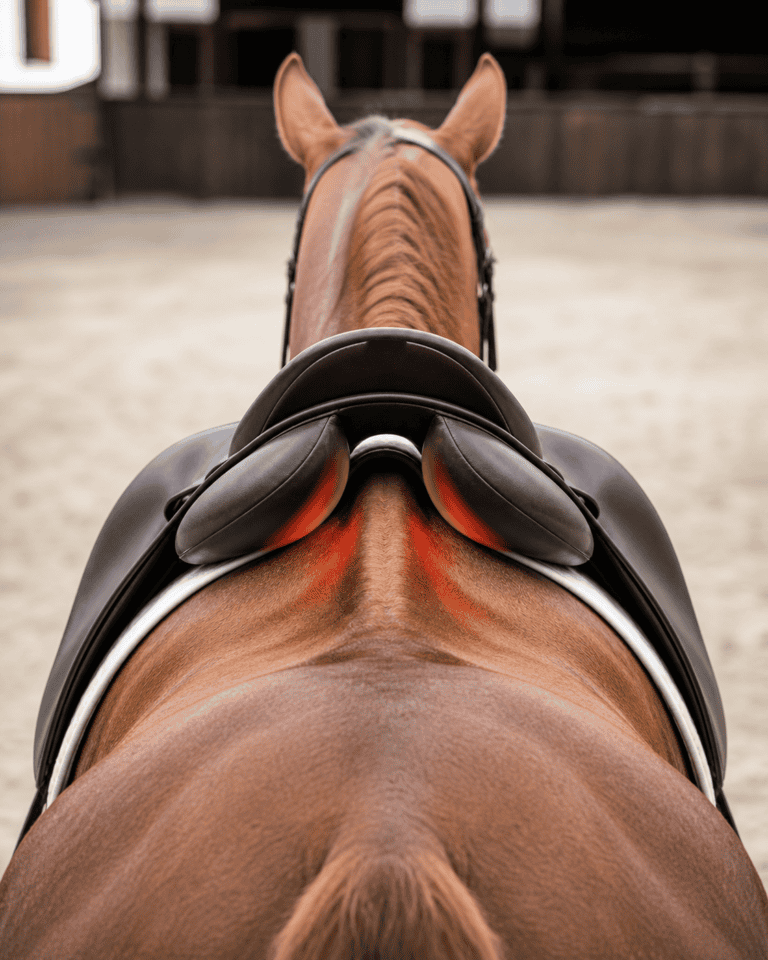
This is the same category of problem as heat and pressure trapped under a saddle, where the damage announces itself late and permanently. It is worth knowing which pads make that worse and which ones help, for the same reason.
Level 5: The boot is matched to the actual risk
This is the level almost nobody reaches, and it starts by giving something up.
There is no research showing that boots prevent tendon injury. What research exists on support found that boots barely reduce fetlock extension at walk and trot, and those are the speeds where forces are lowest, so the effect at speed is likely smaller still. A cadaver limb study did show some restriction of fetlock extension, but a cadaver limb has none of the muscular and ligamentous structures a live leg uses to hold itself up. Biomechanically, it is hard to explain how a strap of neoprene could meaningfully resist forces that regularly exceed the horse’s own body weight.
So the thing on the tack room shelf labeled “tendon boot” does not protect the tendon from strain. It protects the tendon from being struck by another hoof. Once you accept that, the decision stops being about brand and starts being about your horse’s actual work.
| The work you do | What actually threatens the leg | What that argues for |
|---|---|---|
| Arena jumping, horse straight and in balance, clean legs | Very little. Poles fall when hit | Open front boots and hind boots on jumping days. Arguably nothing on flat days |
| Cross-country over fixed obstacles at speed | The leg meets timber that does not give, on uneven ground | A tested strike plate, front and hind. This is where level 3 earns its money |
| A horse that genuinely interferes, with marks you can see | Its own opposite limb, every ride | Correctly fitted brushing boots every ride, plus a farrier and conformation conversation |
| Flatwork on a horse that has never struck itself | Effectively nothing | Nothing, or the lightest thing that comes off fastest |
| Hacking out on roads and rough ground | Overreach, stones, scrapes | Overreach boots where the horse pulls shoes. Little argument for a full tendon boot |
The uncomfortable arithmetic underneath all of this is simpler than any market figure. Boots have been close to universal in sport horse work for decades, and tendon injury is still one of the most common reasons a performance horse stops being a performance horse. If leg protection prevented tendon strain, several decades of near-total adoption should have shown up somewhere in those numbers by now, and no study has found it. That does not make boots useless. It makes them useful for something other than the thing they are sold on.
What to check before you pay
Stop shopping for the boot that will save the tendon, because it does not exist. Start shopping for three things you can actually verify:
- It handles a strike. A strike plate over the area that gets hit, ideally from a company that has published what happened when someone hit it.
- It comes off fast. Because the heat research says the boot should be off the leg the moment the work ends.
- It lets heat out in between. Vents and construction that a manufacturer will describe in specifics rather than adjectives.
Those are checkable before you hand over money. “Shock absorbing” is not.
Where this leaves you
Most riders reading their own boot bag right now are sitting at level two and think they are near the top. The question that actually moves you up is not which brand to buy next. It is simpler: when did your horse last actually hit itself? If the honest answer is that you cannot remember, what exactly is on its legs for?
This ladder works the same way further up the horse. The five levels of saddle fit covers the equipment that spends even more of its life pressed against your horse, and the same pattern of confident claims and thin evidence shows up in what is sold as a comfortable bit.
References
- Wilson, A.M. & Goodship, A.E. (1994). Exercise-induced hyperthermia as a possible mechanism for tendon degeneration. Journal of Biomechanics 27(7): 899–905.
- Birch, H.L., Wilson, A.M. & Goodship, A.E. (1997). The effect of exercise-induced localised hyperthermia on tendon cell survival. Journal of Experimental Biology 200: 1703–1708. Conducted at the Royal Veterinary College, United Kingdom.
- Brock, K. & Spooner, H. (2021). Effect of leg protection on skin surface temperature in exercising horses. Journal of Equine Veterinary Science, vol. 100, abstract 28. Middle Tennessee State University.
- Thermographic comparison of bare, booted and bandaged limbs after lunging. American Journal of Veterinary Research (2014) 75(4): 375.
- Glessner, A. (2021). Review of equine leg protection and tendon support claims.
- Roepstorff, L. Published work on force distribution and peak pressure reduction in equine boots.
- Equilibrium Products. Published independent laboratory testing and breathability method, developed with Dr. David Marlin. Company website.
- Majyk Equipe. Published independent blunt-trauma testing conducted at a military body-armor laboratory. Company website.
- Manufacturer product specifications and published marketing claims for Veredus, LeMieux and Woof Wear, reviewed August 2026.
Disclosure
Hoof & Honest takes no sponsorships and no brand deals. Nothing in this article was paid for or supplied by a manufacturer. Every claim traces to a published study or to a company’s own published testing, and claims that could not be verified were left out rather than softened. Where a company paid for its own testing, that is stated. Where no published test could be found, that is stated rather than treated as evidence of absence.