Synthetic or Leather Saddle? What the Research Says Your Horse Actually Feels
Hoof & Honest was not paid by any saddle maker, retailer or publication for this article, and it contains no affiliate links. Research completed October 2026.
Riders agonize over leather versus synthetic for weeks, and the research we found suggests the horse feels the cover far less than the shape and width underneath it. In a 2023 study of 150 horses with musculoskeletal pain, an ill-fitting saddle contributed to poor performance in 37 percent of them, despite recent professional saddle fitting. In a study of 14 sports horses at the Royal Veterinary College, moving each horse into a saddle one width wider or narrower than a qualified fitter had chosen was enough to change pressure and back movement. Neither study compared leather with synthetic.
That is the awkward part of this debate. We found no study that keeps the tree and panels identical, changes only the cover from leather to synthetic, and measures the horse. What exists is a 2001 magazine test of synthetic saddles, retailer guidance, and care advice from makers. This article lays out what each source supports, where synthetic and leather each have a documented advantage, and how to decide.
A saddle is three decisions stacked together
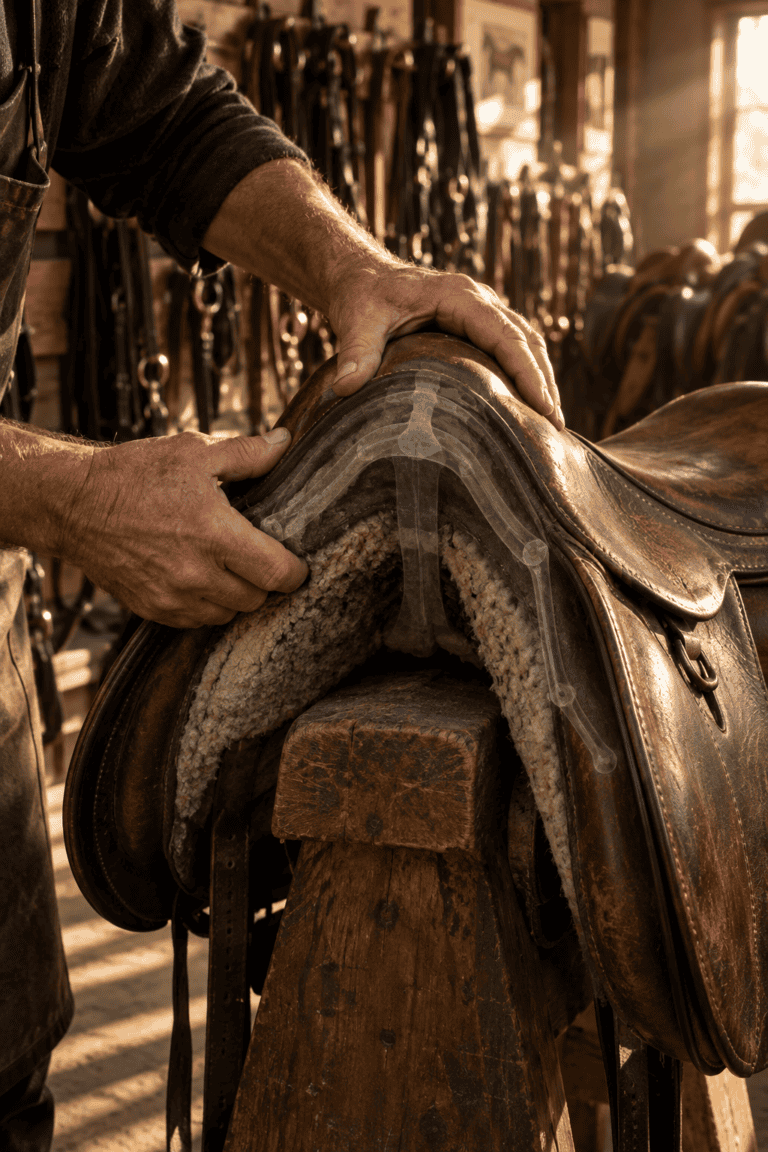
- The tree. EQUUS magazine describes it as the wooden or fiberglass interior frame that determines fit for both rider and horse.
- The panels. The underside cushions that carry the flocking. Master saddler Laurence Pearman says ideally a saddle is completely reflocked every two years, and the Society of Master Saddlers warns that irregular, uneven or lumpy flocking can cause pressure points that may seriously damage the horse’s back.
- The cover. The leather or synthetic you see and touch.
Every study below is about the first two.
What the research says goes wrong
| Study | What was found | What it means for the cover debate |
|---|---|---|
| Dyson and Pollard, Animals, 2023 (150 horses with musculoskeletal pain) | 56 of 150 horses (37.3 percent) had an ill-fitting saddle. The authors write that despite recent professional saddle fit, an ill-fitting saddle contributed to poor performance in 37 percent | A fitting visit does not guarantee a fitting saddle. Nothing here concerns cover material |
| Greve and Dyson, Animal Health Trust, as reported by Horse & Rider UK | 43 percent of horses in the clinical assessment had an ill-fitting saddle and 14.6 percent had saddle slip. Of horses whose saddles were checked at least once a year, 30 percent still had an ill-fitting saddle | Fit problems are common and survive annual checks. The cover is not mentioned |
| Latif and colleagues, Swiss Equine Research Day (racehorses) | Racing saddles with a wooden tree, a flexible synthetic tree or no tree were measured with a 256-sensor pressure mat. The team expected wooden trees to put more pressure on the rear of the saddle. At the trot, every saddle showed surprisingly high pressure in the rear third, and tree type made little difference | Racing saddles on racehorses, so do not stretch it, but it shows the obvious suspect is not always the cause |
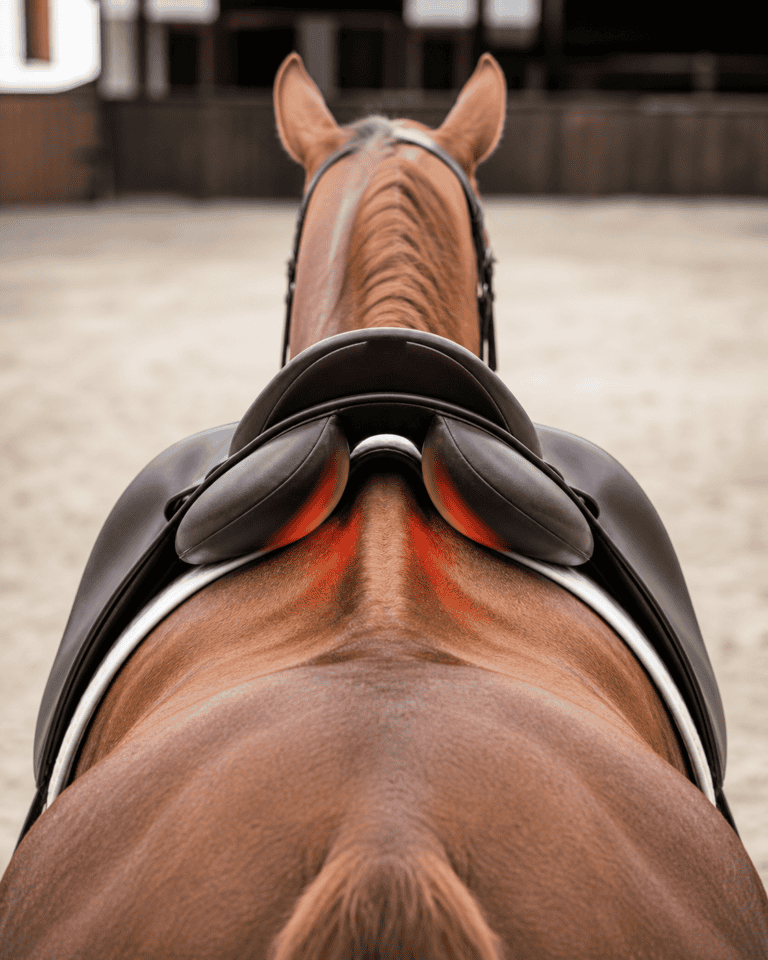
| MacKechnie-Guire and colleagues, Animals, 2019 (14 sports horses, 13 analyzed) | Each saddle was fitted by a Society of Master Saddlers Qualified Saddle Fitter. One width wider raised trot peak pressure under the front of the saddle by 8.5 percent, cut the T13 muscle profile by 14 percent and reduced T13 mediolateral movement by 6 percent. One width narrower raised peak pressure under the rear by 14 percent and reduced T13 mediolateral movement by 8 percent | One width changed pressure and back movement. Width and shape matter more than anything printed on the flap |
What nobody has measured
We found no study that isolates the cover. Claims that leather is kinder to the horse’s back, or that synthetic is, come from people selling saddles or from rider experience, not measurement. For example, the idea that leather breathes against the horse’s back while cheaper synthetics trap heat is plausible, but we found no measurement behind it, so we do not rely on it. A missing study is not proof that no difference exists. It means the question is open.
Where synthetic has a documented advantage
The best test we found was published by EquiSearch (HorseJournal) on January 31, 2001, so treat it as dated. Its findings:
- Price. The synthetic saddles tested averaged half the price of a mid-quality leather saddle or less.
- Weight. The lightest western saddle, the 17-pound Abetta Ultimate Trail Rider, weighed as little as a typical English leather saddle.
- Cleaning. The testers wrote that you just hose them off and let them air dry.
- Grip. Many testers felt even the smooth synthetic materials offered better grip than leather.
- A fit caveat. The saddles initially perched, with a good four-inch space between the withers and saddle in many cases, and they settled within three to 10 days.
Dover Saddlery’s comparison page lists synthetic saddles as available at economical prices, lightweight, easily cleaned with soap and water, low maintenance and virtually weatherproof.
Where leather has a documented advantage
Dover Saddlery lists leather saddles as breaking in for the rider’s seat, developing an attractive patina, durable with proper maintenance, offering enhanced grip for some leathers, and having good resale value if properly maintained. That page is a retailer’s, so these are advantages dealers cite, not measurements. We found no hard numbers on how much more a leather saddle resells for.
Leather also asks for upkeep, and maker advice varies:
- Antarès Sellier says to apply conditioner once or twice a month if you ride daily, to oil a new saddle not at all in its first year and then once or twice a year, and warns that too much oil can stretch the leather and make the dye seep.
- EquiSearch’s saddle care article says a very light coat of oil two or three times a year is usually enough, and warns that excess oil can make leather mushy and weak.
Antarès sells the products it recommends, so its advice favors its own range.
Side-by-side summary
| Factor | Synthetic | Leather | Strength of evidence |
|---|---|---|---|
| Price | Averaged half the price of mid-quality leather or less (2001 test) | Range of prices (Dover) | Dated test, retailer page |
| Weight | Lightest western tested: 17 pounds | Typical English leather saddle weighs about the same as that western synthetic | Dated test |
| Cleaning and upkeep | Hose off; low maintenance | Conditioning and oiling routines, which vary by maker | Test, retailer and maker pages |
| Grip | Testers felt smooth synthetics gripped better than leather (2001) | Some leathers offer enhanced grip (Dover) | Conflicting, opinion-based |
| Resale | Not addressed by our sources | Good resale if maintained (Dover) | Retailer claim, no numbers |
| Effect on the horse’s back | Not measured | Not measured | No study found |
How to decide
This section is our reading of the evidence above, not a study’s conclusion.
- Spend on fitting first. Horse & Rider UK says to have the saddle checked every six months unless your fitter recommends otherwise, because horses change shape with workload, diet and season. The annual-check figure above shows even that is not a guarantee, so it matters who does it. For horses that are hard to fit, see our guide to saddles for hard-to-fit horses.
- Look for a saddle that can be adjusted. Equine Ink says spring trees are useful for young horses or horses being brought back into work, because their bodies change in ways that affect saddle fit, and HQ magazine says the flocking in a saddle can be redistributed, removed or supplemented between full reflocks.
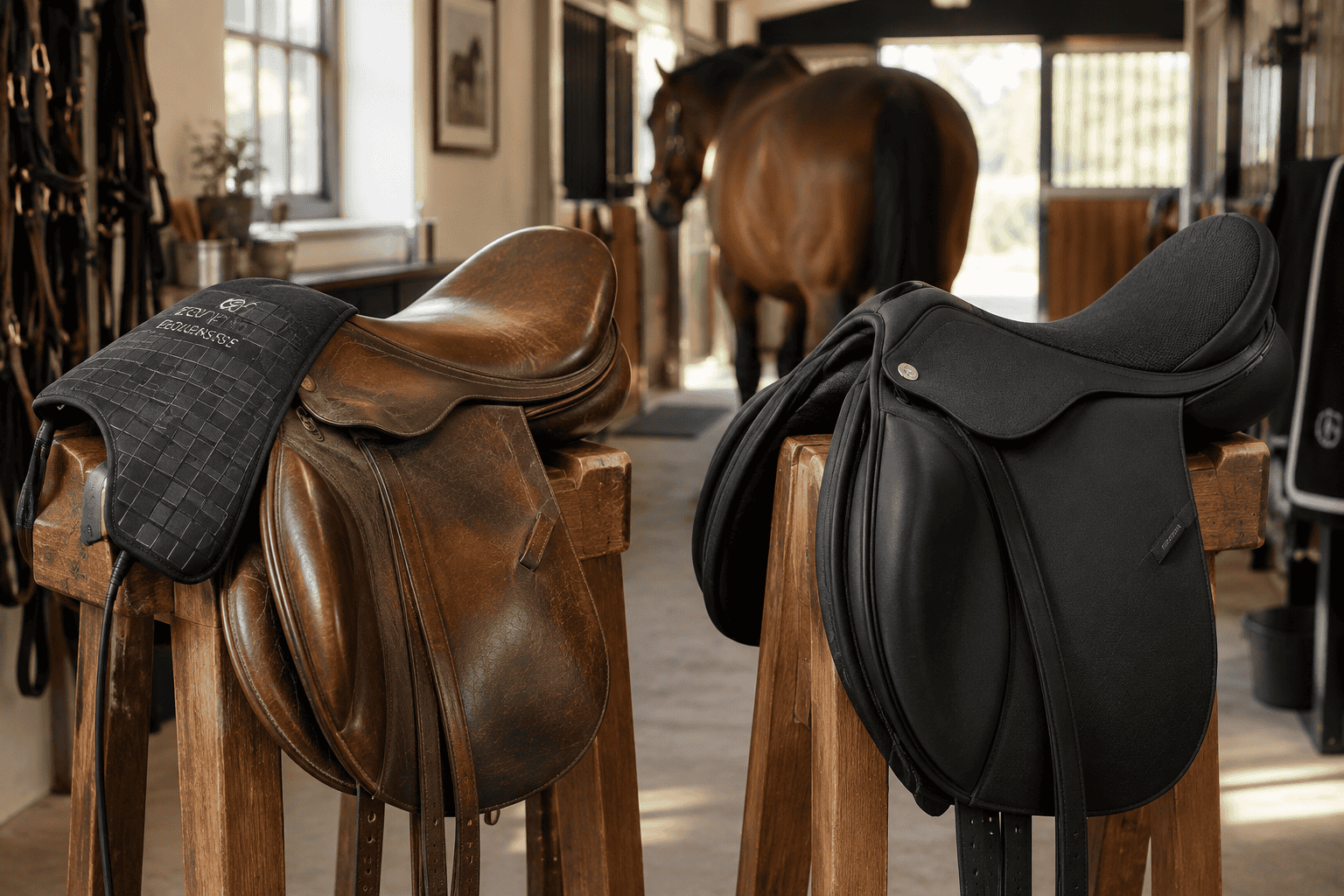
- Then pick the cover for your life. Wet weather, sharing a saddle, and wanting little upkeep point toward synthetic. One horse, one rider and years of use point toward a flocked leather saddle that can be reworked as the horse changes.
- Avoid the two traps. Buying leather because it is leather and living with a frame that does not fit, or buying synthetic to save money and then skipping the fitter.
For how fit is judged at each level, see our five levels of saddle fit. If you are weighing a used saddle of either kind, our guide to checking the tree of a used saddle covers the tests.
Frequently asked questions
Is a synthetic saddle worse for a horse than leather?
We found no study that tests this. The fit research we found does not compare covers.
Is leather worth the extra money?
Dealers cite resale value, break-in and patina. We found no numbers on resale and no measurement of benefit to the horse, so the case rests on what you value in upkeep, feel and longevity.
Do synthetic saddles fit worse?
The 2001 test found synthetic saddles initially perched about four inches above the withers in many cases and settled within three to 10 days. That test is dated and does not say a leather saddle on the same frame would behave differently.
What we could not verify
- No study isolating leather versus synthetic covers on a horse. The comparison table says so where it applies.
- Greve and Dyson’s journal and year are not stated in the Horse & Rider UK report we used. Find the original paper before relying on the exact percentages.
- The year of the Latif presentation is not stated in the article we used.
- The synthetic saddle test dates from 2001, and the grip and retailer statements are opinion.
- Resale value and breathability claims have no published numbers behind them in our sources.
References
- Dyson S, Pollard D. Application of the Ridden Horse Pain Ethogram to 150 Horses with Musculoskeletal Pain before and after Diagnostic Anaesthesia. Animals 2023;13(12):1940
- MacKechnie-Guire R, MacKechnie-Guire E, Fairfax V, Fisher D, Fisher M, Pfau T. The effect of tree width on thoracolumbar and limb kinematics, saddle pressure distribution, and thoracolumbar dimensions in sports horses in trot and canter. Animals 2019;9(10):842
- Horse & Rider UK: Ill-fitting saddles are culprits for horse and rider back pain concludes new study (Greve and Dyson, Animal Health Trust)
- The Horse: Saddle Tree Types and Pressure Distribution (Latif, Swiss Equine Research Day)
- EquiSearch HorseJournal: Try A Synthetic. We Bet You’ll Like It (January 31, 2001)
- Dover Saddlery: Advantages of synthetic and leather saddles
- Antarès Sellier: How to look after your leather saddle? (November 21, 2022)
- EquiSearch: Saddle Care and Storage Tips
- EQUUS: Testing your saddle tree
- The Horse: Seven Common Saddle Faults (Laurence Pearman)
- Horse & Country: Essential saddlery advice from the Society of Master Saddlers
- Horse & Rider UK: 15 things to know about saddlery and tack fitting
- Equine Ink: Tips for Buying a Used Saddle
- HQ Magazine: AskHQ Saddle Flocking
Disclosure: Hoof & Honest was not paid by any publication, retailer or brand named in this article. Claims trace to the published sources above, and claims we could not verify were left out or flagged.