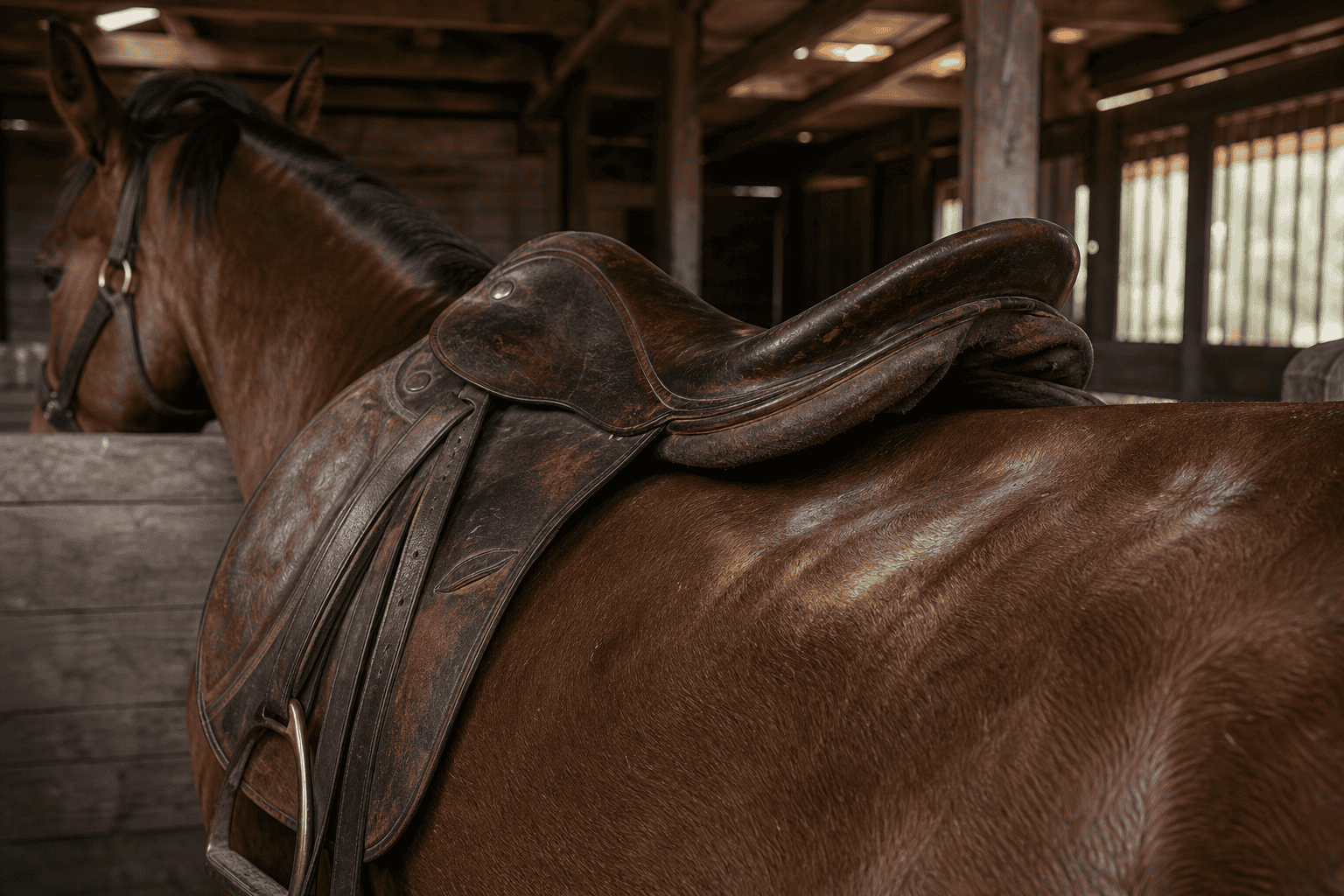
The Cheap Saddle Problem: Why the Tree You Can’t See Decides Everything
These are the numbers nobody selling you a saddle wants to lead with. In a study supported by World Horse Welfare and the Saddle Research Trust, 84% of saddles were judged likely to impair the horse’s performance. In a separate Swiss study, 90% of saddles were assessed as sub-optimally fitted — while 95% of those horses’ owners believed the fit was ideal. The gap between what riders think they know and what is actually pressing into a horse’s back is where the real damage happens, and where most of the wasted money goes.
So let us talk about what is actually inside the saddle you are about to buy, what it is doing to your horse, and where the line falls between a genuine quality investment and pure marketing markup.
The tree is the skeleton, and it is where cheap saddles fail first
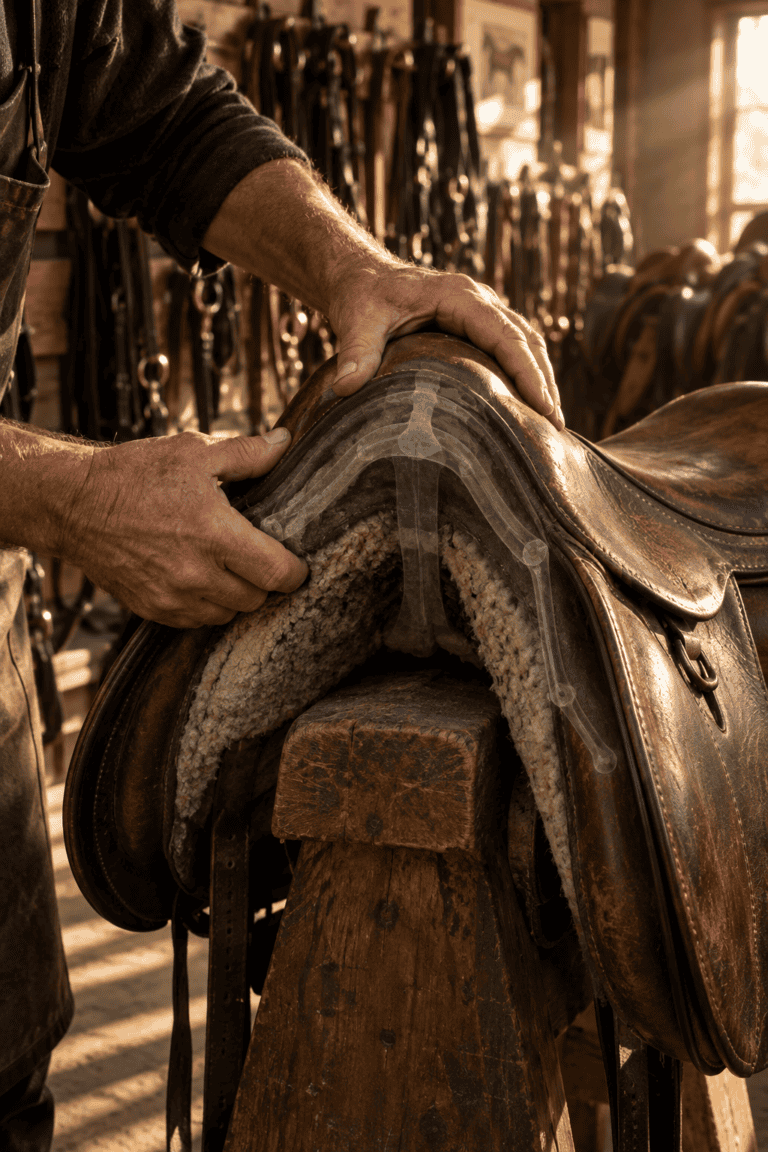
The tree is the rigid or semi-rigid frame that determines how weight distributes across your horse’s back. Cheap saddles do not fail at the leather or the stitching. They fail at the one part you literally cannot see.
The most common faults identified in the World Horse Welfare study were tree points that were too tight or sitting against the scapulae, pommels too low to give adequate wither clearance, and bridging of the panels. These are not cosmetic problems. They are structural failures, and in a budget saddle they are frequently designed in before the saddle ever touches your horse — a tree too straight to make contact through the middle of the back, too narrow, or too short for the seat length.
Can you pad your way out of a bad tree?
This is where riders spend the most money to the least effect, and the research is more interesting than the slogan suggests.
A study at New Mexico State University measured 200 roping and barrel racing horse-and-saddle combinations using a pressure mat reading 304 points across the back. It found that thicker pads increased the probability of a bad fit for roping saddles — each additional inch raising that probability by more than 23% — but did not find the same effect for barrel racing saddles, possibly because of the smaller sample.
Be careful with how far you push that finding. Other work, including Kotschwar and colleagues, found that none of the pads tested created pressures resembling an ill-fitting saddle, and that thicker pads may in some cases reduce pressure on the back. The honest summary is not “thick pads are bad.” It is that a pad changes the geometry between saddle and back, and adding thickness to a saddle that already fits badly is as likely to move the problem as to solve it.
What does not change is the order of operations. Fit the saddle first. The pad is the last layer, not the fix.
What a badly fitting saddle actually does
Compression, friction and pinching from an ill-fitting saddle produce back pain. This is not mild discomfort.
- In the New Mexico State data, 93% of the ill-fitting roping saddles showed their problems at the front of the saddle, around the pommel.
- In the Swiss study, only 10% of saddles were free of the assessed fit problems, and back pain was associated with certain of those problems — though notably not with raw pressure magnitude alone.
Over time that pressure creates bruising beneath the skin. Left uncorrected, the bruising leads to scarring, stiffness and chronic soreness. Eventually you may notice white hair patches on the withers or back — and those white spots are permanent. The pressure was severe enough, and sustained long enough, to destroy the pigment-producing cells in the hair follicles. That damage does not reverse. Those hairs are a scar recording exactly where the saddle was failing, often for months or years before anyone noticed.
The horse will not tell you clearly
Dr Joyce Harman estimates that nearly half of poorly performing or behaviourally difficult horses have a pain-based reason for their behaviour, and that a large proportion of that pain is potentially tack-related. Many horses are stoic enough to keep working through significant back pain, showing no obvious signs until the damage is advanced.
The bucking, the girthiness, the pinned ears, the refusal at fences — those are not necessarily attitude problems. That may be the horse finally saying what it has been feeling for a long time.
Where the quality floor actually sits
Saddles range from around $150 for a basic synthetic to over $6,000 for a custom fit. Do you need to spend thousands? No. But you do need to spend enough that the tree is not the compromise.
That does not mean every expensive saddle fits your horse. It absolutely does not — the Swiss data makes that plain, since owners of badly fitting saddles overwhelmingly believed their fit was ideal. Brands like Wintec and Thorowgood have engineered adjustable synthetic-tree saddles that work across a range of horses at accessible prices. A well-engineered polymer tree can be a marvel of biomechanics. A cheap polymer tree may be brittle or overly flexible, and there is no way to tell from the outside.
We break the price tiers down in more detail in our guide to what a saddle is actually worth at every price point.
The fit check matters more than the price tag
Your horse’s back shape changes with fitness, with age, with seasonal weight fluctuation. A saddle that fitted in April may not fit in October. As one researcher put it, saddle fit is transient — having it fitted once does not mean it stays fitted. Professional assessment should happen at minimum twice a year, and more often if your horse is recovering from injury or going through a major change in workload.
Here is a number that should stop you cold. When 401 riders were tested on their ability to identify correct saddle placement from photographs, they averaged 58.25% accuracy — barely better than a coin flip. Riders who had previously had a saddle professionally fitted did measurably better, which is itself an argument for paying a fitter.
Dr Sue Dyson’s work found something similar on the rider’s side: of 193 horse-and-rider combinations, only 35% of riders were correctly positioned in the middle of the saddle, riding in balance and appropriately sized for it. Over 50% sat toward the back of the saddle, 49% lacked balance, and 40% were too big for the saddle they were in.
The saddle fit problem is not just about the saddle. It is about the whole system.
What to do before you spend
- Fit the saddle before you reach for padding. A pad is a final adjustment layer, not a correction for a tree that does not match the back.
- Get a professional fitter involved before you buy, not after. The fitting fee is the cheapest insurance you will ever pay on a purchase this size.
- Learn the physical signs. After every ride, check under the pad. Uneven sweat patterns are a red flag. Dry spots mean no contact. Excessive sweat means too much pressure. Check for hair ruffling, heat spots, or sensitivity when you press along the back.
- Check wither clearance the old-fashioned way. Stand in your stirrups and see whether you can get two fingers under the pommel. It is basic, and Dyson has pointed out that riding in a saddle with a pommel too low is a poor reflection on the standard of horsemanship.
The bottom line
The brand tax is real, but so is the quality floor. Cheap saddles cut costs where you cannot inspect them, and the tree is the first casualty. Expensive saddles cut nothing — and still fit your horse wrong roughly as often as anyone else’s, because price has never been a fitting method.
A cheap saddle does not only cost you money when you replace it. It costs your horse comfort, soundness and potentially months of veterinary rehabilitation. Spend the money on a fitter. Learn your horse’s back. Then buy the saddle that actually fits it. That is not the most expensive option. It is the most informed one.
Nothing here replaces a qualified saddle fitter examining your horse in person, or a veterinarian if your horse is showing signs of pain. We describe general principles and published research; we cannot assess your horse.
Sources
- Dyson, S. — Saddle Fit and Gait Abnormalities in the Ridden Horse, Horse Sport. Reports the study supported by World Horse Welfare and the Saddle Research Trust in which 84% of saddles were considered likely to impair performance.
- Bevan, E. — Alarming statistics show high number of riders are using saddles that don’t fit, Your Horse. Source for the 193-saddle figures and the rider position and balance data.
- Dittmann, M. et al. — “Feel the Force” — Prevalence of Subjectively Assessed Saddle Fit Problems in Swiss Riding Horses, Journal of Equine Veterinary Science. Source for the finding that only 10% of saddles were free of assessed problems.
- The Role of Equestrian Professionals in Saddle Fit for Horses and Riders in the United Kingdom, PMC. Source for the Swiss figures of 90% sub-optimal fit against 95% of owners believing fit was ideal.
- How accurate are riders in assessing saddle position?, Journal of Equine Veterinary Science. The 401-participant survey averaging 58.25% accuracy.
- Evaluating saddle fit analysis, dvm360. Source for the New Mexico State University pad-thickness and pressure findings, and for Dr Joyce Harman’s estimate on pain-based behaviour.
- Western Saddle Fit Problems Revealed in Recent Study, Horse Illustrated. Further detail on the New Mexico State University methodology and pommel pressure findings.
Related on Hoof & Honest: the five levels of saddle fit · how to check a used saddle’s tree · saddles for hard-to-fit horses