Are You Too Heavy For Your Horse? (Most Riders Do The Math Wrong)
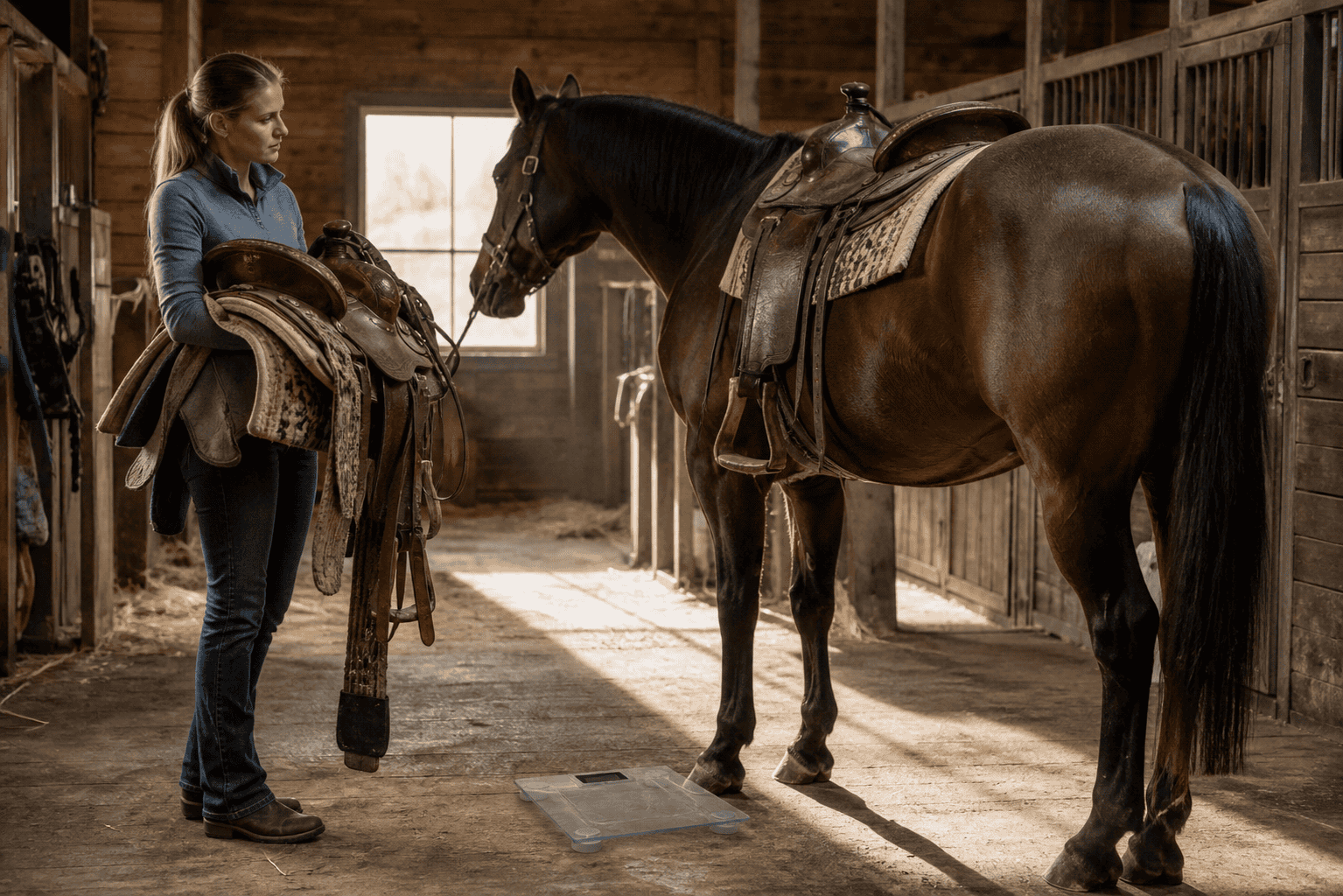
A rider who steps on the bathroom scale at 160 pounds does not put 160 pounds on the horse. By the time the saddle, pad, girth, bridle, and the boots and helmet the rider is wearing are on board, the horse is carrying closer to 200. The 40-pound gap is not a rounding error. It is roughly a fifth of everything a 1,000-pound horse is supposed to carry, and almost nobody weighs a single piece of it.
That gap has a consequence, and it has been measured. In a pilot study run by Sue Dyson and colleagues, horses went lame during ordinary flatwork under riders who were inside the accepted limit, and the tests were abandoned. In a separate study at Ohio State University, horses loaded to 30 percent of their bodyweight showed elevated creatine kinase — the enzyme that leaks into blood when skeletal muscle has been injured — immediately after exercise, 24 hours later, and 48 hours later. A horse cannot report any of that. It gets tight and sore, and starts refusing work it used to do easily.
This article works through the three published studies that the whole rider-weight debate actually rests on, and the equipment accounting that sits underneath all three. Between them, those studies tested thirty horses. The fifth-of-bodyweight figure survives as a starting point and fails as a rule — and in every one of them, the equipment was part of the measured load.
What is actually on the horse
Start with the part nobody disputes: the total load is the rider plus everything else. The problem is that most of the “everything else” has no published weight at all.
| Item | Published weight | Source |
|---|---|---|
| Western saddle (TW Saddlery Classic Western) | approx. 25 lb | Manufacturer product page |
| Lightweight western dressage saddle (TW Saddlery Western Dressage Lt) | approx. 20 lb | Manufacturer product page |
| Western dressage saddle (Contour Saddlery) | 28 lb (12.7 kg) | Manufacturer product page |
| Icelandic competition saddles used in the 2025 Söderroos study | 13.2 lb and 18.5 lb (6.0 and 8.4 kg) | Published study methods |
| Saddle pad used in the same study | 4.4 lb (2.0 kg) | Published study methods |
| Girth | Not published | — |
| Bridle with bit | Not published | — |
| Brushing or sport boots, set of four | Not published | — |
| Rider’s tall boots, helmet, body protector or air vest | Not published | — |
That table is the finding, not a limitation of the research. Outside a handful of makers who treat low weight as a selling point, saddle weight is simply absent from product pages — and what fills the vacuum is a set of ranges on retailer sites and content farms that contradict each other outright. One will state that a western saddle runs 15 to 20 pounds. Another puts the same category at 25 to 60. Those cannot both describe the object hanging in your tack room, and neither is a specification.
Weight is one of several numbers the trade declines to publish. It sits alongside the questions covered in the western saddle brands that document their tree construction and where it is built, and the shimming and correction options examined in the five levels of saddle pad.
Where the fifth-of-bodyweight figure comes from
The guideline is widely traced to the United States Cavalry and its Manual of Horse Management. That attribution needs handling carefully. Secondary sources date the manual to 1920 in some places and 1941 in others, and the 2008 research paper most often cited alongside it states only that the recommendation may have originated there. Nobody in this discussion appears to have gone back to the primary document.
What is consistent across every version of the claim is the part that gets dropped in repetition: the limit covered the rider and the equipment together. It was never a rider-weight rule.
The three studies
| Study | Horses | Loads tested | Key finding |
|---|---|---|---|
| Powell et al., 2008 J Equine Vet Sci 28(1):28–33 | 8 light riding horses | 15, 20, 25, 30% of bodyweight | No measurable change until 25%. At 30%, creatine kinase elevated immediately, at 24h and at 48h. |
| Dyson et al., 2020 Equine Vet Educ 32:527–539 | 6 test horses (from 24 evaluated), 500–600 kg | Rider:horse ratios of 10–12%, >12–15%, >15–<18%, >20% | Tests for the heavy and very heavy riders abandoned, predominantly for temporary lameness. All horses trotted sound afterwards. |
| Söderroos et al., 2025 Acta Vet Scand 67:35 | 16 Icelandic tour-riding horses, 386 ± 32 kg | 20, 25, 30, 35% of bodyweight in tölt | Physiological response relatively low. Four of fifteen never reached the lactate threshold even at 35%. |
Powell 2008 — where the number holds
Eight horses carried 15, 20, 25 and 30 percent of their bodyweight in randomly assigned trials with 14 days of rest between them. The researchers recorded work rate, heart rate, respiration rate, rectal temperature, plasma lactate and serum creatine kinase. Nothing measurable happened until the load reached 25 percent.
Two details rarely survive the retelling. The load was applied as a rider plus varying weights of tack — which is how the researchers themselves understood the question. And horses with wider loins and greater cannon bone circumference became less sore as the load increased. Conformation moves the line.
Dyson 2020 — where the number fails
Six test horses, selected from 24 evaluated, all between 500 and 600 kilograms. Four riders worked through four bands of rider-to-horse bodyweight ratio. The riding tests for the heavy and very heavy riders were abandoned, predominantly because the horses went temporarily lame. Every horse trotted sound afterwards and finished the study moving well.
Coverage of the study reports one horse going lame roughly 30 minutes into flatwork under a rider at 16.7 percent — inside the guideline, with room to spare on paper. We have not been able to confirm that specific figure against the published paper itself, only against secondary reporting of the National Equine Forum presentation, and it is flagged here on that basis.
The part that matters most is something the authors flagged against their own work. They recorded as a limitation that saddle fit was not ideal in every horse and rider combination, and that the criteria for abandoning a test were subjective. The study could not cleanly separate the weight of the rider from the fit of the saddle underneath. Dyson’s own conclusion asks for a saddle correctly fitted to the horse and to the rider, and asks for both in the same sentence.
The mechanism, as far as anyone can state it: a rider too large for the saddle sits further back than the saddle was built to place them, and the load concentrates over a smaller area of the back than the panel was designed to spread it across. The number on the scale has not changed. What the horse is carrying has. That is the same territory covered in the five levels of saddle fit, and in the Royal Veterinary College work on saddle width discussed in saddles for hard-to-fit horses.
Söderroos 2025 — where the number stops being a number
Sixteen adult Icelandic horses used for tour riding, averaging 386 kilograms, carried 20, 25, 30 and 35 percent of their bodyweight in tölt on a gravel track. Four of the fifteen horses analysed never reached the lactate threshold at all, even carrying 35 percent. Mean bodyweight ratio at the lactate threshold was 31.4 percent, with individual horses ranging from 24.6 to 36.5.
The same breed behaved differently in an earlier study. Icelandic horses used for higher riding education reached the lactate threshold at an average ratio of around 23 percent. The tour-riding horses in the 2025 study were routinely carrying tourists of varying weights over 20 to 40 kilometres a day, and the authors suggest they may have been physiologically and biomechanically adapted to it.
Conformation traits associated with greater weight-carrying capacity were a wider chest, an “uphill” build, a straight backline and a smaller hock circumference. Notably, the narrow-back and broad-back groups showed no difference — which cuts against the folk wisdom that a broad back means a strong back. The authors state plainly that correlation is not causation and that the number of horses was a limitation.
Working it out on your own horse
| Horse bodyweight | One fifth of bodyweight | Less 35 lb of tack and rider kit | Left for the rider, dressed |
|---|---|---|---|
| 900 lb | 180 lb | −35 lb | 145 lb |
| 1,000 lb | 200 lb | −35 lb | 165 lb |
| 1,100 lb | 220 lb | −35 lb | 185 lb |
| 1,300 lb | 260 lb | −35 lb | 225 lb |
The 35-pound deduction is an illustration, not a measurement of your setup. It is there to show the shape of the correction. The actual figure is one you can establish in about ninety seconds.
- Weigh yourself on the bathroom scale wearing what you actually ride in — breeches or jeans, tall boots, helmet, and body protector or air vest if you use one.
- Stand on the scale holding the saddle, then subtract your own weight. This is the number no manufacturer publishes.
- Repeat with the pad, girth and bridle together, and again with boots or wraps if the horse wears them.
- Add anything you carry out on a hack — hoof pick, phone, water bottle, saddle bag.
- Get your horse’s weight from a weighbridge if one is available, or a weight tape as a rough figure. A weight tape is an estimate, not a measurement.
- Divide the total load by the horse’s weight. Under 20 percent is the starting point, not the finish line.
What the research does not tell you
Four honest limits, stated rather than glossed over.
- Thirty horses. Powell’s eight, Dyson’s six and Söderroos’s sixteen make up the evidence base cited here. That is a small foundation for a rule applied to every horse in the world, and all three papers describe themselves in cautious terms.
- The studies measured different things. Powell measured muscle enzymes and work rate. Dyson measured gait and behaviour. Söderroos measured lactate and heart rate. They are not directly comparable, and pooling their thresholds into one number would be misleading.
- No study here isolates saddle fit from rider weight. Dyson’s team said so explicitly about their own work. Until someone runs that experiment with fit controlled, the relative contribution of the two is unknown.
- The Cavalry attribution is unverified. We could not confirm the original manual, its date, or its exact wording from a primary source. It is repeated here as an attribution, not as a fact.
We have also left out the claim, common in online discussion, that a specific breed or type can safely carry a specific higher percentage. The Söderroos results suggest training history may matter as much as breed, and no study we found supports a breed-level number.
The short version
The fifth-of-bodyweight guideline is a reasonable place to start and a poor place to finish. It has always included tack. The equipment nobody weighs is routinely 30 to 40 pounds, which is most of the margin a rider believes they have. And the load is not just mass — where it sits on the back is a variable the research has not yet been able to separate out.
Powell’s horses carried 15 and 20 percent of their bodyweight with nothing measurable happening to them, and the equipment was on the scale the whole time. Where your own horse sits is a question about your horse, your saddle and a bathroom scale — not a question anybody in a comments section can answer for you.
For the wider question of where money stops reaching the horse at all, see the seven levels of tack spending.
Disclosure
Hoof & Honest was not paid for this article, and no brand named here was given advance sight of it. This article carries no affiliate links: it concerns horse welfare rather than a buying decision, and we do not place commercial links on welfare content. The manufacturers whose saddle weights appear above were named because they publish the figure, not because of any commercial relationship.
This article is not veterinary advice. A horse showing lameness, back soreness or a change in behaviour under saddle should be assessed by a veterinarian, and saddle fit by a qualified fitter.
References
- Powell DM, Bennett-Wimbush K, Peeples A, Duthie M (2008). Evaluation of Indicators of Weight-Carrying Ability of Light Riding Horses. Journal of Equine Veterinary Science 28(1):28–33. doi:10.1016/j.jevs.2007.11.008
- Dyson S, Ellis AD, Mackechnie-Guire R, Douglas J, Bondi A, Harris P (2020). The influence of rider:horse bodyweight ratio and rider-horse-saddle fit on equine gait and behaviour: a pilot study. Equine Veterinary Education 32:527–539. doi:10.1111/eve.13085
- Söderroos D, Stefánsdóttir GJ, Ragnarsson S, Gunnarsson V, Jansson A (2025). Physiological response to weight carrying and associations with conformation traits in Icelandic horses used for tour riding. Acta Veterinaria Scandinavica 67:35, published 19 June 2025. doi:10.1186/s13028-025-00818-5
- Stefánsdóttir GJ, Gunnarsson V, Roepstorff L, Ragnarsson S, Jansson A (2017). The effect of rider weight and additional weight in Icelandic horses in tölt: part I. Physiological responses. Animal 11:1558–1566. doi:10.1017/S1751731117000556
- Clayton HM, Lanovaz JL, Schamhardt HC, Van Wessum R (1999). The effects of a rider’s mass on ground reaction forces and fetlock kinematics at the trot. Equine Veterinary Journal 31:218–221.
- National Equine Forum (March 2018). Landmark pilot study addresses effects of rider weight on equine performance. nationalequineforum.com
- University of Minnesota Extension. Guidelines for weight-carrying capacity of horses. extension.umn.edu
- TW Saddlery, published saddle weights for the Classic Western and Western Dressage Lt. twsaddlery.com
- Contour Saddlery / Natural Horseman Saddles, published saddle weight for the Western Dressage model. naturalhorsemansaddles.com