5 Saddle Pads You Should Never Buy (And 5 That Are Worth It)
The white hairs come last. By the time you can see them on a horse’s back, the pigment cells under that patch of coat have already been damaged, usually permanently, and whatever was pressing on them had been pressing for a long while before the color ever changed.
Most horses never get that far, and most riders never see it. What they see instead is smaller and much easier to explain away. A horse that hollows for the first ten minutes and then settles. One dry patch sitting in the middle of a sweat mark where everything around it came up wet. Ears going back when the girth comes up, every time, for years.
And the standard response to all of it — the response the entire saddle pad industry rests on — is to buy something soft and put it in between.
There is a good deal of published research on what happens when you do that. It gets quoted wrongly more often than it gets quoted right. This is what it actually found.
One saddle pad in four did anything at all
The cleanest version of the experiment was run at the University of Veterinary Medicine in Vienna. Same horses, same correctly fitted dressage saddle, same rider, same treadmill. The only variable that changed between runs was the pad underneath.
They tested gel, leather, foam and reindeer fur. Then they removed the pads entirely and ran the saddle bare against the horse’s back as a control.
One of the four lowered the force on the horse’s back, and it was the fur. The other three measured out the same as riding with nothing under the saddle at all.
Three of the four saddle pads were, functionally, decoration.
That finding sets up everything below, because it means the useful question about a saddle pad is never how thick it is or what it costs. It is what the thing is made of.
Why pressure matters more than softness
It helps to understand what sustained pressure does to a horse, because it does not behave like a knock or a strain. The damage works slowly and it does not announce itself.
Steady pressure squeezes the small blood vessels shut underneath it. The tissue in that spot runs short of oxygen, and it degrades across weeks of perfectly ordinary work. Nothing about that process feels like an injury on the day it happens. It feels like a horse getting a bit stiff behind, or a bit less willing than it was last spring.
Researchers working with pressure mats have proposed working thresholds above which the load is associated with back pain, and those figures are what the studies below are measuring against. Horses are also poor at telling us when they have crossed one, which is the same problem that shows up with bitting, where the early signals get read as attitude rather than pain.
5 saddle pads to avoid
1. The gel half pad
A British research group took a dozen horses whose saddles had been properly fitted and signed off by qualified saddle fitters, then slid different half pads underneath to measure the effect.
The gel half pad pushed pressure up at the front of the saddle in sitting trot, and did it again in canter. Wool and closed-cell foam both left it alone.
The suspected reason is that gel handles sideways force badly. It absorbs a straight downward impact well enough, which is exactly what it gets marketed on, but a horse’s back does not move straight down.
2. Any thick pad bought to fix a saddle that does not fit
The same Vienna group repeated their experiment using a saddle that was deliberately too wide, and the results refused to settle into anything you could act on. A pad that helped at walk did nothing at trot. Leather made things worse at both gaits.
You cannot predict which direction a saddle pad will push the load under a badly fitting saddle. Buying one to solve a fit problem is a coin toss you are asking your horse to call — and if the tree itself is the wrong width, no amount of padding reaches the problem.
3. A half pad added to a saddle that was fitted without one
This is the quiet one, and it catches careful owners more often than careless ones.
Nearly every saddle sold gets fitted over a thin cotton cloth, because that is what is on the horse when the fitter takes the template and sets the flocking. Add ten millimetres of wool or foam underneath afterwards and the fit you paid for is no longer the fit your horse is wearing. The saddle sits higher, the tree behaves as though it is narrower, and the balance point shifts back.
None of that is the half pad’s fault. It is doing exactly what any ten millimetre object does when you put it somewhere that was measured without it. If you want a half pad, the saddle needs fitting with it in place.
4. Any saddle pad that has already died
Open-cell foam and well-used wool both harden and go lumpy over time. A pad that has gone lumpy has not simply stopped helping you — it is now concentrating pressure into the lumps.
This point comes from working saddle fitters and biomechanics practitioners rather than a controlled trial, so weigh it accordingly. It is what the materials would predict, and it is worth remembering before buying a secondhand pad that looks like a bargain.
5. Any pad sold without naming what is inside it
This is the one worth arguing hardest for. Every study on saddle pads sorts its results by material. Not one sorts them by brand.
So a product page that calls something a contoured shock-absorbing comfort pad, and never names the fill, has told you nothing at all about what will happen to your horse’s back. Thickness is not a specification. Neither is a colorway, and neither is the price — as the white-label pad trade demonstrates, a $30 pad and a $150 pad frequently leave the same factory.
5 saddle pads worth buying
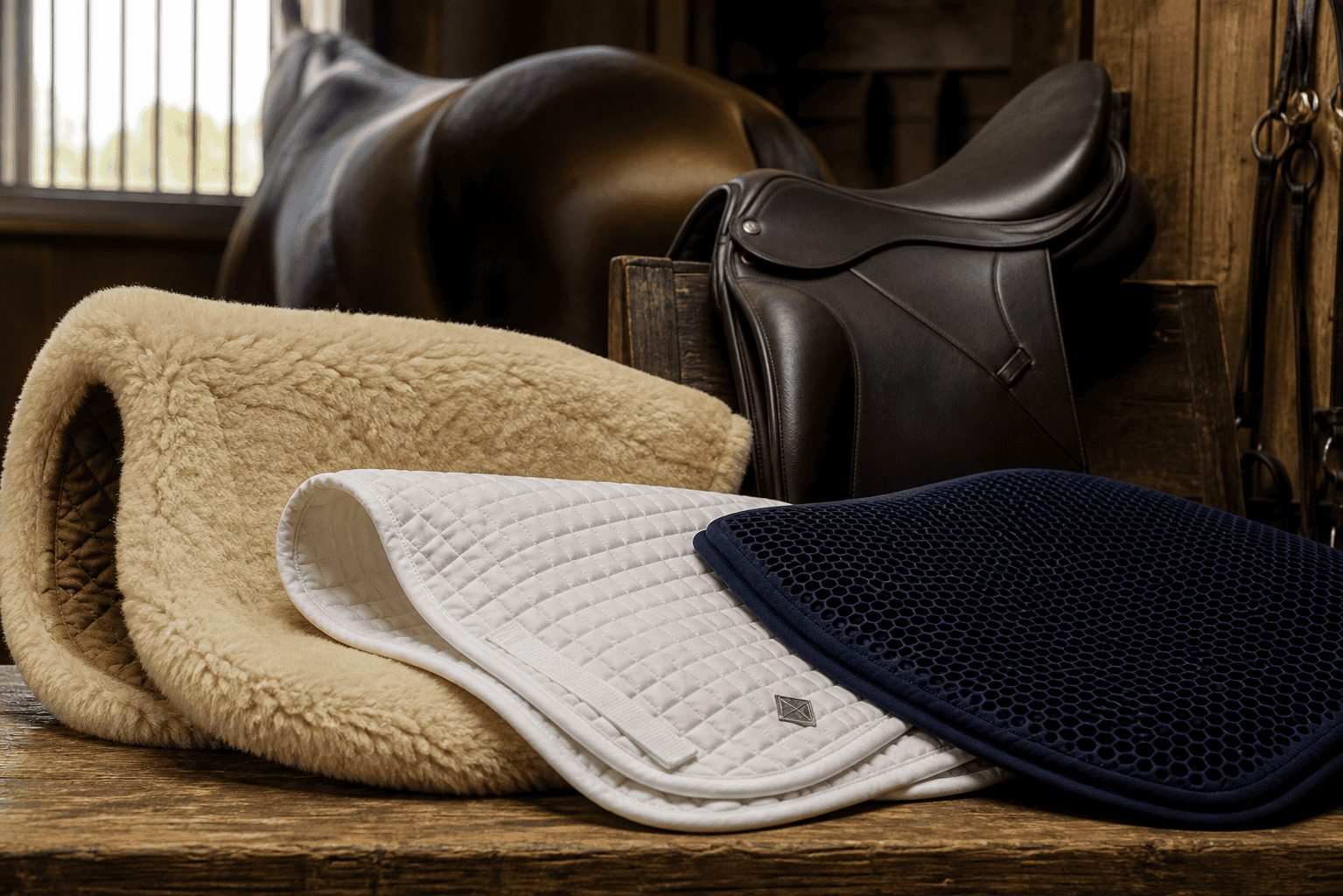
1. Real sheepskin or genuine wool fleece
Natural fleece is the only category to have cleared the bar in two separate labs. The Vienna pad that beat the other three was reindeer fur, and a Swiss group testing commercially available saddle pads a few years later found pressures were lower under sheepskin than under a thin plain numnah. Different animals, same principle.
The catch is upkeep, and it is a real catch. Sheepskin has to be washed properly and it will mat if you neglect it. A matted sheepskin has quietly stopped being the material anybody tested.
2. A wool half pad
If you have established that you actually need a half pad, wool is the evidence-backed choice. In the British study, wool produced the lowest pressure at the back of the saddle in sitting trot. It was the strongest single result in the paper.
3. Medical-grade closed-cell foam
Same study, different gait. In canter, the closed-cell foam half pad brought pressure down at the back of the saddle.
Pay attention to the words medical-grade, because they are carrying the whole claim. That specification is what separates foam that holds its shape under a rider from foam that has flattened out by your second circle.
4. A shimmable half pad — but only if your saddle drifts
The same research group fitted thin closed-cell foam shims into pocketed quarters on horses whose saddles consistently slid to one side. The saddles came back towards the centre, with the load spreading more evenly across both panels.
That is a targeted fix for a problem somebody has actually diagnosed. It wants a fitter setting it up, rather than you guessing which pocket.
5. A plain thin cotton numnah
The cheapest thing on the list, which is usually how these end.
In the Vienna work, none of the saddle pads made a fitting saddle meaningfully worse, and none except the fur made it better. Under a saddle that is right, the pad is a small adjustment in either direction. Get the saddle wrong and you are asking a piece of fabric to do the job of a qualified fitter and a flocking hammer.
Where to find the five worth buying
Every study above sorts its results by material, never by brand, so these link to the material rather than to a maker. Read what the fill actually is before you buy, because that is the only specification that predicted anything in the research. These are affiliate links and a purchase through one earns us a small commission at no extra cost to you.
- Real sheepskin and wool fleece pads — the only category to clear the bar in two separate labs
- Wool half pads — lowest pressure at the back of the saddle in sitting trot, the strongest single result in the British study
- Closed-cell foam half pads — check the listing says medical-grade closed-cell, because open-cell foam is a different material and flattens
- Shimmable half pads — only if a fitter has diagnosed a consistent drift and is setting the shims
- Plain thin cotton numnahs — the cheapest thing on the list, and under a saddle that fits, the correct answer
Nothing in the gel or thick-pad sections above is linked, deliberately. Those are the products the research found either did nothing or raised pressure, and there is no version of this article where we take a commission on them.
The thing that matters more than any saddle pad
Across all of this research the pad moved the numbers a little, and the saddle set the level that everything else was measured from.
An afternoon of a fitter’s time will change your horse’s back more than any saddle pad you can buy. If you are unsure where your own setup sits, the five levels of saddle fit is the place to start, and it is worth knowing what you are actually paying for when you buy a saddle before you spend anything further on padding.
There is one detail from the Swiss study that is hard to let go of. After every ride, the team asked their rider which pad she had liked best, and they wrote her answer down next to the pressure readings. They never published whether the two agreed.
Sources
- Kotschwar AB, Baltacis A, Peham C (2010). The effects of different saddle pads on forces and pressure distribution beneath a fitting saddle. Equine Veterinary Journal 42(2):114–118. PubMed
- Kotschwar AB, Baltacis A, Peham C (2010). The influence of different saddle pads on force and pressure changes beneath saddles with excessively wide trees. The Veterinary Journal.
- MacKechnie-Guire R et al. (2021). Effect of a Half Pad on Pressure Distribution in Sitting Trot and Canter Beneath a Saddle Fitted to Industry Guidelines. Journal of Equine Veterinary Science. ScienceDirect
- Dittmann MT et al. (2022). The effects of different saddle pads on the pressure exerted on the equine back by correctly fitting dressage saddles. Pferdeheilkunde 38(2):100–108.
- Dittmann MT et al. (2021). Feel the Force — Prevalence of Subjectively Assessed Saddle Fit Problems in Swiss Riding Horses. Journal of Equine Veterinary Science 99:103388.
- Review of pressure mat studies of saddle fitting to the horse’s back (including the Nyikos 2005 pressure thresholds). Computer Methods in Biomechanics and Biomedical Engineering. Taylor & Francis
- Centaur Biomechanics — half pad fit and material degradation. Practitioner guidance rather than a controlled trial, and cited as such above.
Hoof & Honest was not paid for this article. No manufacturer paid for a mention here, supplied a product, or saw a draft before publication. Some links on this page are affiliate links, and a purchase made through one earns us a small commission at no extra cost to you. What passed was decided before any link was added, and what failed stays unlinked. As an Amazon Associate we earn from qualifying purchases. Where an opinion appears above, it is labelled as one.
This article is general information, not veterinary advice. If you suspect your horse has back pain, or you find white hairs, dry spots or swelling under the saddle area, speak to your vet and work with a qualified saddle fitter.