The 5 Levels of Saddle Pad (Most Riders Never Get Past 2)
MATTES sells a set of six felt shims for $54.60. Each one is five millimeters thick, and slid into the pockets of a correction half pad they let you change how a saddle sits on a horse by up to thirty millimeters, without anybody touching the flocking. The shims aren’t the interesting part. The interesting part is what that product assumes, which is that the saddle that fitted your horse in spring may not fit it by fall.
Most riders never get anywhere near that question. They buy a pad that matches the saddle cloth, put it on, and replace it when it looks tired. That works fine under a saddle that fits. Under one that doesn’t, the pad is the only thing between a pressure problem and the horse’s back, and very little of what is sold for that job has been tested independently.
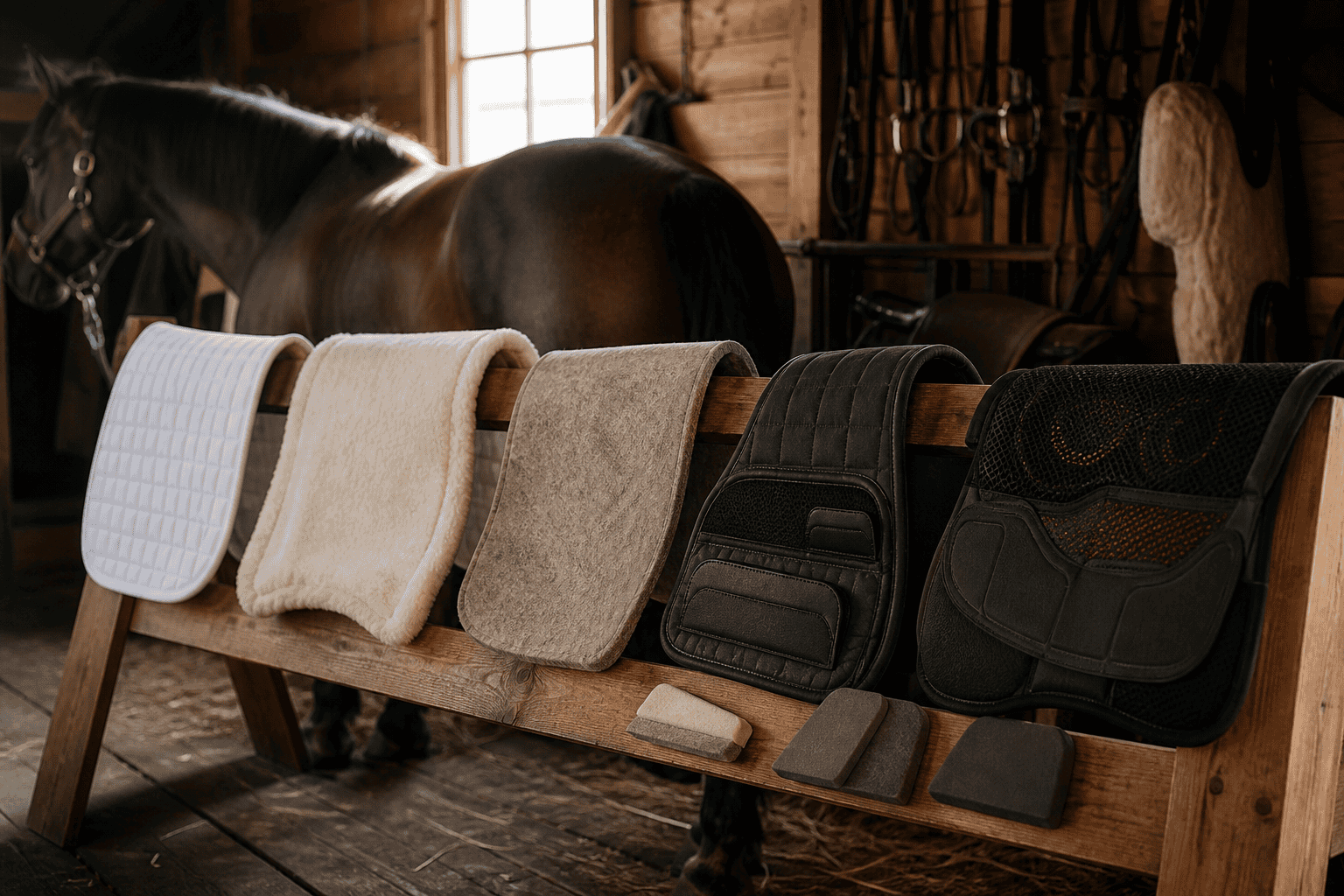
We sorted saddle pads into five levels, from a plain cotton square to therapeutic and correction systems, and checked each level against the published pressure research and the manufacturers’ own specifications. The short version is that the material matters far more than the price, wool has the strongest evidence of anything on the shelf, and the top of the market is where claims start to outrun the evidence. Level two, the correction pad, is the one most riders skip, and for a horse whose shape is changing it does more than anything above it.
The five levels of saddle pad at a glance
| Level | What it is | What it does for the back | Evidence behind it | Best for |
|---|---|---|---|---|
| 5 | Cotton and fleece | Sweat barrier, protects the saddle | Neutral under a fitting saddle in lab tests | Light work under a saddle that fits |
| 4 | Wool and wool felt | Spreads load, wicks moisture | Wool gave the lowest rear pressure in a half pad study; natural fleece beat gel, foam and leather in another | Most horses in regular work |
| 3 | Premium wool and memory foam | As level 4, with better materials and build | Material-level evidence only; no brand has been independently tested | Riders who put in a lot of hours |
| 2 | Correction pads with shims | Adjusts fit as the horse changes shape | Shims helped saddles that drift to one side in a controlled study | Young, returning or changing horses |
| 1 | Therapeutic and impact-tech pads | Impact polymers, infrared textiles, specialist builds | Mostly manufacturer claims | Specific, diagnosed needs, with a vet involved |
Level 5: cotton and fleece
This is where almost everyone starts. A cotton all-purpose pad or a fleece-lined square, usually at the cheapest end of the tack store wall. Cotton breathes, washes easily and is soft against the coat. Fleece adds a little cushion and handles sweat reasonably well.
What cotton doesn’t do is change the load on the horse’s back in any meaningful way. That isn’t a disaster. When researchers at the University of Veterinary Medicine in Vienna ran the same horses under the same correctly fitted saddle with different pads, most pad materials measured roughly the same as riding with no pad at all. A thin cotton pad under a saddle that fits is doing its job, which is keeping sweat off the leather.
The trouble starts when a cotton pad is expected to do more than that. It won’t make up for a saddle that bridges, rocks or pinches, and as a pad wears thin and lumpy it can start concentrating pressure rather than spreading it. We went through the research on this in detail in our breakdown of which saddle pads raise pressure and which lower it.
When level 5 is enough: light arena work, a saddle that has been fitted recently, and a pad that still lies flat. Wash it, check it for lumps, and replace it once it has thinned out.
Level 4: wool and wool felt
Wool is the level where the evidence starts to show a difference. In a 2021 study published in the Journal of Equine Veterinary Science, MacKechnie-Guire and colleagues put different half pads under saddles that had been fitted to industry guidelines. The wool half pad gave the lowest pressure at the back of the saddle in sitting trot. The gel half pad pushed pressure up at the front.
The Vienna group found something along the same lines. The only pad in their test that lowered the load on the horse’s back was natural fur, and a later Swiss study found lower pressure under sheepskin than under a thin plain pad. What these results share is natural fiber, not a brand.
In Western riding, pressed wool felt has been the standard for a long time. Felt conforms to the horse’s back over time, handles moisture well and doesn’t hold heat the way closed synthetics can.
How to choose a wool pad
- Start from the saddle. The pad should fill the space between tree and back without lifting the saddle noticeably higher than it was fitted.
- Use one pad of the right thickness. Stacking two pads makes the setup less stable and can load the withers.
- If you add a half pad to a saddle that was fitted without one, have the fit checked again with the pad in place.
- Look at the underside after a ride. Even sweat marks are a good sign. A dry patch surrounded by wet hair means that spot is taking too much pressure.
Level 3: premium wool and memory foam
Level three uses the same materials as level four, made to a higher standard. The pads cost more because of what goes into them and how they’re built, not because of new technology.
5 Star Equine is a good example on the Western side. The company says it has been making wool felt pads for more than 25 years, describes its pads as 100 percent USA made from 100 percent pure wool, and publishes a compression figure for its felt of 6.0 PSI. That is more specification than most pad makers give you, and it is still a manufacturer figure, not an independent test.
On the English side, Ogilvy Equestrian builds its half pads around removable memory foam inserts. Its jump half pad offers three insert options: 1.25 inch for maximum shock absorption, 1 inch for closer contact, and a thinner, denser half-inch foam. Being able to swap the insert, instead of buying a new pad, is the practical advantage.
Be clear about what this level can’t show you. No saddle pad study we found tests brands. They test materials. A premium wool pad has the wool evidence behind it; the premium itself has none.
The cost-per-ride question
Premium pads are often sold on longevity, and the math is real, but it depends entirely on lifespan. A $300 pad that lasts ten years at four rides a week works out to about 14 cents a ride. A $40 pad replaced every year costs $400 over the same decade. If the cheap pad lasts three years instead of one, the gap disappears. Manufacturers rarely publish how long their pads hold their shape, so treat any cost-per-ride pitch as an estimate you’ll need to check against your own pads.
Level 2: correction pads with shims
Horses change shape. A young horse in training puts on muscle behind the withers over a single season. A horse coming back from time off loses topline. A saddle fitted in March is fitted to the horse as it was in March.
Correction pads exist for exactly that gap. They carry pockets that take thin shims, so the fit can be adjusted in small steps as the horse changes.
What the main systems offer
| System | Shim material | Layout | Adjustment | Price checked |
|---|---|---|---|---|
| MATTES Correction System | POLY-FLEX felt, 5 mm per shim | Front, or front and rear pockets, 3 shims per pocket | Up to 30 mm | $54.60 for a 6-shim set |
| ECP 6-Pocket Correction Half Pad | Memory foam | Six pockets, two front, two middle, two rear, 3 shims each | Front lift, middle fill, or front and rear | $65.95 for the pad with shims |
| ThinLine shim pads | ThinLine foam | Varies by model | Varies by model | Varies by model |
ECP describes the six-pocket layout as allowing a front lift for higher withers, middle fill for swayed backs, or a front-and-back combination for flatter backs. MATTES says its shims give the same pressure relief as a good quality new saddle padded with wool and horsehair. Both are company descriptions.
ThinLine makes a bigger claim. The company describes its foam as moving impact sideways across the pad instead of up into the rider’s spine, and calls itself the only product endorsed by spinal surgeons, master saddlers and veterinarians for sore backs, saddle fit and kissing spine. We could not find the endorsements themselves published anywhere independent, so read that as ThinLine’s own statement.
The research support for shims is narrow and useful. The same group behind the half pad study fitted thin closed-cell foam shims into pocketed pads on horses whose saddles consistently slid to one side, and the saddles came back toward the center. That is a fix for a problem somebody has identified. It is not a general upgrade, and it doesn’t fix a tree that is the wrong width, which is the problem covered in the five levels of saddle fit.
Before you shim anything
- Have a qualified saddle fitter assess the horse and the saddle together.
- Find out whether the problem is left-right (drift), front-back (tipping or bridging), or width. Shims can help the first two. Width needs the saddle adjusted.
- Add one shim at a time and check the sweat pattern after each change.
- Book a recheck whenever the horse’s workload or condition changes noticeably.
Level 1: therapeutic and impact-technology pads
This is the most expensive level and the least tested. The products here are real and some of them are well made. Most of what is said about them comes from the people selling them.
Classic Equine Zone Series. Classic Equine describes the Zone material as a polymer that changes its properties on impact, and says the same technology is used in protective gear for bull riders, race car drivers and professional football players. The ContourPedic version pairs a felt top with a closed-cell foam bottom and is made in Granbury, Texas. This is a Western pad for disciplines with a lot of concussion, such as roping, barrel racing and hard stops.
Back On Track. The Welltex fabric has ceramic particles fused into the fibers, which the company says reflect the horse’s own body heat back as far infrared radiation, increasing circulation and helping muscles relax. Back On Track tells owners to introduce Welltex products gradually. We did not find independent equine research confirming the circulation claims under a saddle, so treat this as a warm-up and comfort product, not a treatment.
EcoGold Secure XC. A cross-country pad with breathable high-density foam in the seat area and a non-slip underside, made in Canada and listed at $190. The SmartPak listing names Phillip Dutton, Buck Davidson, Karen O’Connor and Boyd Martin as riders who use it.
SaddleRight. Custom pressed wool felt Western pads starting at $435. SaddleRight markets an upgrade with extra core thickness for horses with topline atrophy, kissing spine or a mild dropped back.
If your horse has a diagnosed back condition, the pad is one small part of managing it. Your vet and a fitter should decide what goes under the saddle, not a product page.
Saddle pad price ladder
These are prices we checked at the listed retailer or manufacturer in September 2026. Prices change, and custom options push the top end higher.
| Product | Level | Price | Where checked |
|---|---|---|---|
| ECP 6-Pocket Correction Half Pad (with shims) | 2 | $65.95 | Equine Comfort Products |
| MATTES correction shims, 6-piece set | 2 (add-on) | $54.60 | MATTES US shop |
| EcoGold Secure XC Saddle Pad | 1 | $190.00 | SmartPak |
| SaddleRight custom Western pad | 1 | From $435 | SaddleRight |
| SaddleRight Grizzly and Phoenix models | 1 | $550 | SaddleRight |
Signs your horse is telling you the pad setup is wrong
- Dry patches in an otherwise even sweat mark after work
- White hairs appearing under the saddle area
- Hollowing for the first part of a ride before settling
- A shortened stride or reluctance to collect
- Ears back or tension when the girth is done up
- A saddle that consistently slides to one side
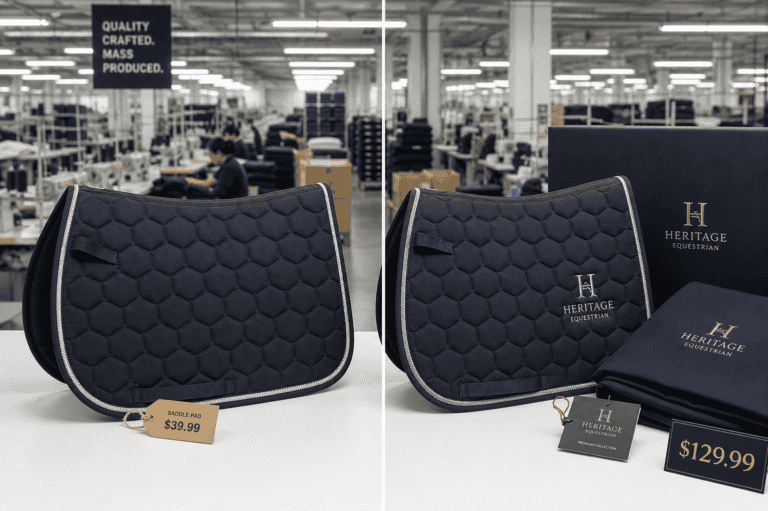
None of these point to a pad on their own. Most of them point back to the saddle. If you are shopping by price, the white-label pad trade is worth reading too, because the price on a pad tells you surprisingly little about where it was made.
What we could not verify
- Claims that the Zone material is the same as what is used in football helmets or military tactical gear. Classic Equine’s own product page names protective gear for bull riders, race car drivers and professional football players, not helmets or military use.
- A widely repeated claim that 5 Star wool pads give three times the compression protection of synthetics. We could not find it on 5 Star’s own site.
- The founding story and named competition riders often attached to Ogilvy. Ogilvy’s product pages do not name either.
- A split-back design on SaddleRight pads for kissing spine. SaddleRight’s Western pad page describes a thicker core upgrade, not a split.
- Independent confirmation of ThinLine’s endorsements from spinal surgeons, master saddlers and veterinarians.
Where to start
For most horses, the useful upgrade is from level five to level four, plus a fitter’s visit. Wool is the one material with repeated research support, and a fitter is the only person who can tell you whether a correction pad would help or whether the saddle itself needs changing. Everything above that is for a specific problem you’ve identified, not something every horse needs.
References
- Kotschwar AB, Baltacis A, Peham C (2010). The effects of different saddle pads on forces and pressure distribution beneath a fitting saddle. Equine Veterinary Journal 42(2):114–118. PubMed
- Kotschwar AB, Baltacis A, Peham C (2010). The influence of different saddle pads on force and pressure changes beneath saddles with excessively wide trees. The Veterinary Journal. PubMed
- MacKechnie-Guire R et al. (2021). Effect of a Half Pad on Pressure Distribution in Sitting Trot and Canter Beneath a Saddle Fitted to Industry Guidelines. Journal of Equine Veterinary Science. ScienceDirect
- Dittmann MT et al. (2022). The effects of different saddle pads on the pressure exerted on the equine back by correctly fitting dressage saddles. Pferdeheilkunde 38(2):100–108.
- MATTES: Correction System Shims, English. Product specification and price, checked September 2026. MATTES US
- Equine Comfort Products: 6-Pocket Quilted Correction Half Pad. Product specification and price, checked September 2026. Equine Comfort Products
- 5 Star Equine Products: company homepage and FAQ (years in business, USA manufacture, wool content, compression figure). 5 Star FAQ
- Ogilvy Equestrian: Classic Jump Memory Foam Half Pad, product page. Ogilvy
- Classic Equine: Zone ContourPedic Felt Pad, product page. Classic Equine
- Back On Track USA: Welltex technology page. Back On Track
- ThinLine: Therapeutic saddle pad for horse and rider backs (endorsement and impact claims). ThinLine
- SmartPak: EcoGold Secure XC Saddle Pad listing (price, construction, named riders), checked September 2026. SmartPak
- SaddleRight: Custom Western Saddle Pads, product page and pricing, checked September 2026. SaddleRight
Hoof & Honest was not paid for this article. No manufacturer named here paid for a mention, supplied a product, or saw a draft before publication. Where a claim comes from a manufacturer, it is attributed to that manufacturer above. Claims we could not trace to a published source are listed as unverified, not repeated as fact.
This article is general information, not veterinary advice. If you suspect back pain, or notice white hairs, dry spots or swelling under the saddle area, speak to your vet and work with a qualified saddle fitter. Horses that are hard to fit may need a different saddle rather than a different pad. We covered some options in saddles built for hard-to-fit horses.