The Only 7 Girth Brands You Can Still Trust
Advertising disclosure: this article contains affiliate links. If you buy through them, this site may earn a commission at no additional cost to you. Hoof & Honest was not paid by any brand named here, and no brand was given advance sight of this article.
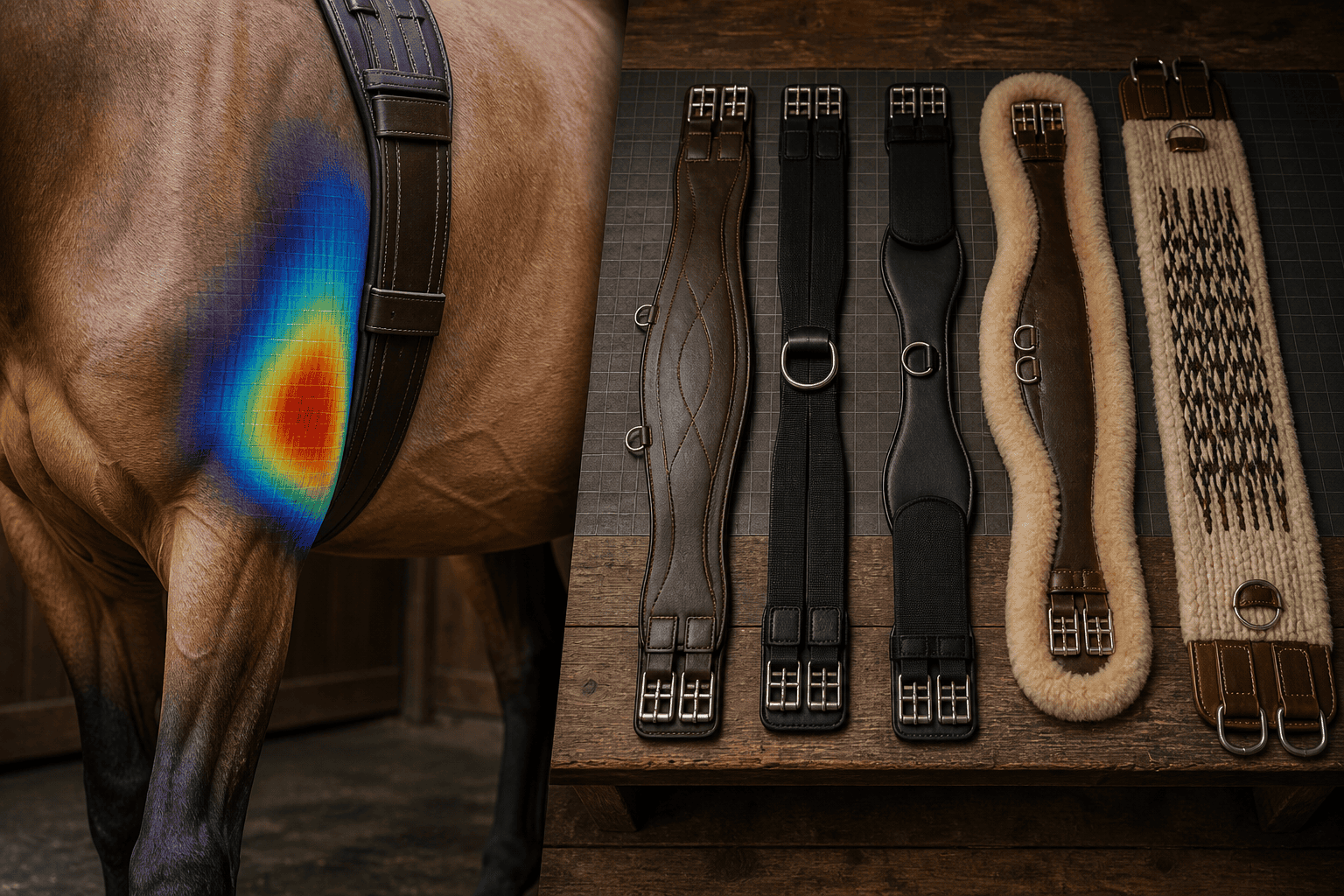
On a standard girth, the pressure does not land where it looks like it should. When researchers at the Animal Health Trust in Newmarket put a calibrated pressure mat under the girths of ten horses, the peak force did not spread down the sternum where the webbing is widest. It concentrated in a narrow band over the muscle just behind the elbow, which is where girth galls and pressure sores tend to appear.
The team then cut a girth shaped to avoid that band and tested it against each horse’s own girth. Peak pressure under the standard girths ran as much as 98% higher. That shaped girth became the Fairfax girth, and as far as this review could find, it is the only girth design on the market with peer-reviewed pressure data behind it. Fairfax helped pay for the study.
This article checks seven girth and cinch brands against four things a buyer can verify before spending anything: Fairfax, Stübben, Total Saddle Fit, Mattes, Prestige Italia, Weaver Leather and Professional’s Choice. The four are where the girth is made, what it is made of, whether the design follows a mechanical logic you can trace, and what kind of evidence stands behind the performance claim. All seven clear the bar for trust. Only one has published evidence for what its girth actually does, and that evidence is not independent. The last section is worth reading before you replace a girth at all. In a University of California, Davis review of girthy horses, the stomach proved a more productive place to look than the tack room.
How the seven were checked
Every check below can be run by anyone with a browser. None of them depends on how a girth looks on the rack or feels in the hand.
- Build location stated by the maker. A town and country where the girth is made, as opposed to “designed in” or “imported”.
- Material stated specifically. “Mohair, 27 strands” counts. “Premium materials” does not.
- A design logic you can follow. The shape or construction has to do something mechanical that you can trace from cause to effect.
- Evidence grade for the performance claim. Peer-reviewed, in-house testing, an unnamed study, or nothing at all.
To make the list, a brand needed to clear at least one of the first three checks. The fourth decides how much weight to put on what the brand says its girth does.
The scorecard
| Brand | Made where (per maker) | Material stated | Design logic | Evidence for the claim | Verdict |
|---|---|---|---|---|---|
| 1. Fairfax | Yes — Walsall, England | Yes — leather, anatomical cut | Yes — shape drawn from a pressure map | Peer-reviewed, co-funded by Fairfax | Pass, with note |
| 2. Stübben | Not confirmed for the Equi-Soft | Yes — elastic-ring body, three cover options | Yes — tension stays constant through breathing | Unnamed “comparative study”, not public | Pass, with note |
| 3. Total Saddle Fit | No — listed as “Imported” | Yes — leather body, stainless hardware | Yes — moves the billets back off the shoulder | In-house pressure test | Pass, with note |
| 4. Mattes | Yes — Myślenice, Poland | Yes — Australian lambskin, own tannery | Yes — cut-back edges; crescent shape for forward-slipping girths | None published | Pass |
| 5. Prestige Italia | Yes — Trissino, Italy | Yes — leather | Yes — air-cushion panel under the sternum | None published | Pass, with note |
| 6. Weaver Leather | Partly — Mt. Hope, Ohio, for handcrafted lines | Yes — 100% mohair, 27-strand | Yes — mohair stretches and recovers; AirFlex vents heat | None published | Pass, with note |
| 7. Professional’s Choice | Not confirmed | Yes — ventilated limestone-based neoprene | Yes — grip lets you girth less tight | None published | Pass, with note |
The column that sorts this category is evidence, not build location. Six of the seven make a sensible mechanical argument, but only one has put its girth under a pressure mat in a study that went through peer review. Most of the girths in a typical tack store fail the first three checks before evidence even comes up.
What the pressure research actually found
The study behind all of this was published in The Veterinary Journal in 2013 by Rachel Murray of the Animal Health Trust, with Russell Guire of Centaur Biomechanics, British Equestrian Federation consultant master saddler Mark Fisher, and Vanessa Fairfax of Fairfax Saddles. It ran in two parts. First, a pressure mat under the girths of 10 horses located the peak-pressure zones. Second, 20 elite horses and riders were ridden in their own girth and in the new design, in a double-blind crossover.
| Measure | Result |
|---|---|
| Maximum force under the standard girth | 22% higher (left), 14% higher (right) |
| Peak pressure under the standard girth | 76% higher (left), 98% higher (right) |
| Forelimb protraction with the shaped girth | 6–11% greater |
| Hindlimb protraction with the shaped girth | 10–20% greater |
| Carpal (knee) flexion with the shaped girth | 4% greater |
| Tarsal (hock) flexion with the shaped girth | 3% greater |
All of these differences were reported at P < 0.01. The authors opened by noting that girths are frequently blamed for veterinary and performance problems while research into how a girth interacts with the horse is sparse. Speaking to Horse & Hound in September 2013, Murray put it more bluntly: “There is not nearly enough rigorous scientific research into tack.”
A 2025 paper in the journal Animals complicates the picture. It rode six horses in rising trot in a plain straight girth and in a Fairfax short dressage girth, each at initial tensions of 8 kg and 16 kg, and measured saddle pressure and forelimb movement. Its authors describe it as the first study of what girth tension does to saddle pressure. They found that changing girth type or tightness had very little effect on how the limbs moved. With six horses against the earlier twenty, a different gait, and a different measurement setup, it does not overturn the 2013 result. It does mean the question is still open.
Which design addresses which problem
| Problem | Design approach | Example on this list | Evidence status |
|---|---|---|---|
| Peak pressure behind the elbow | Anatomical cut drawn around measured hot spots | Fairfax | Peer-reviewed (manufacturer co-funded) |
| Saddle pulled forward into the shoulder | Cut-back sides move the billets rearward | Total Saddle Fit Shoulder Relief | In-house pressure test |
| Girth restricting chest expansion | Elastic rings or elastic center panel | Stübben Equi-Soft; Total Saddle Fit StretchTec | Unnamed study (Stübben); none (StretchTec elastic) |
| Girth creeping forward during the ride | Crescent shape | Mattes | Manufacturer description |
| Chafing along the girth edge | Lambskin cut back along both long edges | Mattes Soft Edge | Manufacturer description |
| Pressure on the sternum | Air-cushion panel | Prestige Italia RP | Manufacturer description |
| Heat and sweat under a western cinch | Mohair fiber; ventilated neoprene; molded airflow channels | Weaver Leather; Professional’s Choice | Manufacturer description |
1. Fairfax: the only girth with a peer-reviewed study, and Fairfax co-funded it
Fairfax Saddles builds in Walsall, in the English Midlands, and says its saddlers work there “using a mixture of traditional techniques and cutting-edge technology.” What sets the girth apart is the order the work was done in. The pressure mapping came first, the shape was drawn to avoid the hot spots the mat had found, and only then was the girth tested blind against the horses’ own girths. According to a USDF feature on girth design, Fisher campaigned to keep the design under wraps until the London 2012 Olympics were over, because the British squad believed it gave them an advantage.
The note on the verdict is about independence. The paper discloses that it was funded by UK Sport lottery money through the BEF World Class Programme and by Fairfax Saddles, and that Vanessa Fairfax is employed by the company. That disclosure is exactly how a study should handle it, and it still means the product was validated by research its maker helped pay for. A later Royal Veterinary College-approved study of girth design in galloping racehorses, presented at the British Equine Veterinary Association congress in 2021, was also funded by Fairfax. Fairfax’s own site now calls its designs “scientifically proven”. Given the 2025 result above, “promising and under-replicated” is closer to the record.
Fairfax lists its girths at £245 to £295 on its UK site (checked September 2026). US pricing depends on the importer.
Check current Fairfax girth listings
2. Stübben Equi-Soft: the most unusual construction, and a study nobody can read
The Equi-Soft does not use a solid strap. Its body is a system of elastic rings in three sections, with the most give in the middle one. As the ribcage expands and contracts, the rings move with it, so tension stays roughly constant and doesn’t clamp tighter on every deep breath. The body fans out around the chest. Covers attach with hook-and-loop, and you can choose lambskin, vachette leather or neoprene.
Stübben also publishes fitting instructions that are worth following for any girth. Center the girth on the girth line, take both sides up evenly, never adjust one side alone, and don’t over-tighten, because over-tightening defeats the design.
The note on the verdict is the claim. Stübben states that in “a comparative study of different girths”, every horse without exception had a lower heart rate in the Equi-Soft. That study is not named, cited or publicly available anywhere this review could find, so it belongs in the marketing column until someone produces it. Two practical points: Stübben North America says the standard Equi-Soft is for flatwork only, with a separate stud girth for jumping, and the cover is sold separately from the girth.
Check current Stübben Equi-Soft listings
3. Total Saddle Fit: sound geometry, company-run testing
The Shoulder Relief girth works on geometry rather than cushioning. The center sits forward in the natural girth groove, while the sides are cut back about two inches to meet the billets further back. That brings the billets toward vertical, so tightening the girth stops dragging the saddle forward into the shoulder. The company notes that the top of the scapula rotates back about two inches as the foreleg reaches forward, which is the arc this design keeps the tree out of. The StretchTec version adds a triangular elastic center panel for the roughly 1.5 cm of chest expansion that comes with breathing at walk and trot. Liners swap between leather, neoprene and fleece.
There are two notes, and both are about how the case gets made. The patent the company cites, US D843,666, is a design patent. It protects how the girth looks, not how it works, so it is not evidence of function. The widely quoted figure of 24.8% less pressure than a standard girth comes from the company’s own BodiTrak testing, not from an independent lab or a journal. Retail listings describe the girth as “Imported” without naming a country.
What earns trust here is the return policy. Total Saddle Fit offers a 90-day “Used & Abused” return, which puts the risk on the company, not on you. That matters with a girth, because nobody can tell from a photograph whether the geometry suits your particular horse.
Check current Total Saddle Fit listings
4. Mattes: the most transparent supply chain on the list
E.A. Mattes says it has sourced lambskins from Australia for more than three decades, using only the top grade of hide, with its own inspector checking batches before they ship. The skins go through the company’s own tannery. Around 100 staff then make the finished goods at its plant in Myślenice, Poland, where production has run since 1992, while sales and management sit in Germany. Mattes also describes itself as one of the few authorized suppliers of lambskin seat covers to Mercedes-Benz.
Two details on the girths earn their price. The Soft Edge design cuts the lambskin back generously along both long edges, so the rim of the girth can’t dig in and chafe. The crescent girth is built for a horse with a short back, a broad ribcage or a narrow chest, where a conventional girth creeps forward every ride. If the whole saddle is creeping forward, or has to be girthed uncomfortably tight to stay put, the girth is probably not the root cause. Tree shape is the first suspect, as covered in the saddles that are worth the money for hard-to-fit horses.
What you trade for all this is maintenance. Lambskin has to be washed regularly with a suitable detergent, and Mattes itself warns that dark or brightly dyed skins can mark a horse once sweat gets involved. A neglected lambskin girth mats and stops doing the one thing you paid for.
Check current Mattes girth listings
5. Prestige Italia: made where it says, with an unproven panel
Prestige Italia has designed and made saddles and leather goods in Trissino, in the province of Vicenza, since 1974, when the company still traded as Appaloosa. Vicenza is one of Europe’s major tanning districts, and Prestige designs and manufactures there instead of licensing an Italian name onto work done elsewhere.
The RP girth, for “Relax and Performance”, uses a round panel that forms a cushion of air between the girth and the sternum. The stated aim is to spread pressure over a wider area, keep the solar plexus clear, and let the girth follow the ribcage instead of rubbing against it.
The note is evidence. That explanation comes from Prestige, and no published pressure study behind the RP turned up, so what you’re buying is a reasoned design from a maker that controls its own production, not a demonstrated result. On sizing, at least one retailer, Our Saddlery, tells buyers to order the RP 10 cm longer than their usual size. In other words, it fits short. Check with the seller before you order.
Check current Prestige Italia girth listings
6. Weaver Leather: the best mohair cinch, from a company that is no longer family-owned
Weaver began in 1973 as the Fryburg Shoe Shop, founded by Harry A. Weaver in Mt. Hope, Ohio. Its 100% mohair roper cinches are woven from Angora goat fiber, 27 strands across, and handcrafted in Holmes County. The material is the argument. Mohair can be twisted and bent without breaking down, it wicks moisture away from the skin, and although it stretches to the shape of a particular horse, it recovers toward its original length and doesn’t stay deformed. For a synthetic option, the patented AirFlex line uses molded airflow channels and a white foam chosen because it doesn’t absorb heat the way black neoprene does.
There are two notes. The first is labeling. Weaver says many of its products are handcrafted in Mt. Hope. Its March 2021 acquisition announcement describes a domestic manufacturing operation supported by “deep, global supplier partnerships”, and the catalog runs from hand-tied mohair to basic rayon. Read the individual product page, not the brand name. The second is ownership, which buying guides rarely mention. Weaver spent about five years under the private equity firm River Associates before Blue Point Capital Partners acquired it in March 2021, with CEO Jason Weaver partnering in the deal. Nothing about that makes the mohair worse, but “family shop in Amish country” is no longer an accurate description of the company.
If you ride western, the cinch is only half of the fit question. Our look at the western saddle brands you can still trust covers the other half.
Check current Weaver mohair cinch listings · Check Weaver AirFlex listings
7. Professional’s Choice: an honest consumable
According to the company, Professional’s Choice was founded in 1976 by Dal Scott and introduced the original Sports Medicine Boot. The SMx VenTECH cinch uses a ventilated, limestone-based neoprene liner with a waffle pattern. The grip is the real feature: a cinch that holds its position doesn’t need cranking tight. The liner peels off the webbing for washing, and the roller buckle and center D-rings are stainless steel.
The note comes straight from the company. Professional’s Choice recommends replacing the cinch at least every two to three years depending on use, the VenTECH warranty runs six months, and replacement neoprene liners are not sold. When the liner wears out, the whole cinch goes. That is an unusually frank description of a consumable, and the cinch does the consumable job well. Just don’t buy it expecting an heirloom.
Check current Professional’s Choice VenTECH listings
Before you buy a girth: rule out the horse first
A horse that pins its ears, snaps or swings away when the girth comes up is usually shopped for as a tack problem. Veterinarians at the University of California, Davis reviewed the records of every horse referred to their hospital for girthiness between 2004 and 2016, 37 horses in total. Here are the final diagnoses:
| Final diagnosis | Horses |
|---|---|
| Gastric ulceration | 12 |
| Orthopedic problems | 10 |
| Other conditions, including liver abscessation, vena cava aneurysm, sternum pain and urinary tract infection | 10 |
| Ill-fitting saddle | 3 |
| Reproductive tract neoplasia | 1 |
Of the 13 horses that were scoped, 12 had gastric ulcers. A later review of the study notes that all of those horses improved on omeprazole and 10 of the 12 stopped being girthy altogether. Read that carefully. These were referral cases, and the scoped horses were chosen for scoping, so 92% is not the ulcer rate among girthy horses in general. The narrower lesson holds, though: when girthing is a serious, persistent problem, the stomach is the most productive first place to look. Saddle fit explained only 3 of the 37 cases. If you’re checking the saddle anyway, the five levels of saddle fit sets out what an assessment should cover.
How to check a girth before you buy it
- If the horse is girthy, start with the vet, not the catalog. Ask about gastroscopy and a lameness and back exam before you change tack.
- Look behind the elbow. Rubs, galls or white hairs in the band just behind the elbow match where the 2013 study found peak pressure, which points toward a girth-shape problem.
- Match the shape to the horse. A girth that creeps forward suggests a crescent shape. A saddle pulled into the shoulder by forward-angled billets suggests a cut-back design like the Shoulder Relief.
- Find out how the claim was tested. Peer-reviewed, in-house or “a study” with no name: each deserves a different level of trust.
- Look for a build location, not a design location. “Imported” and “designed in” don’t tell you where the girth was made.
- Check the return terms. Fit can only be judged on the horse, so a used-return policy is worth more than a long warranty.
- Tighten evenly and gradually, and not harder than needed. Earlier studies used girth tensions from 6 kg to 20 kg, so riders vary enormously, and every design here can be over-tightened past the point where it helps.
What we could not verify
These gaps are stated here rather than left out.
- Build location for three brands. No manufacturer-stated build location turned up for the Stübben Equi-Soft or the Professional’s Choice VenTECH, and Total Saddle Fit girths are listed only as “Imported”.
- Stübben’s heart-rate study is referenced by the brand but not named or published anywhere this review could locate.
- Total Saddle Fit’s 24.8% pressure figure comes from company testing and has not been independently replicated.
- Prestige’s air-cushion explanation is the manufacturer’s. The sizing guidance comes from a retailer, not from Prestige.
- Current Fairfax girths versus the 2013 study girth. The study tested the design sold at the time as the Fairfax Performance Girth, and the 2025 study used a Fairfax short dressage girth. Whether today’s range is identical in shape to either was not confirmed.
- US retail prices vary by importer and retailer. Only Fairfax’s UK list prices are quoted here.
Anecdotal rider testimonials and retailer “best girth” roundups were left out entirely.
Related reading
The pad between saddle and horse fails in the same silent way a girth does. The saddle pads you should never buy covers the white-hair and pressure-point warning signs. For where girth spending sits against everything else on the horse, see the seven levels of tack spending.
References
- Murray R, Guire R, Fisher M, Fairfax V (2013). Girth pressure measurements reveal high peak pressures that can be avoided using an alternative girth design that also results in increased limb protraction and flexion in the swing phase. The Veterinary Journal 198(1):92–97. doi:10.1016/j.tvjl.2013.07.028. sciencedirect.com
- Murray R et al. (2013). A girth designed to avoid peak pressure locations increases limb protraction and flexion during flight. BEVA Congress clinical research abstract, Equine Veterinary Journal. Funding and competing-interest statements. onlinelibrary.wiley.com
- The Effect of Girth Design and Girth Tension on Saddle-Horse Pressures and Forelimb Stride Kinematics in Rising Trot (2025). Animals 15(17):2540. mdpi.com
- Girth design in galloping racehorses influences limb kinematics, under-girth pressures and force distribution (2021). BEVA Congress clinical research abstract, Equine Veterinary Journal. Funded by Fairfax Saddles. onlinelibrary.wiley.com
- Horse & Hound (September 2013). Fairfax girth scientifically proven to enhance equine performance. horseandhound.co.uk
- United States Dressage Federation (2015). Girth Up. usdf.org
- Millares-Ramirez EM, Le Jeune SS (2019). Girthiness: Retrospective Study of 37 Horses (2004–2016). Journal of Equine Veterinary Science 79:100–104. doi:10.1016/j.jevs.2019.05.025. sciencedirect.com
- Can All Behavioral Problems Be Blamed on Equine Gastric Ulcer Syndrome? Review summarizing the omeprazole response in the UC Davis girthiness cohort. ncbi.nlm.nih.gov
- Fairfax Saddles: girth range, UK list prices and Walsall manufacture (checked September 2026). fairfaxsaddles.com
- Stübben North America: Equi-Soft girth design and the “comparative study” claim. stubbensaddles.com. Flatwork-only guidance: stubbennorthamerica.com
- Total Saddle Fit: StretchTec Shoulder Relief Girth, design patent D843,666, in-house BodiTrak figure and 90-day return policy. totalsaddlefit.com
- E.A. Mattes: production, tannery and Myślenice plant. e-a-mattes.com. Company history and Mercedes-Benz supply: e-a-mattes.com
- Prestige Italia: company history and Trissino manufacture. prestigeitalia.com. RP sizing guidance: oursaddlery.com
- Weaver Leather (2013). Past, Present and Future: Weaver Leather LLC Celebrates 40 Years. weaverbrands.com
- Business Wire (18 March 2021). Blue Point Makes Local Platform Acquisition of Niche Market Leader Weaver Leather. businesswire.com
- River Associates (March 2021). Weaver Leather is Sold to Blue Point Capital. riverassociates.com
- Weaver Equine: mohair and alpaca cinches. weaverequine.com
- Professional’s Choice: SMx VenTECH Western Cinch, warranty, replacement interval and liner availability. profchoice.com