The 5 Levels of Tack Room (Most Barns Never Get Past 2)
A saddle can go into a tack room in November and come out in spring with a stiff, cracking seat, a gray bloom of mold along the flaps, and a wool pad underneath it chewed down to felt at the corners. None of that takes neglect. It takes an unheated room between a manure pile and a hay loft, holding the most valuable portable equipment on the property, built out of whatever space was left once the stalls were finished.
Tack rooms tend to move through the same five stages, and most of them stall at the second one, because by then the floor is clear and the room looks organized. Looking organized and protecting the gear inside are two different jobs.
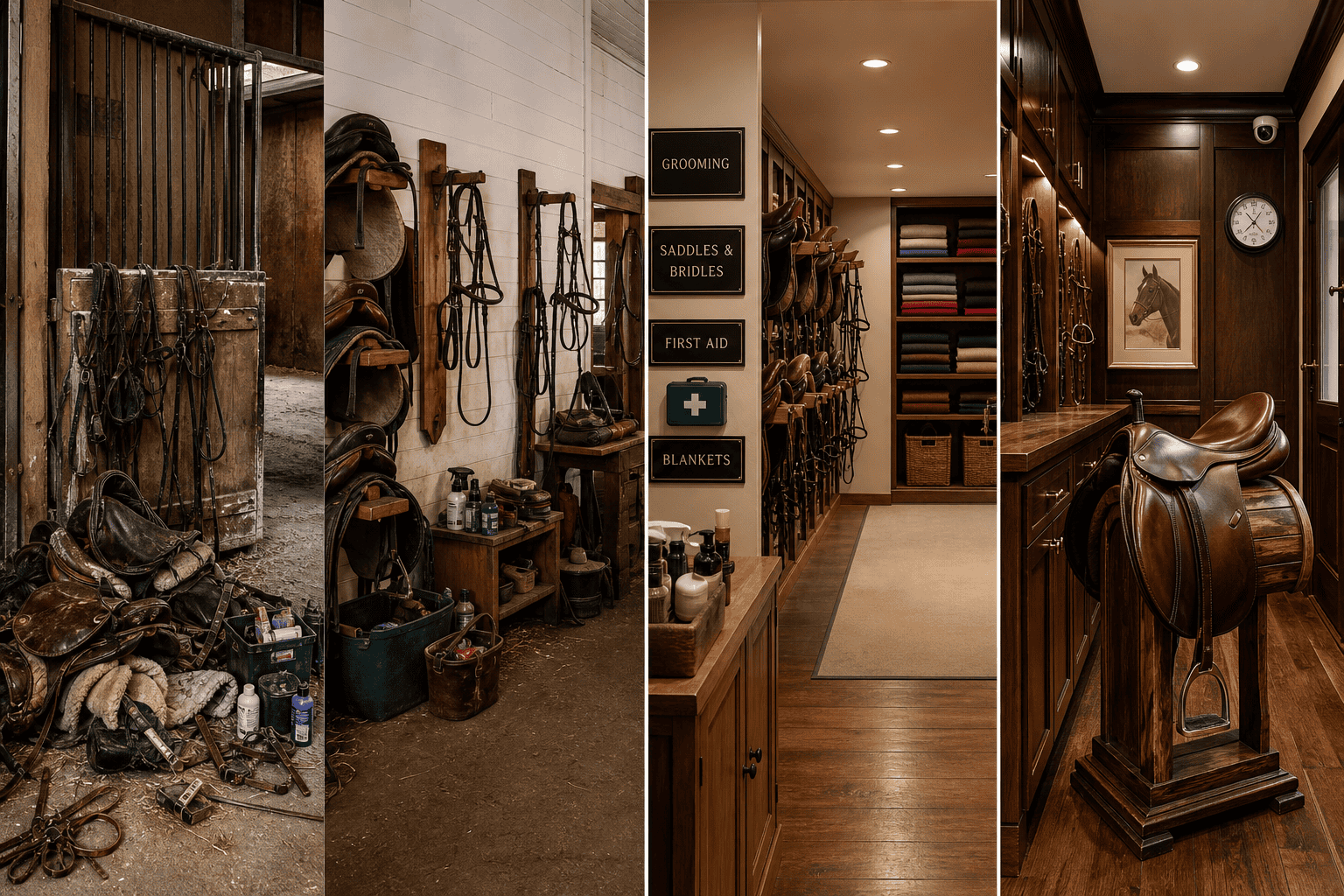
This article ranks all five levels, from the floor pile to the showroom, and marks what each one fixes and what it leaves broken. The short version: the jump from Level 2 to Level 3 costs almost nothing and changes how the room works every day. Level 4, climate and security, is the only level that directly protects the money on the wall. Level 5 is a choice, not a requirement.
The five levels at a glance
| Level | What it looks like | What it fixes | What it leaves broken | Cost to reach |
|---|---|---|---|---|
| 1. The Floor Pile | Saddles on the ground, bridles on stall doors, supplies in three corners | Nothing | Pests, moisture, damage, lost time | None |
| 2. Hooks and Shelves | Wall racks, bridle hooks, a pegboard, a grooming shelf | Gear off the floor, visible, easier to reach | No system; everything still lives everywhere | Low: racks, hooks, lighting |
| 3. The Smart Workflow | Dedicated zones laid out by how the barn is actually used | Daily flow; gear gets put back | Climate and theft | Close to zero: mostly rearranging |
| 4. The Vault | Insulated, humidity-controlled, locked, lit, watched | Mold, cracking, freeze damage, break-ins | Nothing essential | Moderate to high: insulation, dehumidifier, locks, cameras |
| 5. The Showroom | Island workspace, cabinetry, lounge, heat | Makes the room somewhere people want to be | Nothing; this is preference | High, but optional |
Level 1: The Floor Pile — where every barn starts
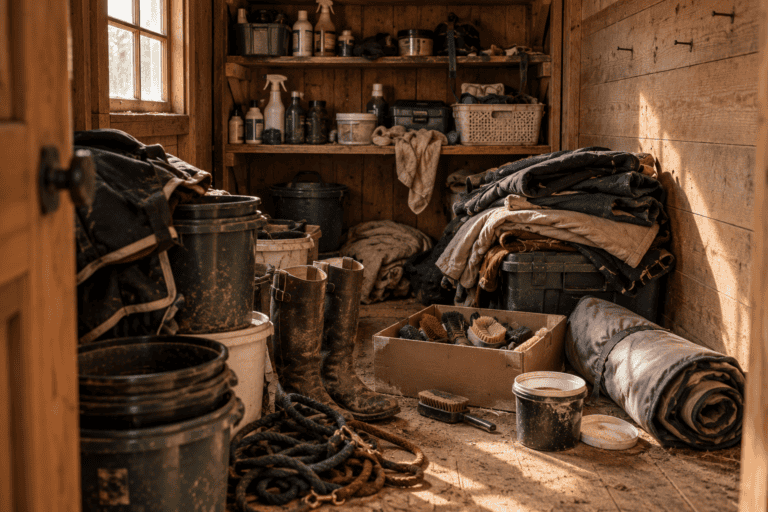
Saddles stacked on the ground, bridles draped over stall doors, grooming supplies scattered across the barn with no rhyme to where anything goes. You walk in for one bit, one girth, one pad, and twenty minutes later you are still digging. The lost time is the cheap part.
Everything on the floor is within reach of rodents, and they do not need much of a way in. Wildlife damage guidance from the Cooperative Extension system puts the threshold at any opening larger than a quarter inch for house mice and larger than half an inch for rats, which describes most barn walls, doorframes, and cable runs. Once inside, rodents chew leather, shred wool pads for nesting, and gnaw at wiring. Gear stacked in corners picks up moisture from the floor and the walls as well, and leather that stays damp is where mold starts.
You will also hear that neatsfoot oil, applied before storage, is edible and draws rodents to the saddle. That claim circulates widely in barn circles, but we could not find a primary source that tested it, so treat it as lore rather than fact. What conservators do document is that soiled or undisturbed items are the most prone to pest attack, which points to the same practical habit either way: clean tack before it goes into storage, and don’t leave it untouched for months.
Barns start here because tack storage sits at the bottom of the build list. Stalls come first, then paddocks, and the room that holds the most expensive portable equipment on the property becomes whatever is left over. The way out does not start with buying organizers. It starts with pulling everything out, checking what is damaged, and committing to one rule: no leather on the ground, ever.
Level 2: Hooks and Shelves — the comfort zone
This is where most barns plateau, because it feels like enough. Saddle racks go on the wall, bridle hooks go up beside them, maybe a pegboard and a shelf for grooming supplies. The floor is clear and nobody complains.
Barn designers will tell you that this basic layer is where most of the value sits. John Blackburn of Blackburn Architects told Stable Management that tack storage “is pretty basic. Function is most important,” and Joe Martinolich of CMW, Inc. pointed out in the same piece that you get a lot of value from the basics before any finish work. Wall-mounted racks free up the floor space that portable racks eat, and bright, even lighting turns finding a girth from a headlamp search into a glance.
The trouble is that this level solves the visibility problem and leaves the workflow untouched. Hooks and shelves without a system still mean everything lives everywhere. The objects are organized; the way people move through the room is not. Riders still hunt for the missing girth and untangle bridles while the lesson waits. Looking organized is the enemy of being organized, and Level 2 is where that trap closes.
Level 3: The Smart Workflow — zones, not more storage
This is where the real leap happens, and it barely costs anything. Level 3 is not about buying more storage. It is about laying the room out according to how the barn actually uses it every day, in dedicated zones, each with a purpose, a location, and a rule: everything that lives there belongs there, and everything that does not gets moved.
| Zone | Where it goes | What lives there |
|---|---|---|
| Grooming | Nearest the entrance or grooming area | Brushes, sprays, clippers, towels |
| Tack | Primary wall | Saddle racks and bridle hooks, arranged by horse or by rider |
| Medical | Clearly marked, never blocked | Veterinary supplies and first aid |
| Seasonal | Back of the room, or out of it entirely | Off-season blankets, spare gear, show equipment |
The ordering rule underneath the table is simple: what you reach for every ride sits closest to the door, and what you touch twice a year sits farthest from it. Winter blankets in July are dead inventory taking up the best real estate in the room. A heavyweight turnout that spends five months a year on the horse needs somewhere clean and dry to spend the other seven, which is part of why turnout blankets that last a decade tend to belong to owners who store them properly between seasons.
The medical zone deserves a special word. It holds the one kit you need fastest in an emergency, and it is the one most likely to disappear behind a stack of blankets. Mark it, keep it clear, and make sure everyone at the barn knows where it is.
The tack storage industry sells products, not systems: racks, hooks, and bins rather than layouts. A barn with a dozen hooks and no zones is still at Level 2 with better hardware. Divide the space by how you actually move through it, not by how it looks in a catalog photo. A tack room that works for your barn will always beat one made for Instagram.
Level 4: The Vault — climate and security
This is where the tack room stops being storage and starts protecting an investment. Picture a hard cold front in January. The next morning every bottle of fly spray and shampoo on the shelf has frozen and split, and the saddle is so stiff it feels like plywood. Freeze-thaw cycles and damp springs do the rest, and by April the leather is cracking.
What climate does to leather
| Condition | What happens | Source |
|---|---|---|
| Relative humidity above 65% | Conditions favor mold growth on leather; worse with poor air circulation | Canadian Conservation Institute |
| Relative humidity below 30% | Leather loses internal moisture; shrinkage, distortion, and tears | Canadian Conservation Institute |
| Cooler, stable temperature | A 5 °C (about 9 °F) drop slows chemical degradation by roughly half | Canadian Conservation Institute |
| Below freezing | Water-based liquids freeze and split their containers; leather stiffens | Basic physics |
The practical target sits between the two humidity danger lines. We use roughly 40 to 55 percent relative humidity as a working band because it keeps a comfortable margin from both; that band is our recommendation, not a published standard. A hygrometer costs less than a bottle of leather conditioner and tells you where the room actually is. In damp climates, a dehumidifier sized for the room is not optional. Insulate the walls so the room holds a steady temperature instead of swinging with the weather. The same humidity and airflow problems that grow mold on a saddle also land in your horse’s lungs, which is covered in the five levels of stable air quality.
Security
Climate is half of this level. In November 2023, thieves cut through the perimeter fence at The Urban Farm, a nonprofit in Denver’s Central Park neighborhood, broke into the tack room, and took more than $22,000 in saddles, bridles, girths, and stirrups, much of it fitted to individual horses, according to Denver7. Debi Metcalfe, founder of Stolen Horse International, puts the principle bluntly: “An ounce of prevention is worth a pound of cure.”
The measures recommended by Stolen Horse International’s NetPosse and by Texas A&M extension specialists overlap closely:
- Lock the room. A lock doesn’t make theft impossible; it makes it slower, and time on the property is what thieves avoid. Keypad or smart locks that lock behind every person remove the “someone forgot” problem.
- Motion-sensor lighting around the barn and tack room entrances.
- Night-vision cameras at entrances and storage areas, with warning signs posted.
- A sturdy, windowless room with door and window sensors where windows exist.
- Permanent identification on the tack itself, such as a branded or engraved ID number, so stolen gear can be traced and identified at resale. The Urban Farm’s saddles carried engraved nameplates for exactly this reason.
- Don’t advertise the room. This one is our own advice rather than a published guideline: a door marked “Tack Room” tells a stranger exactly where the valuables are. Leave it unmarked.
If the saddles on the wall cost what the middle and upper tiers of the seven levels of tack spending cost, the room around them has to be built like it matters. A wooden box with a padlock a screwdriver can defeat is not storage. It is a liability.
Level 5: The Showroom — the heart of the barn
At the top level, the tack room is organized, climate-controlled, and secure, and it is also somewhere people want to be. B&D Builders, a firm that specializes in high-end equestrian facilities, lists the features that define this tier on its own site: a multifunctional central island that balances efficiency and aesthetics, and a lounge with comfortable seating, a wet bar, stained glass accents, and paneled walls. A fireplace or heating system, the firm notes, extends the room’s usability beyond riding season.
The island is the piece that matters most. It turns the room from storage into a workshop: a surface to clean tack, lay out the day’s gear, and repair a strap without balancing it on a hay bale. Heat matters for the same reason, not as luxury but because a room people can use in February is a room that stays in use, and a room in use stays organized.
One piece of advice from this tier applies to every level below it. B&D co-founder Daniel Glick told The Plaid Horse in June 2025 not to shoehorn storage in, because “we never have less tack, we always have more.” Plan every tack room for more gear than you own today.
None of this requires a six-figure budget. Martinolich’s line in Stable Management covers it: “As long as it is organized, the details are up to your personal taste.” The Level 5 mindset is treating the tack room as the heart of the barn rather than the leftover space. The cabinetry is optional.
How to move your tack room up a level
- Empty the room and inspect everything. Separate what is damaged, what needs cleaning, and what belongs somewhere else.
- Seal the gaps. Anything wider than a quarter inch is a mouse entrance. Pack openings with steel wool or copper mesh and back larger gaps with quarter-inch hardware cloth.
- Get all leather off the floor. Wall-mounted saddle racks and bridle hooks first; everything else after. In a small room, 11 tack room hacks for small spaces covers DIY racks, hooks and door storage.
- Clean before you store. Soiled, undisturbed items are the most prone to pest attack and mold.
- Zone the room by use. Daily items nearest the door, the medical kit marked and clear, seasonal gear at the back or elsewhere.
- Put a hygrometer on the wall. If relative humidity sits above 65 percent, add a dehumidifier before anything else.
- Lock, light, and mark. A lock that closes behind every person, motion lights at the entrance, and permanent ID on every saddle.
Most barns can reach Level 3 this weekend and Level 4 within a season. The best tack room isn’t always the one with the biggest budget. Sometimes it’s the barn that already has the bones, waiting for someone to see it for what it could become.
What we could not verify
- Neatsfoot oil attracting rodents. Widely repeated; no primary source found. Included above as lore, not fact.
- A specific ideal temperature for leather storage. Figures such as 60–70 °F circulate online, but the conservation guidance we reviewed recommends avoiding extremes and keeping storage cool and stable rather than naming a single range, so we did not give one.
- The 40–55 percent humidity band is our own working target, placed between the published mold and dryness thresholds. It is not a published standard.
- The average value of tack in a typical tack room. We found no survey data, so the article gives no figure.
References
- Stephens, S. — “The Perfect Tack Room,” Stable Management, May 13, 2016. Quotes from John Blackburn (Blackburn Architects) and Joe Martinolich (CMW, Inc.). stablemanagement.com
- Canadian Conservation Institute — “Caring for leather, skin and fur,” Preventive conservation guidelines for collections. Mold risk above 65% RH, dimensional damage below 30% RH, temperature and degradation rate, pest susceptibility of soiled objects. canada.ca
- Cooperative Extension (Wildlife Damage Management) — “Rodent Exclusion Methods.” Entry thresholds of 1/4 inch for house mice and 1/2 inch for rats; exclusion materials. extension.org
- Denver7 — “Over $22K in horse equipment stolen from nonprofit farm in Denver,” November 2023. The Urban Farm tack room break-in. denver7.com
- NetPosse / Stolen Horse International — “20 Tips To Help Prevent Tack Theft,” updated October 2025, including the quote from founder Debi Metcalfe. netposse.com
- Gibbs, P. and Wall, L. H. (Texas A&M University System, Cooperative Extension) — “15 Steps to Minimizing Theft of Horses and Equipment,” January 2020. horses.extension.org
- B&D Builders — “High-End Features to Elevate Your Horse Barn.” Tack room islands, lounges, and heating. banddbuilders.com
- The Plaid Horse — “B&D Builders Crafts Equestrian Spaces,” June 24, 2025, including the quote from co-founder Daniel Glick. theplaidhorse.com
Hoof & Honest was not paid for this article, holds no sponsorship or brand relationship with any builder, architect, or organization named in it, and no one quoted was given advance sight of it. Every factual claim traces to the published sources above; claims that could not be verified are either left out or labeled as such.