12 Cowboy Hat Brands Ranked Worst to Best
Advertising disclosure: this article contains affiliate links, placed only on brands ranked number nine through one that are sold through retailers we can link to. If you buy through them, this site may earn a commission at no additional cost to you. Hoof & Honest was not paid by any brand named here, and no brand was given advance sight of this article. Research completed October 2026.
The Stetson name on the band of a cowboy hat does not tell you who made it. The company that built the original in Philadelphia ceased manufacturing around 1970. Today Stetsons are made in Garland, Texas, by Hatco, a company that also makes Resistol and Charlie 1 Horse. The name kept going. The factory that earned it did not.
That gap between the name on the front and the hands behind it is why we ranked 12 cowboy hat brands on three things: where the hat is made, what it is made of, and whether the name still points back to the people who earned it. We did not rank them on how a hat looks on the rack, and we did not rank them on the X rating printed inside. Resistol finished first. The rest of this article shows how the other eleven landed, including one famous name that does not take second place for the reason you might expect.
By the end you will also have a label check you can run on any hat in about five seconds.
How we ranked them
Every brand got the same three questions, answered from published sources only:
- Where is it made? A named company, a named town, a named factory.
- What is it made of? Wool, fur felt, straw, and what the maker actually says about it.
- Does the name still point to its makers? The brand and the people who built its reputation should still be connected.
Where a brand did not publish an answer, we say so. We did not fill gaps with guesses, and we left out claims we could not trace to a source.
What the X rating means (and why we ignored it)
If you have ever seen a number like 4X or 6X inside a hat, you were looking at the X rating. It began as a way to describe how much beaver fur went into the felt. Today it is a loose label, not a measurement.
| Question | Answer | Source |
|---|---|---|
| What did X originally signal? | The quality of the felt and how much beaver fur it contained. | American Cowboy; Willow Lane Hats |
| Is the scale standardized? | No. Makers use it as a relative scale within their own lines, so one brand’s 6X may not match another’s. | Willow Lane Hats; American Cowboy |
| Does a higher X guarantee more beaver? | No. Some X-rated hats may contain little or no beaver. | Willow Lane Hats |
The scorecard
| Rank | Brand | Where it’s made (published) | Material (published) | Name tied to its makers? | Result |
|---|---|---|---|---|---|
| 12 | Twister | Not stated in the listings we read | Wool felt (Laredo) | Unclear | Fail |
| 11 | Rodeo King | Retailers disagree (Texas vs. USA); company address in New Jersey | Wool and fur felt lines | Unclear | Fail |
| 10 | Bullhide | One listing says “imported” | Wool and fur felt lines | Unclear | Fail |
| 9 | Charlie 1 Horse | Hatco, Garland, Texas | Varies by style | Yes (Hatco brand) | Partial |
| 8 | Smithbilt | Calgary, Alberta | No felt grade found | Yes | Partial |
| 7 | Atwood | Felt hats at a Frankston, Texas factory | No felt grade found | Yes | Partial |
| 6 | Master Hatters of Texas | Garland, Texas | No grades found | Yes | Partial |
| 5 | Bailey | Los Angeles origin; current factory not found | Not found | Yes, under new ownership | Partial |
| 4 | American Hat Company | Bowie, Texas | Felt body source not found | Yes | Pass |
| 3 | Greeley Hat Works | Greeley, Colorado | European fur blends or pure beaver belly hair | Yes | Pass |
| 2 | Stetson | Hatco, Garland, Texas | Fur felt; straw bodies woven overseas | Name and original maker separated | Pass, with a caveat |
| 1 | Resistol | Hatco, Garland and Longview, Texas | Fur felt; straw bodies woven overseas | Yes | Pass |
12. Twister
Twister is the hat line of M and F Western Products, a company that describes itself as a distributor and manufacturer of western accessories. Its catalog runs from belts and hatbands to boot supplies and resin dinnerware, and hats sit in that same list. That does not make a bad hat. It does say where hats fall in the company’s priorities.
The Twister Laredo, a wool felt hat, was listed at $82 at Boot Barn when we checked. Its copy says “handcrafted from premium materials.” In the listings we read, we did not find a country, a factory, or a town. “Handcrafted” can happen anywhere, so the word does less work than it sounds like. Wool felt is a reasonable choice for an everyday hat. The problem here is that a buyer has to do the detective work.
11. Rodeo King
Rodeo King is a brand of the Alboum Hat Company, which a 2013 trade announcement placed in Irvington, New Jersey. That announcement named Rodeo King as the licensee for Tony Lama hats that year, with a plan for domestically crafted wool and fur felt.
The paperwork does not line up. One retailer calls Rodeo King made in Texas. Another describes its felt hats as made in the USA. The company behind the brand is in New Jersey. All three could be true at once, but we found nothing that puts the whole chain on one page. Rodeo King also sells hats rated as high as 100X, and as covered above, the X scale is not standardized.
10. Bullhide
Bullhide is the western line from Montecarlo Hats, which says it was founded in 1999 on a family legacy dating to 1949. The pitch is finish: the company says its hat bodies are dipped by hand in lacquer, and its straw and crushable felt hats carry a wire in the brim so you can shape them yourself.
The listings are where it slips. At Boot Barn the Rockford was listed as a 4X premium wool felt and the Pistol Pete as a 6X premium wool felt, so a wool hat can wear six X’s. The Rockford page also described the hat as imported, without saying from where. In fairness, Bullhide also sells an 8X fur felt hat, the Legacy, so there is a fur option in the line.
9. Charlie 1 Horse
Charlie 1 Horse is a Hatco brand, described in a 2016 trade article as a women’s fashion-forward western hat line. That means it shares a Garland, Texas manufacturer with Stetson and Resistol, which is a stronger paper trail than anything ranked below it.
It sits at number nine because the appeal is in the styling, and we found nothing that tells you what the hat body is made of on a given style. If the trim is what sold you, ask what is underneath it. Shop Charlie 1 Horse hats on Amazon.
8. Smithbilt
Smithbilt is a Calgary hat maker tied to the city’s identity. According to the Calgary Stampede, the Stampede teamed up in 1946 with Morris Shumiatcher, then owner of the Smithbilt Hat Factory, to encourage Calgarians to wear cowboy hats. That is where the Stampede’s white hat tradition begins. In 1948 the Stampeders football team wore their Smithbilt white hats to the Grey Cup in Toronto and handed them out along the way, and the announcer on that trip, Don MacKay, later became mayor and formalized “white hatting” visiting dignitaries.
The history is strong. The specifications are thin. We did not find a published felt grade or a warranty, and on this list, paper wins ties.
7. Atwood Hat Company
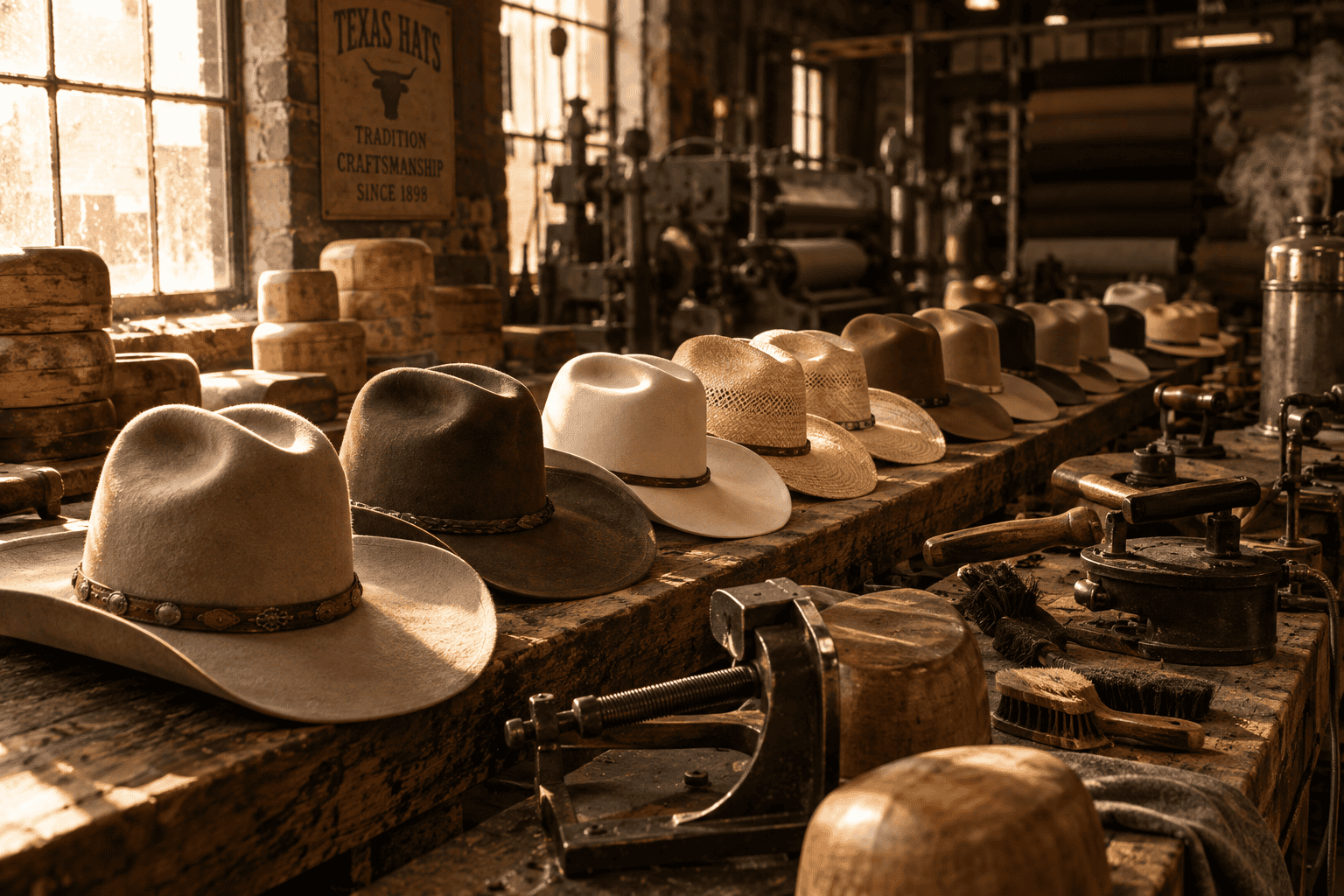
Atwood started with a favor: Richard Atwood brought palm leaf hats back from Mexico for friends, saw they were a tough alternative to traditional straw, and brought the material to the U.S. market. His son Brooks is now his business partner. According to Texas Co-op Power, Atwood makes felt cowboy hats at a factory in downtown Frankston, Texas, attached to a shop in an old brick building lined with antique machinery. Hats are also sold at the company’s storefront on the Frankston square.
A named family, a named town and a factory you can walk past is good. We did not find a published felt grade or warranty.
6. Master Hatters of Texas
Master Hatters has a Resistol connection. According to the Garland Landmark Museum’s account, William Cook moved to Garland in 1939 with the Byer-Rolnick workforce and became head of quality control. In the late 1960s he left to start Master Hatters of Texas, which also took Resistol’s overflow work. He died in 1977 and his sons took over the company.
It is a real maker with a clear lineage. It ranks sixth because we found little published detail on materials or grades.
5. Bailey
George S. Bailey set up his hat company in Los Angeles in 1922. Bailey acquired the rights to make the Hopalong Cassidy hat in 1949. In 1951 factory supervisor Earl Young came up with the idea of inserting wire into the brim edge, which became the U-Rollit. After Disneyland opened, Bailey made the Mouseketeer hats sold there, and at the peak it made over a million hats a year. In 1969 it moved to a plant in California’s San Fernando Valley, and in 1986 the employee-owned Bollman Hat Company acquired the Bailey family of brands.
That is a long, well-documented history. What we could not find is a page that says which factory builds which Bailey today, or what its felt is made from. Shop Bailey hats on Amazon.
4. American Hat Company
Sam Silver opened his first hat store on Main Street in Houston in 1915. His son Bubba took over the business in 1949 and, according to the company, was the first to introduce waterproof straw hats, which it says it is still the only cowboy hat maker producing. The Silver family sold it in 1984 to Bill and Billie George. In 2003 Keith and Susan Maddox bought it and located it in Bowie, Texas.
The company ships the majority of its hats with an open crown and a flat brim, so a store can shape the hat to the buyer. A named town, a named history and a hand-woven process earn the high placement. What we could not confirm is where its felt bodies come from.
3. Greeley Hat Works
Greeley Hat Works dates to 1909, when it was called The Shining Parlor. Trent Johnson has run it since 1996 and is the fourth owner in the line. According to KUNC, most of the equipment dates from the early 1900s to about 1953, and the conformateur used to fit hats to heads has been with the shop since it opened. The shop has made hats for members of Aerosmith and all the hats for the TV series Yellowstone, and hats cost between $400 and more than $1,000 in that 2018 report. Colorado Life reports that in 1998 the National Cattlemen’s Beef Association ordered 100 all-beaver hats for its 100th anniversary, and that one feedlot cowboy’s daily beaver hat lasted 13 years of sun, dirt and sweat. Some of its hats use European fur blends; others use pure beaver belly hair.
Greeley ranks third because Hatco says it controls fur-to-finish production in-house, and we found no comparable statement from Greeley. The hats themselves are excellent, and they are the closest thing to a custom hat on this list.
2. Stetson
Stetson’s Boss of the Plains, a high-crowned, wide-brimmed hat, became the prototype for the cowboy hat. By 1886 the company was the largest hat maker in the world. Then the factory in Philadelphia ceased manufacturing around 1970. Hatco has manufactured and distributed Stetson since 1987, and Stetson production moved to Hatco’s Garland facility in 2004. According to a 2019 factory tour account, the straw bodies are woven overseas and finished in Garland.
Stetson is not ranked second because the hats are poor. It is ranked second because the name and the original maker came apart half a century ago, and what you pay for today is largely the name. The company that makes it also makes number one. Shop Stetson hats on Amazon.
1. Resistol
Resistol is the other half of the Hatco story. Harry Rolnick joined forces with E.R. Byer in 1927, and by 1938 they named Garland, Texas their home. The company says its original factories in Garland and Longview still operate, using the same machinery approved by Rolnick. Hatco says it is “the only vertically integrated fur felt American-made hat” manufacturer in the United States. Longview felts bales of fur into rough hat bodies and ships them to Garland, where hats are blocked, sanded and finished. President Lyndon B. Johnson famously wore a Resistol hat.
One honest footnote: Resistol’s straw bodies are woven overseas and finished in Garland, so the fur-to-finish story is a felt story. It wins because the name, the maker and the factory still point to the same address. The owners have changed. The address has not. Shop Resistol hats on Amazon.
The five-second label check
- Turn the hat over and read the brand.
- Find the material: wool, fur felt, or straw.
- Find where it was made, and look for a town, not just “imported.”
- Ignore the X rating until you have done steps one through three.
- If all three point to the same place, you have found something rare.
Related reading
- Made in USA western saddles: which brands actually are
- Cowboy boot brands: six robbing you blind and six worth every penny
- American-made tack brands still worth trusting
References
- Willow Lane Hats, “What Does the X Rating Mean on Cowboy Hats?” willowlanehats.com
- American Cowboy, “X Factor: Cowboy Hat Quality.” americancowboy.com
- “John B. Stetson Company,” Wikipedia. en.wikipedia.org
- The Gentleman Racer, “Made in Texas: Stetson & Resistol,” 2019. thegentlemanracer.com
- SCW Magazine, “Hatco” (2016). scw-mag.com
- Resistol, “Hats Off to Harry.” resistol.com
- The Garland Texan, “Garland Hats: Harry, William and John.” thegarlandtexan.com
- KUNC, “From heads of state to heads of ranchers, Greeley hatter covers them all,” June 25, 2018. kunc.org
- Colorado Life, Greeley Hat Works. coloradolifemagazine.com
- Calgary Stampede, “Hats off to heritage: the white hat as Calgary’s crown.” news.calgarystampede.com
- Bailey Hats, “Here’s to 100 Years of Bailey.” baileyhats.com
- American Hat Company, About Us. americanhat.net
- Texas Co-op Power, “Co-op Connected: Atwood Hats.” texascooppower.com
- Retailer product listings for Twister, Rodeo King and Bullhide hats (Boot Barn and others), viewed October 2026, and a 2013 trade announcement for Alboum Hat Company and Tony Lama hats. Cited as text only, with no links, because these brands did not pass.
Disclosure and limits: Hoof & Honest was not paid for this article. Claims trace to the published sources above, and the ranking is our opinion based on them. Claims we could not verify were left out. Where a maker’s own statement is the only source, we say so. Company information can change, so check current details before you buy.