The 5 Levels of Winter Turnout (Most Horses Never Get Past 2)
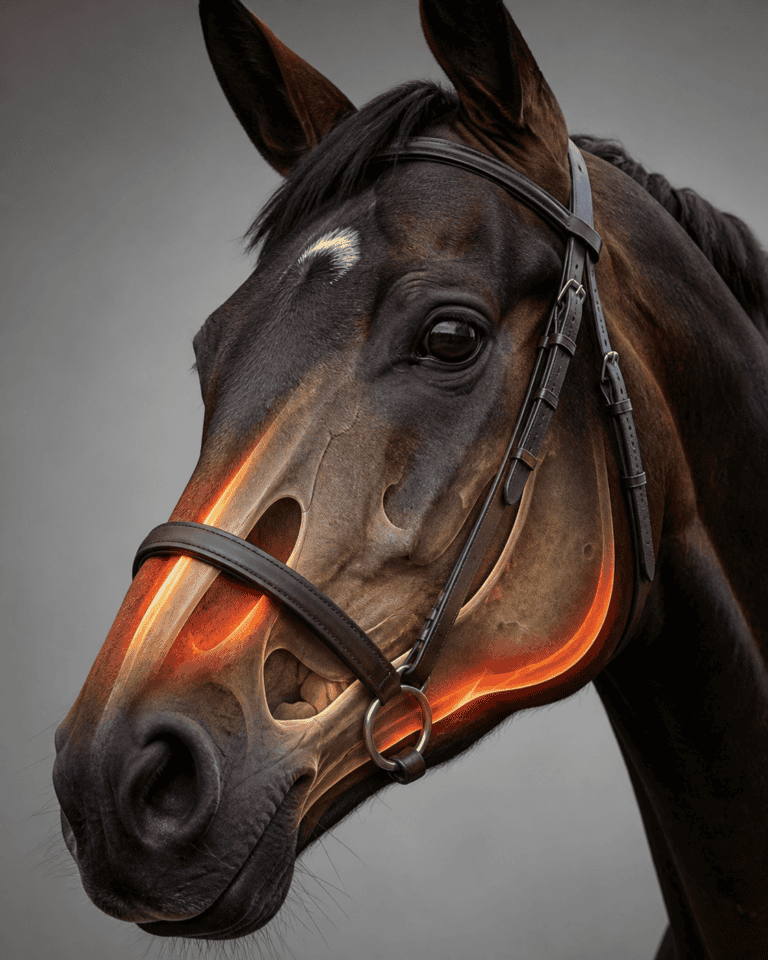
A heavyweight turnout blanket spends about five months of the year on a horse’s back, and underneath it is a coat that stopped working sometime in October. Hair only insulates when it can stand up and trap a layer of air against the skin. Flattened under nylon, it is just hair. Michigan State University Extension makes the point even earlier in the season: a horse blanketed in the fall grows a shorter winter coat than one left alone, because the coat responds to daylight and to the conditions it actually meets.
That is the small version of a much larger problem. Stall overnight, blanket by day, an hour out when the footing cooperates — this is not a neutral holding pattern until spring. It carries measurable costs in the gut, the lungs and the skeleton, and those costs are paid daily by horses who look completely fine.
We ranked five levels of winter turnout against three measures and nothing else: how many hours a day forage is moving through the hindgut, how many hours a day the horse breathes outside air instead of stall air, and how far the horse walks. Scored that way, exactly one level of the five clears all three, and it is the one almost nobody runs. The level directly below it clears two and gets close on the third. Levels four and five — which between them cover most horses in most barns, including the setup most conscientious owners consider responsible — fail at least two of the three.
How the five levels were scored
Three criteria, chosen because each one maps onto a documented failure mode rather than onto a feeling about welfare.
- Forage moving through the hindgut. The equine stomach secretes acid continuously, and chewing produces the saliva that buffers it. Long gaps without forage are the mechanism behind both ulcer risk and slowed gut motility.
- Hours out of stall air. Bedding dust, mold spores and ammonia off wet bedding are inhaled at head-down height for as long as the horse is inside.
- Distance walked. Movement loads bone, conditions hoof horn, and supplies the behavioral outlet that confinement removes.
| Level | Forage through the hindgut | Out of stall air | Distance walked | Clears all three |
|---|---|---|---|---|
| 5. Minimal turnout | Fail | Fail | Fail | No |
| 4. Part-time turnout (2–4 h) | Partial | Fail | Fail | No |
| 3. Extended daily turnout (12 h+) | Pass | Pass | Partial | No |
| 2. Around the clock with run-in shed | Pass | Pass | Partial | No |
| 1. Track system (Paddock Paradise) | Pass | Pass | Pass | Yes |
Level 5: Minimal turnout
Stabled for most of the day, turned out briefly when the footing allows, back inside before dark. Clean stall, dry horse, straight blanket. It photographs extremely well, which is part of why nobody questions it.
The published picture of confinement is consistent across the gut, the lungs and the mind. Long stabling is associated with reduced gut motility and with higher colic risk relative to horses with majority pasture access; the effect compounds in winter, when pasture moisture is replaced by dry hay and water intake typically drops. Stall air adds a second, slower bill — the one that arrives years later as a cough nobody can quite date. We took that apart separately in the five levels of stable air quality, and what stabled horses are actually breathing.
Then there is the behavioral evidence, which is the hardest to argue with. Crib-biting has been described in domestic horses since the sixteenth century and has never been documented in a free-living herd. Close to four hundred and fifty years of written record for a behavior that appears only where there are walls.
The useful move at this level is not a management tweak. It is recognizing that the level itself is the cost.
Level 4: Part-time turnout, and the two-hour line
A few hours out each day, usually late morning to early afternoon when the footing is best. Blanket on, turn out, bring in. Compared with level five this is a real improvement, and it has a ceiling most people never notice they are standing under.
Work on gastric ulceration has reported a protective effect for horses getting more than two hours a day in a paddock compared with horses getting less. Ulcers are not a fringe problem in domestic horses, which is what makes that threshold worth knowing:
| Group | Reported gastric ulcer prevalence |
|---|---|
| Racehorses in active training | At least 90% |
| Non-racing performance horses | Roughly 40–60% |
| Domestic horses overall | Estimates span 50–90% |
Stall confinement has been associated with higher prevalence. Paddock turnout has not been identified as a risk factor at all. Two hours buys the gut enough time to resume something closer to a normal motility cycle and enough chewing to buffer stomach acid. That is what it buys. That is all it buys. It is a floor that an entire industry has quietly mistaken for a ceiling, and the horse spends the remaining twenty-two hours paying the difference.
Level 3: Extended daily turnout
Outside for the majority of the day or the majority of the night, with shelter and forage available, free to move, graze and stand alongside other horses. This is where the curve bends: the two big criteria flip from fail to pass at the same time.
The welfare literature converges here. Horses with full or majority outdoor time have more opportunity to perform species-typical behavior, and studies of young horses have reported substantially more crib-biting among individually stabled animals than among pair-housed ones, with weaning into a stall producing abnormal behavior at a higher rate than weaning into a paddock. Karyn Malinowski, who founded the Rutgers Equine Science Center, has spent a career arriving at the same plain conclusion: horses do better outside.
The snow test
There is a free diagnostic for whether the coat is doing its job, and it takes twenty minutes of a snowy morning.
- Wait for snow to settle on the horse’s back and quarters. Look at the back itself, not at the blanket.
- Check again after fifteen to twenty minutes. Snow that sits without melting means almost no body heat is reaching the surface — the trapped air layer is working exactly as designed.
- Snow that melts off quickly means heat is escaping. Before reaching for more blanket, ask whether the blanket is the reason: hair that cannot stand up cannot trap air.
This matters most for horses who are out, wet and unclipped. If you do need a shell over a working coat, the construction differences are real and mostly invisible on the rack — we went through them in the turnout blanket brands that hold up on horses living out.
The change at this level is one number. Push past the halfway mark: twelve hours or more outside, with enough hay and water that is not frozen. Kristula and McDonnell reported that ponies in cold weather drank roughly 40% more when the water was warmed above the near-freezing mark, which makes a tank heater infrastructure rather than a luxury. The five levels of winter water covers how to get there.
Level 2: Around-the-clock turnout with a run-in shed
The stall goes away. The horse lives outside, day and night, all winter, with a three-sided shelter it can walk into whenever it wants. One concession to domestication: a solid roof and a wall against the wind.
- A shed of roughly 240 square feet (12 by 20 feet) serves two horses.
- It does not need to be heated, and it does not need to be sealed.
- Orientation matters more than size: the open side faces away from the prevailing winter wind.
- Free-choice hay is the actual heater. Microbial fermentation of fiber in the hindgut produces heat continuously, which is why forage — not a rug — is the first thing to increase when the temperature drops.
Wind chill, not air temperature, is the threat that gets underestimated.
| Condition | What the numbers say |
|---|---|
| 20 mph wind | Drops effective temperature by roughly 15–20°F — a 20°F afternoon in an open field feels like zero |
| Blanket threshold, healthy horse | Karen Waite (Michigan State University Extension): a healthy horse with a full coat, a body condition score of at least 4 and access to shelter may only need a blanket below about 10°F to 0°F |
| Shivering | Waite notes shivering typically appears when a horse is cold and wet, not merely cold |
| Water temperature | Warmed above near-freezing, intake rose roughly 40% in cold-weather pony trials |
| Acclimatization | Allow 10–21 days for a horse coming off a stalled routine |
Somebody at the barn will call this neglect. It is worth knowing in advance that the work is being done by the horse’s own coat and hindgut, and that the objection is usually about how the arrangement looks rather than how the horse is.
Level 1: The track system (Paddock Paradise)
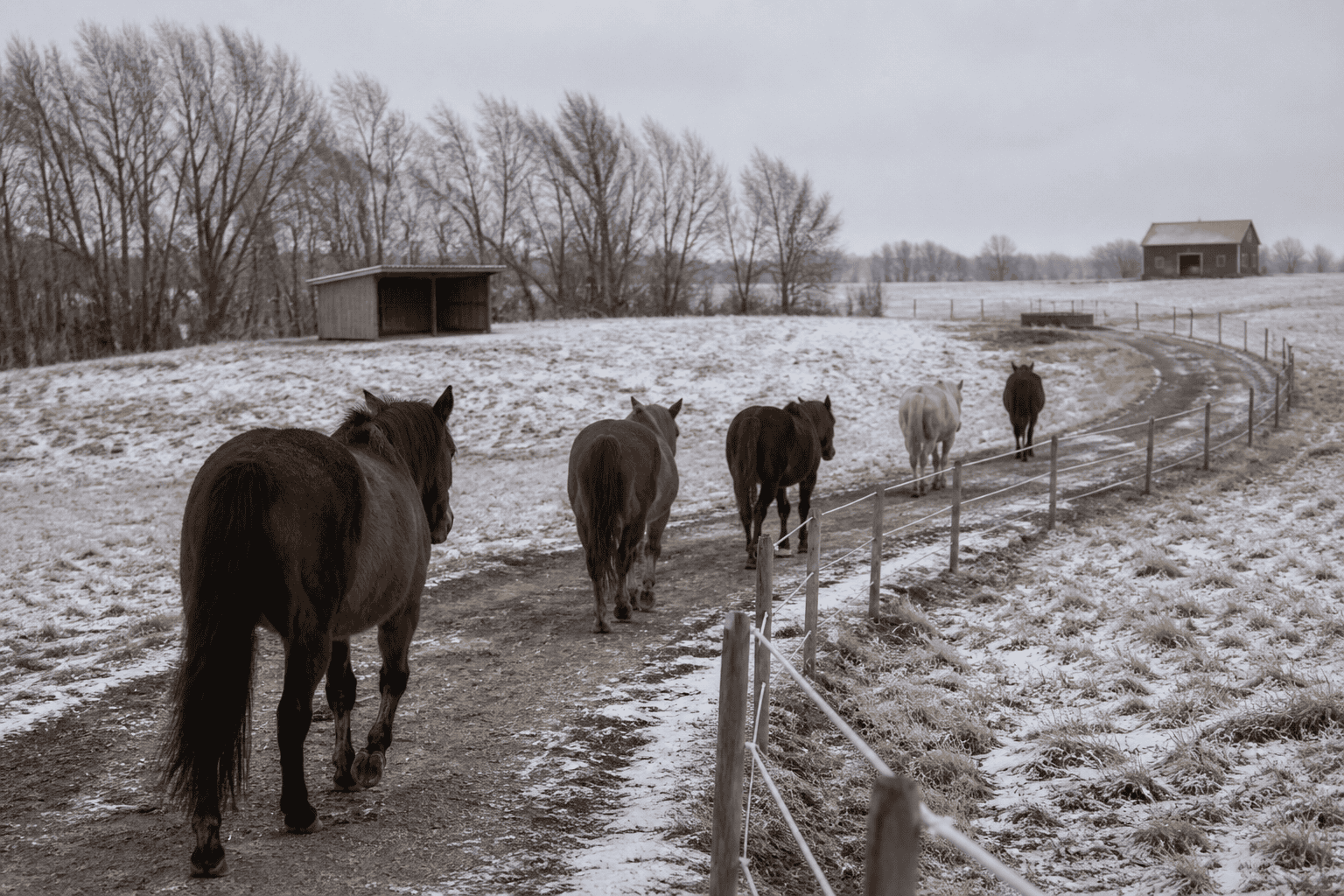
Almost nobody reaches this level, and the people who build one rarely go back. A track system converts existing acreage from a static field into a loop — usually around the perimeter — with hay stations, water and shelter spaced so the horse has to walk to reach any of it. The concept was set out by Jaime Jackson, a barefoot hoof care practitioner, after years of observing free-living horses in the Great Basin: they do not stand in fields, they travel established routes between forage, water and shelter.
It is the only level that clears the third criterion, because it is the only one that makes distance non-optional. Movement keeps bone loaded — bone density falls measurably when a horse goes abruptly onto stall rest. Forage spread along the track keeps the hindgut fermenting and producing heat. Company along the track removes the isolation that drives stereotypies. And hooves condition on varied ground instead of on bedding, which is the same argument that decides whether a horse needs protection on hard going at all — see the hoof boot brands worth trusting for barefoot and trail work.
Building one
- Fence a track along the property perimeter, minimum 12 feet wide; wider at corners and gates where horses pass each other.
- Split hay across multiple stations rather than one pile, so the herd spreads out and keeps moving.
- Place water at the opposite end from the main shelter. The distance between the two is the engine of the whole system.
- Put footing (gravel, sand, or whatever drains locally) on the high-traffic sections before they become the mud sections.
- In deep-snow regions, plan to plow sections of the track. The principle survives snow; an unplowed loop does not.
It scales in both directions. Five acres works. Fifty works. What it does not do is look like a barn, which is most of the reason it gets dismissed: it looks like fence posts and hay nets in the cold.
What to change this week
- Count the actual hours. Not the barn’s turnout policy — the hours on a clock, for seven days. Most setups score a level lower than their owners assume.
- Do the snow test on the next snowfall, before buying anything.
- Get water above freezing. This is the cheapest single intervention on the list and it feeds both the colic and the forage-intake problem at once.
- Move forage from meals to free choice, or as close to it as the horse’s weight allows. Slow feeders extend the eating window without extending the ration.
- Only then consider structural change — the shed, the track, the move to a barn that turns out.
What we could not verify
The channel’s position is that sourcing is the product, so the gaps get stated rather than papered over.
- Track systems are not an extension-service recommendation. We could not find guidance from Colorado State University Extension, or any other extension service, that specifically endorses building a Paddock Paradise track. What extension services do publish is sacrifice-area and small-acreage grazing guidance, which shares the land-protection logic but not the movement design. A CSU Extension pasture specialist has been described in trade press as working on a Colorado property that incorporates a track system; that is one reported case, not published guidance.
- Distance figures for free-living horses vary widely by study and by terrain. The commonly repeated figure of roughly nine miles a day, and the contrast with a stabled horse covering a fraction of a mile, come from different sources using different methods. Treat them as an order-of-magnitude difference, not a measurement.
- Secondary sources describe the water-temperature result differently — some as ponies drinking about 40% more warmed water, others as 40% less near-freezing water. The direction is consistent; the exact framing depends on which trial arm is used as the baseline.
- Stereotypy prevalence figures circulate at wildly different values. We have deliberately not quoted a single headline percentage for stabled horses showing stereotypic behavior, because the published range is too wide for one number to be honest.
- No individual quotation is attributed to Karyn Malinowski here, because we could not verify the wording of the quote that circulates online. Her position is characterized, not quoted.
References
- Waite, K. Equine winter hair coats 101. Michigan State University Extension, October 2012. canr.msu.edu
- Waite, K., quoted in Horse Blanketing FAQs, The Horse (blanket threshold, body condition score, shivering). thehorse.com
- Kristula, M. A., & McDonnell, S. M. (1994). Drinking water temperature affects consumption of water during cold weather in ponies. Applied Animal Behaviour Science, 41(3–4), 155–160. doi.org
- Colorado State University Extension, Grazing for Small Acreages (sacrifice areas, rotational grazing). extension.colostate.edu
- Rutgers Equine Science Center — equine welfare and turnout research program, directed at its founding by Karyn Malinowski.
- Jackson, J. Paddock Paradise: A Guide to Natural Horse Boarding (track system design, Great Basin observations).
Disclosure
Hoof & Honest was not paid for this article. No brand was given advance sight of it, and there are no affiliate links in it — welfare content on this site does not carry them. Claims here trace to published sources; where a claim could not be traced, it was either left out or listed above as unverified.
Related: The 5 Levels of Stable Air Quality · Turnout Blanket Brands You Can Still Trust · Hoof Boot Brands for Barefoot and Trail