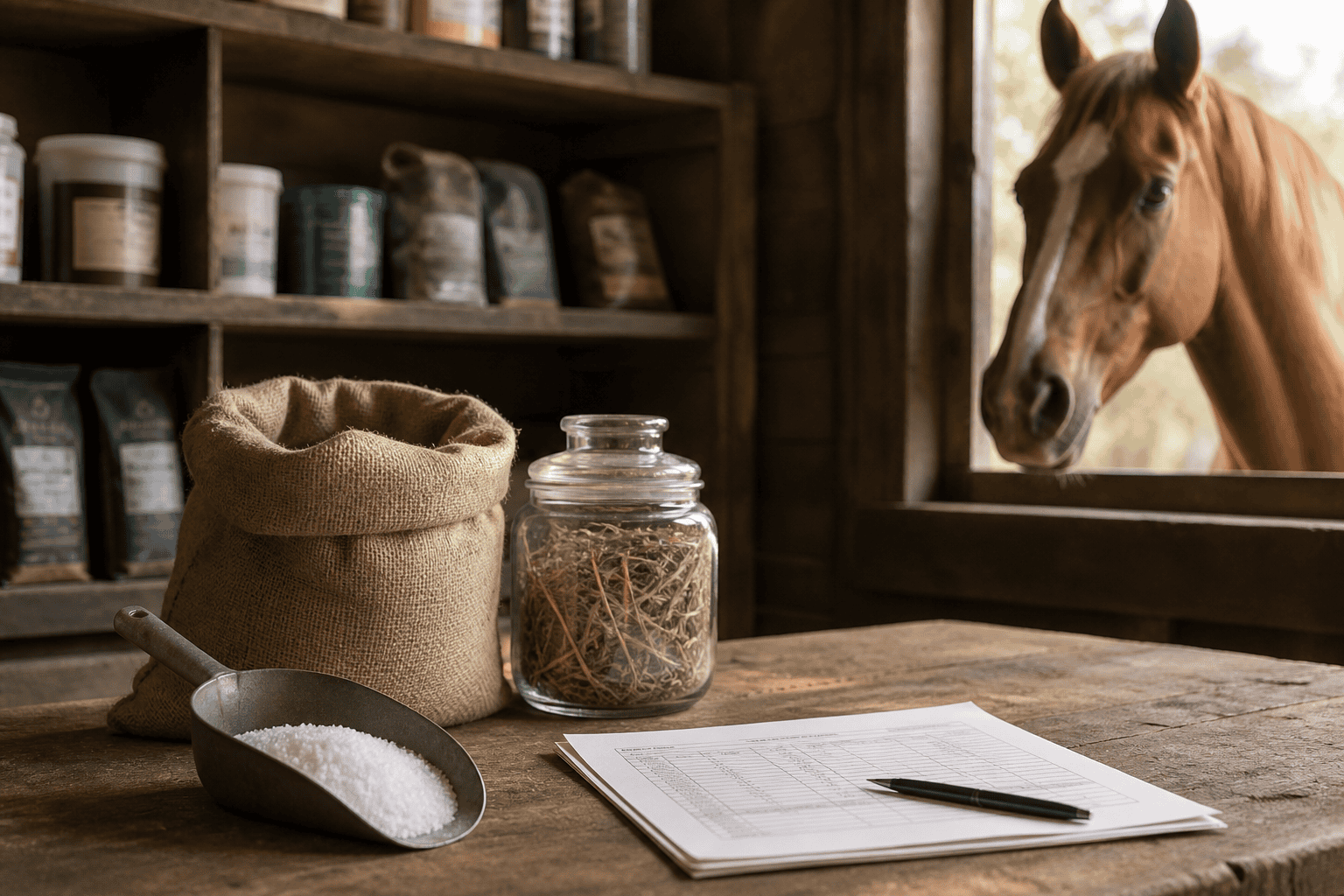
7 Horse Supplements Your Horse Doesn’t Need (And 5 They’ll Thank You For)
In 2011, Scott Weese and Heather Martin bought twenty-five commercial veterinary probiotic supplements off the shelf and tested what was actually inside them. Two of the twenty-five contained what their labels claimed. Of the twenty-two products that named a specific organism, seven had that organism misspelled on the label. Of the fifteen that promised a specific number of viable organisms, four delivered it.
Nothing was recalled, because nothing had to be. An equine supplement does not have to demonstrate that it works before it reaches your feed room, and it does not have to demonstrate that what is printed on the tub is inside the tub. That is the regulatory environment every product in this article sits in.
We put twelve of the most commonly fed equine supplement categories through the same four questions. Seven failed. Five passed. The one that failed hardest is not exotic or expensive — it is iron, which most horses already consume in excess from forage and water, and which actively competes with the copper and zinc that build hoof horn and coat. The one that passed hardest costs about ten dollars a bag.
The four questions
Every category was assessed against the same criteria. These are deliberately low bars — they ask whether evidence exists at all, not whether it is overwhelming.
- Is there a controlled study in horses? Not in humans, not in dogs, not in vitro. In horses.
- Does the label state the dose of each active ingredient, and does that dose match the dose that was studied? A product that will not disclose milligrams per serving cannot be compared to any published trial.
- Does the horse already get enough of it from forage and a fortified feed? A supplement that duplicates the base diet is not filling a gap.
- Is there a test that shows whether this particular horse needs it? A hay analysis, a blood panel, or a regional soil map.
Scorecard: 12 supplement categories
| Category | Horse study | Dose stated | Already in diet | Test exists | Verdict |
|---|---|---|---|---|---|
| Electrolytes, light work | Yes | Yes | Yes | No | Fail |
| Calming supplements | Yes (null result) | Varies | No | Only if deficient | Fail |
| Generic all-in-one | No | Varies | Yes | No | Fail |
| Untested herbal blends | No | No | No | No | Fail |
| Under-dosed joint products | Yes (null result) | Often not | No | No | Fail |
| Probiotics, no diagnosis | Limited | Often inaccurate | No | No | Fail |
| Iron | Yes | Varies | Yes, in excess | Yes | Fail |
| Marine omega-3 | Yes | Yes | No | Partial | Pass |
| Selenium | Yes | Yes | Region-dependent | Yes | Pass |
| Natural vitamin E | Yes | Yes | Only on pasture | Yes | Pass |
| Copper and zinc | Yes | Yes | Often short | Yes | Pass |
| Plain loose salt | Yes | Yes | No | Yes | Pass |
The seven your horse does not need
7. Electrolytes for the light-work horse
The arithmetic here is unusually clean. A horse at maintenance or in light work needs roughly 10 to 12 grams of sodium chloride per day — about two level tablespoons for an 1,100 lb horse — which is the figure the National Research Council works from. Forage is rich in potassium and poor in sodium, so that sodium genuinely has to be added. The amount is two tablespoons.
| Workload | Approximate daily salt requirement |
|---|---|
| Maintenance to light work | 10–12 g (about 2 level tablespoons) |
| Hard work, hot or humid conditions | Sweat losses can exceed 30 g in 1–2 hours |
That second row is the gap a commercial electrolyte product was designed to close, and it only opens at a level of work most horses never reach: sustained heavy sweating, competition, endurance, or long work in heat and humidity. Not a weekend trail ride, and not three arena sessions a week. The tub fails question three.
6. Calming supplements
This category has actually been tested, which is rarer than the shelf space suggests. Researchers at Colorado State, including Temple Grandin, ran eleven horses through a randomised crossover trial with four oral tryptophan doses — 0, 20, 40 and 60 mg/kg body weight — measuring startle response on day one and day three. No calming effect appeared at any dose. An earlier review had already noted that plasma tryptophan does rise when fed at commercial rates, but that the rise is not reflected in behaviour.
Magnesium is the more interesting case. Magnesium deficiency genuinely does affect nervousness and excitability, and correcting a deficiency does settle a horse. Feeding magnesium above requirement, to a horse that is not deficient, has not shown a reliable effect. The times a calmer appears to work are most likely the times it happened to fill a hole in the base diet.
Two competition notes: injectable magnesium is prohibited, and valerian carries sedative compounds that have prompted bans.
5. The generic all-in-one, fed over a fortified feed
A commercial feed formulated to complement forage already has its vitamins and minerals balanced at the fed rate. Adding a broad-spectrum supplement on top does not fill a gap; it creates an overlap. Overlaps in trace minerals are not harmless, because minerals compete for shared absorption pathways — push one up and its neighbours come down. The all-in-one fails questions three and four simultaneously: it cannot tell you what your horse is short of, having been formulated without ever seeing your hay.
4. Untested herbal blends
Most herbs marketed for horses have never been tested in horses, and effective doses have not been established. “Natural” does not mean safe — plants manufacture toxic compounds as a matter of course, as anyone who has pulled ragwort from a pasture knows. Several herbal ingredients that appear routinely in equine supplements are controlled or prohibited under competition rules, and those lists change.
The contamination risk is not confined to fringe products. In February 2017, two dressage horses competing at Wellington, Florida tested positive for the banned substance ractopamine, and both riders were provisionally suspended. The source was traced to Progressive Nutrition Soothing Pink, a gastric supplement made by Cargill. Cargill investigated its own product, accepted responsibility, and discontinued the ingredient that carried the contamination. The substance had never appeared on the label. The FEI tribunal that heard the case took the position that by using a supplement at all, the rider had already been negligent.
3. Under-dosed joint supplements
Joint products are the largest category in the equine supplement aisle. The pattern is well known inside the industry and invisible from outside it: glucosamine on the label, chondroitin on the label, at quantities that would do nothing even if the ingredients performed perfectly.
The honest version of this story is less convenient than the version usually told. In 2014, a team at Utrecht University published a randomised, blinded, placebo-controlled trial in the Equine Veterinary Journal: twenty-four geriatric horses, mean age twenty-nine, given three months of a glucosamine, chondroitin sulfate and MSM supplement against placebo, with stride length measured objectively on a treadmill alongside carpal flexion and tarsal range of motion. Stride length did not improve in the treated horses. The gait parameters that did improve improved in the control group, which the authors suggest may reflect the exercise the horses received during the trial.
So “buy the same ingredients at a higher dose” is not a conclusion the evidence supports either. What it supports is question two. This is the same structural problem as the one in what leg protection can and cannot actually do: a product category sold on a mechanism it has never been shown to deliver.
2. Probiotics without a diagnosis
Gut health arrived in the horse world from human medicine, and the evidence did not travel with it. The reference work is a 2014 review in the Journal of Veterinary Internal Medicine by Schoster, Weese and Guardabassi, which concluded that despite wide availability, the peer-reviewed evidence behind commercial equine probiotic formulations is limited. Laboratory results have been promising; demonstrated health benefits in the living horse have been much harder to produce. The review also notes that quality control of over-the-counter products is not tightly regulated — which is where the label audit at the top of this article comes back in.
Foals are a partial exception and the picture there is genuinely mixed. Some trials have shown reduced diarrhoea; at least one found a high-dose multi-strain product made diarrhoea worse. This is not a category to experiment with on a neonate without veterinary direction.
1. Iron
Iron tops the list because it manages to be both unnecessary and actively counterproductive.
| Measure | Figure |
|---|---|
| Maintenance requirement, 1,100 lb horse | ≈400 mg/day (≈40 mg per kg of total diet) |
| Typical forage-based diet supplies | Well over 100 mg per kg, frequently far more |
| Justified indication | Confirmed significant blood loss |
Iron is in the soil, the hay, the pasture and often the water. Excess iron does not sit inertly: iron, copper, zinc and manganese compete for the same intestinal transport proteins, so when iron runs high it crowds out the copper and zinc that build hoof horn, coat and connective tissue. Feeding more of it makes the rest of the diet harder to balance, and it does so invisibly. In foals, acute iron toxicity has caused liver failure and death.
Added iron is often not announced on the front of a label. In the ingredient panel it appears as iron oxide, ferrous fumarate, ferrous sulfate or ferrous gluconate, and some reddish salt blocks are iron-fortified. If you are chasing chronic poor hoof quality, this is worth ruling out before you buy anything marketed at feet — the same logic that governs which hoof boot brands publish real sizing and durability data applies here: check what is actually documented before you pay for the claim.
The five your horse will thank you for
5. Marine-source omega-3
This one earns its place with its limits stated plainly. In a study of arthritic horses fed long-chain omega-3 fatty acids for ninety days, treated horses showed a greater decrease in synovial fluid white blood cell concentration and in plasma prostaglandin E2 than controls — measured anti-inflammatory change inside the joint. Force plate data from the same study found no significant increase in weight placed on the arthritic limbs. A separate study confirmed that EPA and DHA reach joint fluid in supplemented horses without shifting most standard inflammation markers.
The biochemistry moves; the lameness, at least measurably, does not. That is still a better evidence position than most of the aisle, and the studied doses are published, so a label can be held against them. Marine sources outperform plant sources for this purpose.
4. Selenium — where the map and the bloodwork agree
Selenium is genuinely deficient in soils across large regions of the United States, and a deficient horse is a real clinical problem. It is also the most test-first item on this list. In a cross-sectional study of 349 horses, nearly 88% were already receiving supplemental selenium and only about 3% showed low blood selenium. Most of that population was covered, and adding more would have been risk without benefit — selenium is toxic in excess with a narrow margin. Test, then decide.
3. Natural vitamin E for the horse that does not live out
Fresh green pasture is where horses get vitamin E. Once grass is cut and stored as hay the content falls, and it keeps falling in storage, so the horse standing in a stall on a hay-based diet is the one at risk. The same 349-horse study found roughly 15% of horses deficient in plasma alpha-tocopherol and a further 20% marginal — about a third of the population at or below the line.
Prolonged deficiency is linked to equine motor neuron disease, seen in horses kept without access to green forage for eighteen months or more. This is not a performance supplement. If your horse is stabled for most of the year, this belongs in the same review as the air quality and forage handling in the barn itself. The natural form, listed as d-alpha-tocopherol, is more bioavailable than the synthetic dl- form; the price difference is real, and so is the difference in blood levels.
2. Copper and zinc, matched to your own hay analysis
This is the targeted version of the all-in-one discarded at number five. Copper and zinc are the two trace minerals most often genuinely short in a forage-based diet, and the two most often crowded out when iron runs high. They build hoof horn, coat pigment, connective tissue and antioxidant enzymes, so a horse with poor hoof quality and a bleached, dull coat is more likely short of these than short of anything sold in a bottle with a hoof on the label. A hay analysis costs less than one month of most products on the first list. Fill the holes it finds, in the ratio it specifies, and stop.
1. Plain loose salt
The single supplement nearly every horse actually needs is the cheapest thing in the feed room: 10 to 12 grams daily, around two level tablespoons for a horse in light work, and more in heat. Forage is genuinely low in sodium, so unlike almost everything else discussed here, this is a real deficit in a real diet.
The block in the corner is not a reliable answer. Some horses work at them constantly and others ignore them entirely, and studies have found that horses do not regulate intake from a lick to match requirement. Loose salt in the feed, measured, is how you know it went in.
What separates the two lists
Every one of the five that passed can be tested for before it is bought — a hay analysis, a blood panel, a regional soil map. None of the seven that failed can be. That is the whole distinction, and it is the same distinction that runs through what you are actually paying for when two products share a factory: the price tells you about the marketing, not about the contents.
A hay analysis runs about sixty dollars. Most owners will spend more than that on the first list before spring.
What we could not verify
- The “75% of supplements are unnecessary” figure. This circulates widely. It traces to two individual veterinarians stating personal estimates, not to any study, and one of those estimates is conditional on the horse already receiving quality hay and grain. It is informed opinion and is presented here as nothing more. The measured figure worth citing instead: in a survey of over 2,000 US horse owners, 84% were feeding at least one supplement.
- Equine joint supplement market size. Published market-research figures for this category vary by more than an order of magnitude between providers and in at least one case contradict themselves within a single document. No dollar figure is given here.
- Specific herbal ingredients on competition prohibited lists. These lists change. Check the current FEI and USEF publications rather than relying on any article, including this one.
References
- Weese JS, Martin H. Assessment of commercial probiotic bacterial contents and label accuracy. Canadian Veterinary Journal 2011;52(1):43–46.
- Schoster A, Weese JS, Guardabassi L. Probiotic use in horses — what is the evidence for their clinical efficacy? Journal of Veterinary Internal Medicine 2014;28(6):1640–1652.
- Higler MH, Brommer H, L’Ami JJ, et al. The effects of three-month oral supplementation with a nutraceutical and exercise on the locomotor pattern of aged horses. Equine Veterinary Journal 2014;46(5):611–617.
- Davis BP, Engle TE, Ransom JI, Grandin T. Preliminary evaluation on the effectiveness of varying doses of supplemental tryptophan as a calmative in horses. Applied Animal Behaviour Science 2017;188:34–41.
- Nutrient Requirements of Horses, 6th revised edition. National Research Council, 2007 — sodium, iron and trace mineral requirements.
- Merck Veterinary Manual — Nutritional Requirements of Horses and Other Equids.
- Cross-sectional study of management practices and blood selenium, vitamin E and beta-carotene concentrations in 349 horses.
- US Equestrian — Cautions to Consider When Adding Supplements to Your Horse’s Diet.
- FEI Tribunal decisions arising from the 2017 ractopamine cases; Cargill statements regarding Progressive Nutrition Soothing Pink.
Disclosure
Hoof & Honest was not paid for this article, and no brand named here was given advance sight of it. This article contains no affiliate links. Claims are traced to named primary sources wherever a source exists; where a claim could not be verified, it was dropped and recorded in the section above rather than quietly omitted. Nothing here is veterinary advice — supplement decisions for an individual horse belong with your vet and, where the diet is involved, an equine nutritionist working from an analysis of your own forage.