The 5 Levels of Saddle Fit (Most Riders Never Reach 3)
In a study of riding horses in Switzerland, ten percent of the saddles were free of fitting problems. Not ten percent had problems. Ten percent didn’t.
Every horse in that study was sound and in regular work. Every one of them belonged to someone who cared enough about saddle fit to volunteer for a research project about saddle fit. Nine out of ten of those saddles still had something measurably wrong with them.
Most people treat saddle fit as a question with two answers. It fits, or it doesn’t. What the research actually describes is a ladder — five standards, each harder to satisfy than the one below it, and the fitting that most riders pay for stops at the second.
The gap is where the money goes. Into physiotherapy appointments, thicker pads, shims, and eventually into training solutions for something that was never a training problem. It is the same pattern we found when we looked at what a saddle is actually worth at each price tier: the spending rarely lands on the thing causing the problem.
Level 1: The saddle isn’t visibly hurting the horse
This is the level almost everybody is standing on without knowing it. The standard is the absence of damage — no sores or rubs, no white hairs behind the withers, no flinch when the girth comes up.
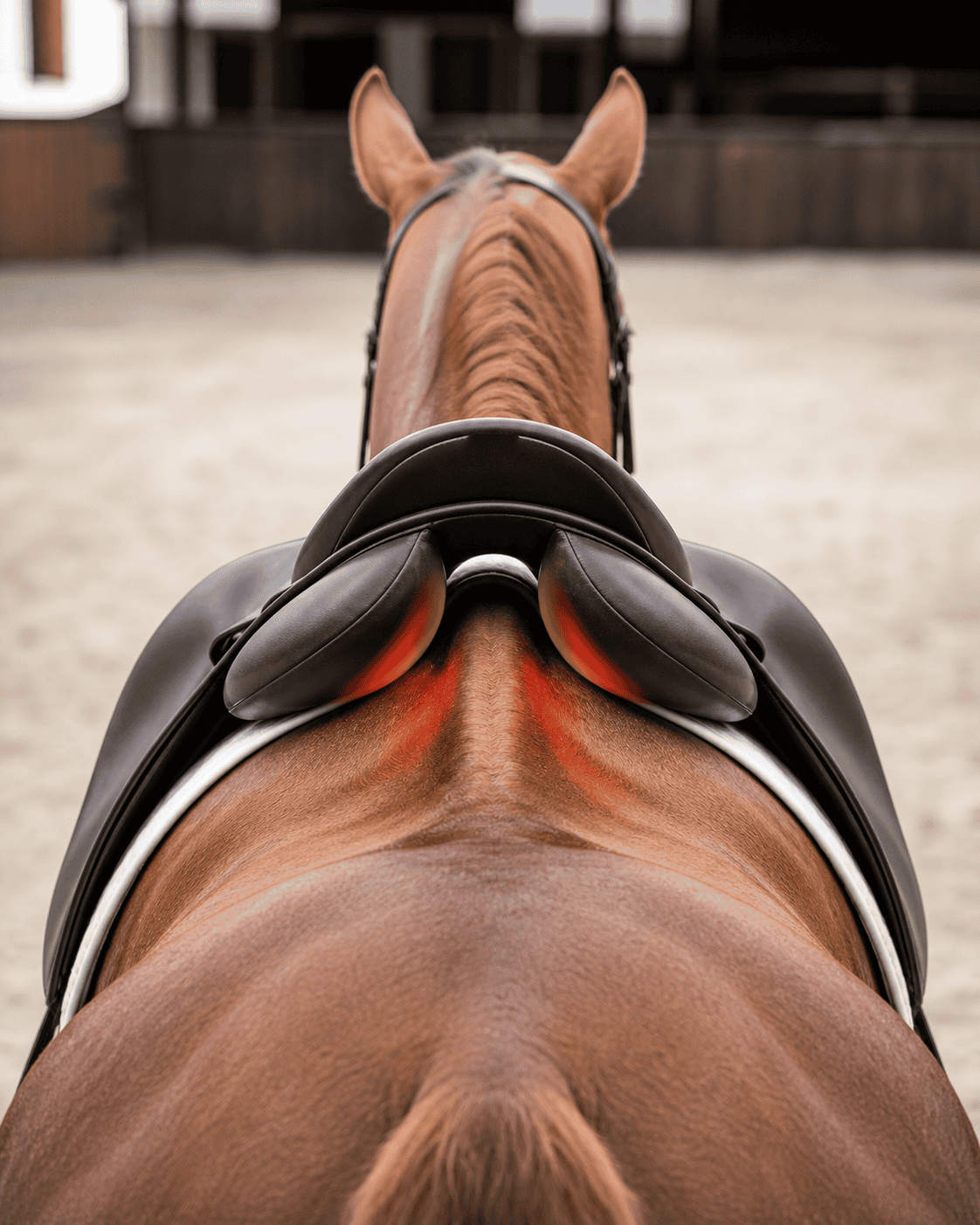
It sounds like a low bar because it is one, and a study out of Zurich shows exactly how low. Researchers measured pressure under the saddles of three groups of horses. Sound horses with well-fitted saddles averaged 7.8 kilopascals at walk. Horses showing dry spots after exercise averaged 15.3. Horses with acute pressure damage at the withers, 24.
For reference, the pressure inside a capillary sits around 4.7 kilopascals. Above that, blood supply to the tissue begins shutting down.
So a dry spot is not the start of a problem. It is damage that has already been happening invisibly, at roughly double the pressure a good saddle produces. The white hair is the receipt, not the warning.
Level 2: Static fit — the standard the industry sells
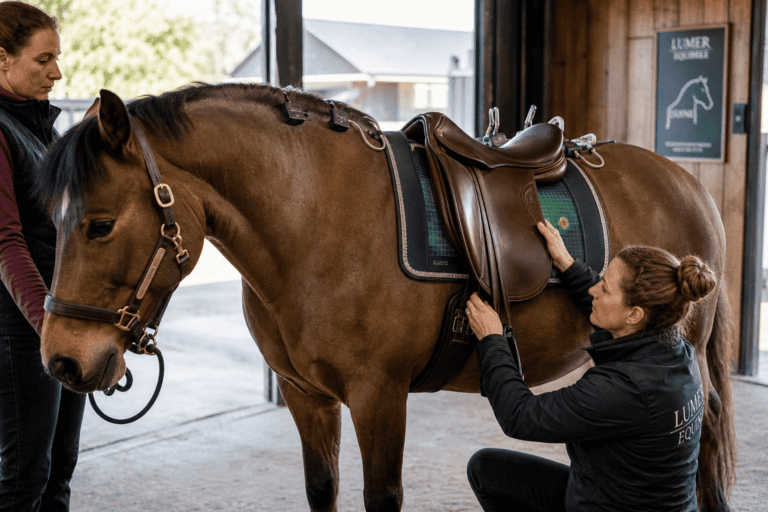
Level two is what a professional fitting delivers. The horse stands square on a level surface, the saddle goes on bare with no pad, and the fitter checks wither clearance at the top and at the sides, checks the seat is level, feels down the panel for even contact, checks the gullet clears the spine, and checks the tree doesn’t run past the last rib.
That is a real skill and it takes years to learn. But there are two things about level two that riders are rarely told.
How many saddles fail it
Ninety percent, in that Swiss study. Work presented by the Saddle Research Trust found 84% of saddles likely to impair performance — the same figure that sits at the centre of our piece on why the tree you can’t see decides everything.
The pad problem
A survey out of New Mexico State University put pressure mats under two hundred western horses and turned up something worth sitting with. Riders using thicker pads had worse fit, not better. Each additional inch of padding raised the odds of a bad fit by roughly 23%.
The reason is geometry. A pad lifts the front and the back of the saddle by different amounts, because the angles are different front and back. It tips the whole thing and opens a gap in the middle. People are spending real money, in good faith, to make the fit worse — and often paying a four to five times markup to do it, as we found when we traced where saddle pads are actually manufactured.
Where even the professionals disagree
In 2017, twenty qualified saddle fitters assessed the same ten horses against the same seven published points of fit. Agreement between them was only fair on several of the criteria, coming out around 0.28 on wither clearance at the sides. In the language of that kind of measurement, that is not a good number.
One clarification, because a version of this gets repeated online that isn’t true: it is not that fitters can’t find the anatomy. A separate study checked them against radiographs and found they located the eighteenth thoracic vertebra reliably, usually to within one spinous process. The bones are findable. It’s the criteria that are slippery. Two competent professionals can agree exactly where the last rib is and still disagree about whether the saddle in front of them is acceptable.
Level 3: Does it stay where it was fitted?
Level three is the horse moving, under a rider. The question stops being whether the saddle fits and becomes whether it stays put — and this is where most riders stop.
What you are watching for is consistent slip, to the same side, with more than one rider. Have someone film you from directly behind at trot and at canter, on both reins, and watch the gullet against the spine.
Here is what should change how you respond to it. Researchers at the Animal Health Trust examined 128 horses and found the saddle slipped consistently to one side in 54% of those with hindlimb lameness, against 4% of those with forelimb lameness and none at all in the sound controls. When they blocked the lameness with local anaesthetic, the slip stopped in 37 of 38 cases.
The caveat the internet leaves off is that those were clinic referrals — a population already selected for having something wrong with it. In 506 ordinary working sports horses, slip showed up in about 12%. Anyone quoting 54% as a general rate is quoting it wrong.
The general population number is arguably worse anyway. In that same group of 506 horses, whose owners considered them to be working normally, 46% were lame or moving with a stiff, stilted canter.
Which means a slipping saddle is more often a symptom than a cause. Reflocking treats the messenger. A lameness workup costs more upfront and less overall. It is the same trap we described with bits and resistance under saddle — the equipment gets blamed for something happening further down the horse.
Level 4: The rider
In work looking at nearly two hundred riders, only about 35% were correctly positioned in the middle of the saddle, in balance, and appropriately sized for the seat they were in. Over half sat towards the back of it.
In the 506-horse study, 37% of riders sat crookedly, which raised the odds of saddle slip roughly sixfold — though the authors were careful to note the crookedness might be a response to the slip rather than its cause.
Rider weight gets repeated harder than the research supports. The pilot study everyone cites had six horses, the heavy rider was at about 16.7% of the horse’s bodyweight, the saddles didn’t fit those riders either, and a Danish group running a similar protocol afterwards didn’t replicate the gait findings.
Our reading — and we are labelling it as a reading rather than a finding — is that the defensible version of level four is seat size and balance point, not a number on a scale. A rider too large for the seat gets pushed backwards, which shifts load onto the weakest part of the back. That is mechanical, and it has a mechanism behind it. The weight limit version isn’t carried by the evidence yet.
Level 5: Fit to a horse that’s actually moving
Almost nobody occupies level five, including a lot of professionals. Every check at level two happens on a horse standing still.
In 2024, a team at the Royal Veterinary College reconstructed the equine back in three dimensions — standing, walking and trotting — and found the curvature in the saddle region is substantially different in motion. Moving horses have flatter backs than standing ones.
Which means the shape your saddle was fitted to is a shape your horse only holds when it isn’t being ridden.
And a study of peak pressures over the tenth to thirteenth thoracic vertebrae found that reducing them improved features of gait even in saddles that had been fitted to published guidelines. Saddles that passed. Signed off against the accepted standard. And the horses still moved better once the pressure came down further.
That is level five: passing and being optimal are not the same thing, and the guidelines are a floor rather than a ceiling. Reaching it usually means pressure mapping, which is neither cheap nor widely available, and we are not going to pretend it is realistic for most horses.
So which level are you on?
- Level 1 — the horse isn’t marked.
- Level 2 — a qualified static assessment within the last year or so.
- Level 3 — you’ve watched footage from behind at canter on both reins and you know whether it slips. This already puts you ahead of most people you ride with.
- Level 4 — you’ve taken an honest look at how you sit in it and whether the seat is the size you need rather than the size you bought.
- Level 5 — a research standard more than a yard standard. Useful mainly as a reminder that the ceiling is higher than the certificate.
Every one of those numbers came from horses whose owners believed things were fine. Believing it isn’t evidence, and the horse has no way to file a complaint except the ones we have spent this article learning to read.
If you are working out where to spend, our guide to underrated tack brands that cost less than you expect covers where the quality floor actually sits.
Sources
- Dittmann, M.T. et al. (2021). Feel the Force: Prevalence of Saddle Fit Problems in Swiss Riding Horses. Journal of Equine Veterinary Science.
- von Peinen, K. et al. (2010). Relationship between saddle pressure measurements and clinical signs of saddle soreness at the withers. Equine Veterinary Journal.
- Guire, R., Weller, R., Fisher, D. & Beavis, J. (2017). Investigation into the Repeatability and Reproducibility of a Pressure Mapping and Static Saddle Fit Assessment. Journal of Equine Veterinary Science.
- Nankervis, K. et al. (2019). Reliability of Saddle Fitters to Determine the Position of the Last Thoracic Vertebra. Journal of Equine Veterinary Science.
- Greve, L. & Dyson, S. (2013). An investigation of the relationship between hindlimb lameness and saddle slip. Equine Veterinary Journal.
- Greve, L. & Dyson, S. (2014). The interrelationship of lameness, saddle slip and back shape in the general sports horse population. Equine Veterinary Journal.
- Smirnova, E. et al. (2024). Shape change in the saddle region of the equine back during trot and walk. Journal of the Royal Society Interface.
- Murray, R. et al. (2017). Reducing peak pressures under the saddle at thoracic vertebrae 10–13 and gait features. Journal of Equine Veterinary Science.
- Dyson, S. et al. (2020). The influence of rider:horse bodyweight ratio and rider-horse-saddle fit on equine gait and behaviour. Equine Veterinary Education.
- New Mexico State University western saddle fit survey (pressure mat assessment of 200 horse and saddle combinations).
Hoof & Honest takes no payment, product or placement from any brand. Where we give an opinion, we say so.
Related on Hoof & Honest: how to check a saddle’s age and tree · synthetic vs leather saddles · kids’ saddles for ponies