6 Nosebands Your Horse Secretly Hates (And 5 They’ll Thank You For)
There is a strip of leather on your bridle that carries roughly three times more pressure than the one you check. Nobody has ever asked you to check it. There is no gauge made for it, no rule written about it, and no product on the market sold to pad it.
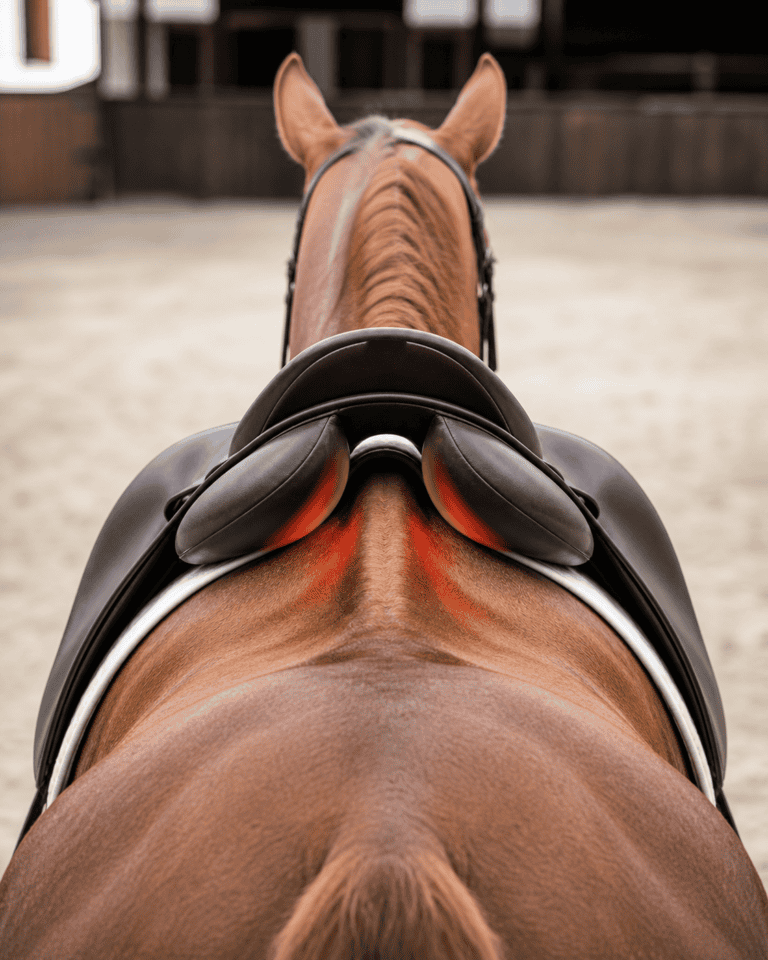
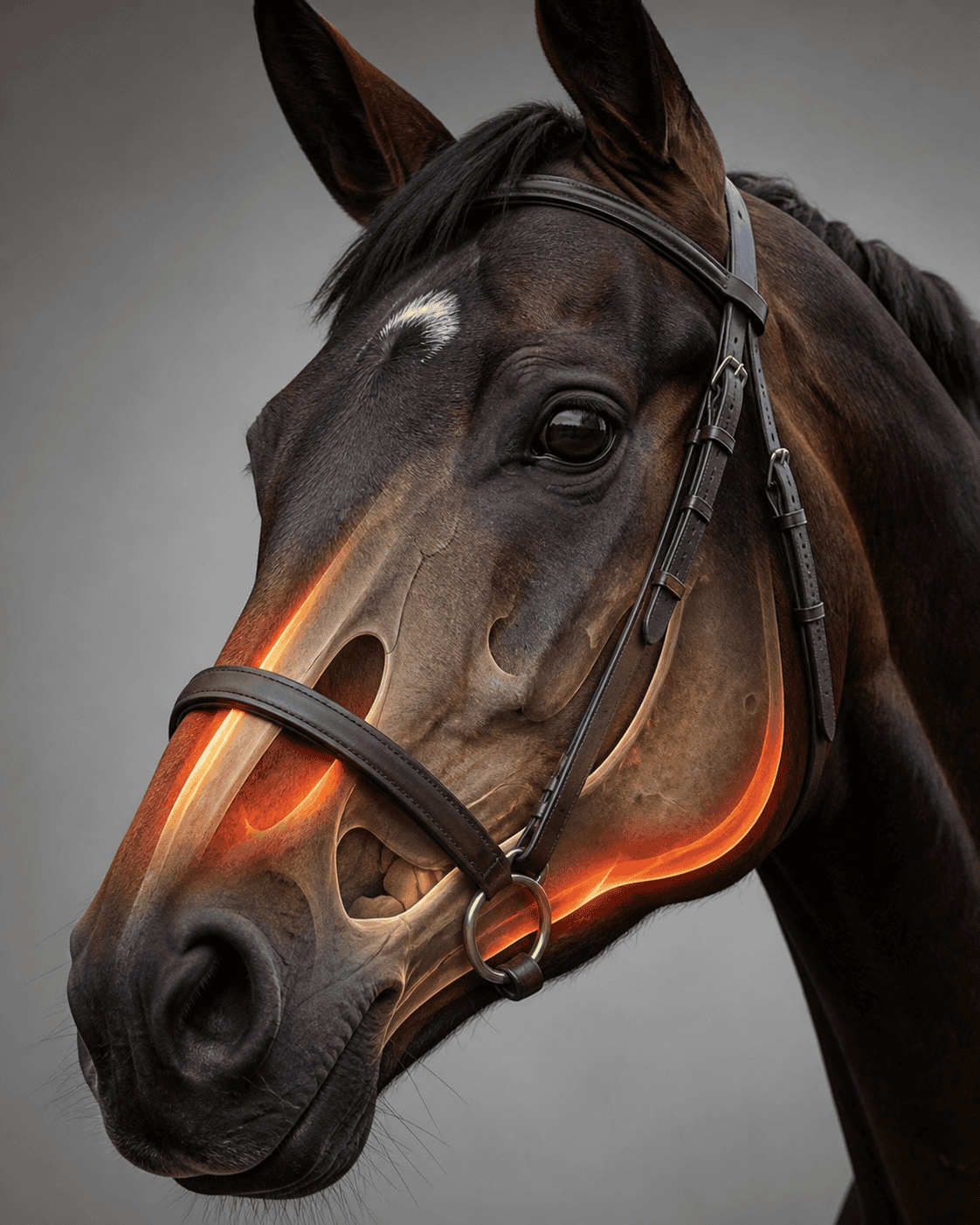
It is not the front of the nose. It is the underside of the jaw — the two branches of bone your noseband’s lower strap crosses on its way to the buckle.
That figure comes from the first study to put pressure sensors on both surfaces of a ridden horse’s head at the same time, published in the Equine Veterinary Journal in September 2024. It reorganises what a noseband buying decision actually looks like, because almost every padded, anatomical, comfort-branded noseband on the market applies its cushioning to the side that measured lightest.
We assessed eleven noseband designs against four criteria. Six failed. Five passed. Two of the passes are designs with bad reputations that the measurement does not support, and two of the passes cost nothing at all, because you already own them. The single most useful purchase in this entire article is a fifteen-dollar hole punch.
The four criteria
Stated before anything is named, so you can check the reasoning against the evidence yourself.
- Independent measurement exists. Somebody has measured the design, and that somebody was not selling it.
- It does not concentrate load on the mandible. The surface that measured highest in every condition tested.
- The marketing claim matches the published data. Not “designed to reduce pressure.” Reduced, measured, published.
- It is adjustable in practice. Not in theory. In holes.
Scorecard: eleven nosebands against four criteria
| Noseband | Independent pressure data | Mean nasal pressure | Claim vs evidence | Verdict |
|---|---|---|---|---|
| Flash (cavesson + flash strap) | Yes | 4.9 kPa | Highest of four types tested | Fail |
| Padded crank sold as comfort upgrade | Yes | 4.3 kPa | Pad sits on lowest-load surface | Fail |
| Kineton | None published | Not measured | Untested claim | Fail |
| Combination noseband | None published | Not measured | Untested claim | Fail |
| Narrow / rolled / rope-cored | None published | Not measured | Contradicts pressure physics | Fail |
| Any noseband with 1-inch hole spacing | n/a | n/a | No correct setting available | Fail |
| Drop noseband | Yes | 1.4 kPa | Matches | Pass |
| Plain wide padded cavesson | Yes | 2.8 kPa | Matches | Pass |
| Swedish crank at 1.5 fingers | Yes | 4.3 kPa | Reputation contradicted by data | Pass |
| Fairfax Performance | Manufacturer-funded, peer reviewed, key findings later replicated | Not published in kPa | Matches | Pass |
| Micklem | Behavioural comparison only | Not measured | Nerve claim unverified | Pass (narrow) |
What the measurement actually showed
Eight high-level dressage horses were ridden in trot by their usual riders. Two pressure mats were fitted per horse — one over the nasal bone, one beneath the mandibular rami — and four noseband types were tested at five tightness levels each, set with a taper gauge.
The funding matters more than the author list. The work was paid for by World Horse Welfare, the British Equestrian Federation, the Canadian Sport Horse Association, Hartpury University and the Worshipful Company of Saddlers. Four welfare and academic bodies, one trade guild, and no bridle manufacturer. The authors declared no conflict of interest.
| Noseband type | Mean pressure on nasal bone | Mean pressure under mandible |
|---|---|---|
| Drop | 1.4 kPa | Not measured |
| Cavesson | 2.8 kPa | 9.1 kPa |
| Swedish (crank) | 4.3 kPa | 10.5 kPa |
| Flash | 4.9 kPa | 8.0 kPa |
For every type, at every tightness level, mandibular pressure exceeded nasal pressure. Not once did it run the other way.
Kilopascals mean nothing without a reference, so here is one you already pay for. Published saddle-fitting guidance holds mean pressure under a saddle below roughly 11 kPa — the figure a fitter works to, spread across an entire panel on a muscled back. A cavesson noseband recorded 9.1 kPa under the jaw, on a strap a fraction of that width, on bone with almost no muscle beneath it. The study’s authors noted plainly that the two locations are not directly comparable. They are right, and the head being bonier and barer is not an argument in the noseband’s favour. If you have worked through what actually separates a well-fitted saddle from an adequate one, the pressure figures here are the same order of magnitude on a fraction of the surface area.
How tight is too tight
Tightening from two fingers to one and a half produced no significant pressure increase. Below one finger, the numbers climb steeply.
| Taper gauge setting | Mean nasal pressure | Mean mandibular pressure | Total force |
|---|---|---|---|
| 2.0 fingers | 1.6 kPa | 5.4 kPa | 43.7 N |
| 1.5 fingers | 2.9 kPa | 7.0 kPa | 66.9 N |
| 1.0 finger | 3.1 kPa | 8.9 kPa | 80.3 N |
| 0.5 finger | 4.2 kPa | 11.4 kPa | 102.5 N |
| 0.0 fingers | 6.4 kPa | 14.6 kPa | 149.2 N |
Total force more than triples between a correctly adjusted noseband and a closed one. Same horse, same bridle, same rider. A separate cadaver study published in July 2025 placed the inflection point at roughly 1.4 fingers of space.
Since 1 May 2025, under Article 1044.8 of the FEI Veterinary Regulations, a steward’s measuring device must pass under the noseband over the nasal bone and be drawn through from top to bottom. The rule covers all noseband types and both upper and lower straps. Failing before competition blocks the start; failing after a round means elimination plus a Yellow Warning Card, and the published protocol states officials have no discretion to amend that.
The six that fail
None of the products in this section carry purchase links. We do not link to equipment we are telling you not to buy.
1. The flash noseband
A cavesson with a thin second strap running through a mid-dorsal loop, passing in front of the bit and fastening in the chin groove. It is the most widely sold noseband configuration in English riding.
It recorded the highest mean nasal pressure of the four designs tested, and the drop beat it at every single tightness level compared. A bridle manufacturer reached the same conclusion nine years earlier in its own pressure-mapping work, published in the Journal of Equine Veterinary Science in 2015, describing a flash strap dragging on the lower edge of the cavesson as the most antagonistic high-pressure design it tested. That is manufacturer research, and would normally warrant caution — except an independently funded team measured it separately and got the same answer.
It also gives you two straps that can fail a tack check instead of one.
2. The heavily padded crank sold as a comfort upgrade
Deep sheepskin or memory foam across the front, a jowl strap through two D rings, and product copy using the words comfort, anatomical or pressure-relieving. Typically $90 to $250 as part of a dressage bridle.
The padding is real. Its position is the problem. Under a crank, the nasal bone carried 4.3 kPa and the mandible 10.5 kPa. The pad sits on the 4.3. The study authors closed their paper stating that further work is needed to determine whether pressure can be reduced with padding beneath the mandibles — researchers writing in 2025 that the highest-load surface remains unsolved, while the product has been sold as solved for two decades.
The crank design is not the failure here. The claim is. No manufacturer we could identify publishes a pressure map showing what its padding does beneath the jaw. This is the same pattern documented in saddle pads sold on shock-absorption claims that were never independently measured.
3. The Kineton
Two metal half-loops pass under the bit on each side, joined by a strap crossing the nose roughly at drop height. No strap holds the mouth closed. E. Jeffries, who manufacture one, describe it as transferring bit pressure from the rider’s hand to the nose. Gag versions retail around $85.
It is marketed as the humane option for a strong horse on the logic that a milder bit becomes viable. The force does not disappear — it relocates, from the bars of the mouth onto a narrow strap on the thinnest bone in the horse’s face, in an amount determined by rein tension.
No published sub-noseband pressure measurement exists for a Kineton. We cannot tell you it measures worse than a flash, and we will not pretend otherwise. What we can say is that the design deliberately increases nasal loading, that narrow straps generate higher pressure than wide ones at equal tension, and that nobody has measured the result. If you are working through bit-related resistance, the mouthpiece designs that reliably cause trouble are a more productive place to start than adding a device to the nose.
4. The combination noseband
A cavesson strap above, a second strap dropping in front of the bit into the chin groove, and on many patterns a rolled or rope-cored front piece sitting low across the nose.
The Kineton’s problem doubled: two bearing surfaces, both narrower than a plain cavesson, both lower on the face, no published pressure data on the type, and two straps to fail a tack check.
5. Narrow, rolled and rope-cored nosebands
At a given tension, a narrow noseband generates higher pressure on the underlying tissue than a wide one, because the same force is distributed across less area. Researchers stated this directly in 2017. Pressure also runs highest over the sharpest curvature — the outer margin of the nasal bone and the branches of the mandible — and a narrow strap bears directly on those edges rather than bridging across them.
Anything sold because it looks refined and disappears against the face is concentrating force by design.
6. Any noseband with one-inch hole spacing
This failure has nothing to do with type, brand or price, and it is the one almost nobody discusses.
In the methods section of the 2024 pressure study, the researchers record punching extra holes in the noseband straps at 0.5 cm intervals for optimal fit. They had to modify stock tack before they could set it accurately. Separately, the FEI’s own published protocol advises riders that puncturing additional holes in the noseband may be needed to pass the measuring check.
The scientists and the governing body are saying the same thing: tack as sold does not carry enough adjustment points to reach a correct setting. One hole is loose enough that the noseband slides down the face; the next is at zero fingers. There is nothing between them, so riders choose the tight one, because loose looks sloppy and tight photographs well.
A 2017 survey of 750 competition horses found 44% wearing nosebands with no measurable space beneath them, and only 7% admitting the two fingers that horsemanship texts have specified since 1956. That distribution is not primarily explained by cruelty or ignorance. A meaningful share of it is hole spacing.
The five that pass
Some links in this section are affiliate links. Hoof & Honest is a participant in the Amazon Services LLC Associates Program and earns from qualifying purchases. This costs you nothing and does not affect which products appear here — the six designs above carry no links at all, and two of the five passes below require no purchase.
1. The drop noseband
Sits above the nostrils with its rear strap running behind the chin groove, in front of the bit. Unfashionable for thirty years, and it recorded the lowest nasal pressure of every design tested, at every tightness level, by a clear margin — 1.4 kPa pooled, against 4.9 for the flash.
The researchers attributed this partly to design and partly to position, since the facial contour at drop height is less likely to present the central hollow and lateral bridging found higher up. Expect $40 to $80; the Nunn Finer adjustable drop noseband is a straightforward US-available option with a usable buckle range.
The caveat is real. Fitted too low, a drop presses on cartilage and can restrict airflow. It must sit on bone, above the end of the nasal bone. That is a fitting requirement rather than a design flaw, and it is the one error that will make a drop worse than the flash it replaced.
2. The plain wide padded cavesson
2.8 kPa on the nasal bone — lower than the crank, lower than the flash. Matched hole-for-hole against a Swedish crank at identical tightness, there was no meaningful difference between them in almost every comparison.
The plain cavesson performs like the expensive one at roughly a third of the price. Bobby’s English Tack, Kieffer and most competent saddlers make a good one for $25 to $70. If you are buying a replacement padded cavesson noseband, select the version without the flash attachment — that single choice moves you off the worst-measuring configuration in the study.
3. The Swedish crank, adjusted honestly
The crank has been described in the research literature itself as a jaw-clamping design. That characterisation originates in a 2012 paper and has been repeated in most noseband welfare writing since.
The 2024 measurement contradicts it directly. Compared with a plain cavesson at matched tightness, hole for hole, there were no differences between them — with one exception at the very tightest adjustment. The authors wrote that this contradicts the previous characterisation, and explained the mechanism: the assumed leverage effect does not occur, because one D ring positions the pad while the other acts alone as a pulley.
The crank is not a clamp. It is a mechanism that makes it easy to pull a noseband tighter than intended, with less hand feedback than a plain buckle. Set at 1.5 fingers it measures like a plain cavesson; set at zero it measures like the worst design in this article. Same object, both times. No purchase required — if you own one, this is an adjustment change, not a shopping decision.
4. The Fairfax Performance noseband
The most expensive item here by a wide margin — the noseband alone runs into the low hundreds, the complete bridle above $400 — and it passes on a criterion nothing else on the market meets. The design was derived from pressure mapping and gait analysis before it was sold, and the work went through peer review into the Journal of Equine Veterinary Science in 2015. Ridden testing reported peak pressure under the horses’ own nosebands as roughly 48% higher than under the Fairfax.
That is manufacturer-funded research and should be weighed as such. What lifts it above a marketing claim is replication: its two most surprising findings — that the flash is the worst design, and that the crank is not worse than a plain cavesson — were both reproduced nine years later by an independent team with nothing to sell. A bridle company published a result inconvenient for the bridle industry, and the independent data later agreed with it. It is the only instance of that pattern we found. Fairfax is sold through fitters rather than general retail, so there is no link here; the same “who actually publishes their testing” question runs through the leg protection market, where only two brands publish independent impact data.
5. The Micklem — with a stated caveat
Shaped to sit higher on the face, clear the protruding upper molars, and arch its cheekpieces over the infraorbital nerve. Horseware publishes all of these design claims. Around $200 to $300 as a complete bridle, and the Rambo Micklem competition bridle is the FEI-approved version.
The caveat. Those nerve-avoidance claims have never been verified by published pressure measurement. What exists is a university comparison finding that horses displayed more positive behaviours and spent more time in correct head carriage in a Micklem than in a conventional flash bridle — a behavioural result from an independent institution, not a pressure map.
It passes because the evidence that does exist is independent and points the right way, and because the geometry moves the strap off the two structures the anatomy literature repeatedly names. It passes with the narrowest margin of the five. Anyone asserting the nerve claim is proven has not read the literature.
The fifteen-dollar fix
If you buy one thing after reading this, buy a leather punch. Failure six applies to every noseband you own, including the five that passed, and it is the only failure on this list you can eliminate in ten minutes.
- Fit the noseband and identify the two adjacent holes that bracket a correct setting — one too loose, one too tight.
- Mark the midpoint. Punch a new hole there, matching the existing hole diameter.
- Repeat on the lower strap if the noseband has one.
- Re-check with a taper gauge on the nasal midline, inserted without force.
A revolving leather punch with a steel ruler handles this; the ruler matters, because 0.5 cm spacing is the interval the researchers themselves used to get usable adjustment out of stock tack.
What we could not verify
- No published sub-noseband pressure data exists for the Kineton, for combination nosebands, or for most premium “anatomical” nosebands. Their failure here is an absence of evidence, not evidence of harm, and we have not claimed otherwise.
- Micklem’s nerve-avoidance claims are unmeasured. Only a behavioural comparison exists.
- Radiographic findings are correlational. A study of 144 cavalry horses in Mexico found changes on x-ray to the nasal bones in 37.5% and to the mandible in 13.8%. The authors explicitly found no causal link to any piece of equipment, and noseband tightness in that population had never been gauge-checked. That is an open question, not a verdict.
- Prices are approximate US retail as of August 2026 and move with stock and leather grade.
- The tourniquet comparison is not used here. It circulates widely, but the primary literature rejects it, because noseband pressure is cyclical with the stride rather than continuous.
The conclusion the data supports
Across eleven designs, the design turns out to be the smaller variable. Four of the five that passed cost less than most of the six that failed. The most expensive item earned its place not through leather quality but because somebody measured it before they priced it. And the highest-value purchase in the article is a hole punch.
Your horse is not objecting to a category of noseband. He is objecting to the hole you selected, on a strap that offered you two to choose between, on a face where the pressure was never where the padding was.
References
- MacKechnie-Guire, R., Murray, R., Williams, J.M., Nixon, J., Fisher, M., Fisher, D., Walker, V. & Clayton, H.M. (2025). Noseband type and tightness level affect pressure on the horse’s face at trot. Equine Veterinary Journal 57(3): 774–788. doi:10.1111/evj.14420
- Fédération Equestre Internationale (February 2025). General and Discipline Specific Protocols for Assessing the Tightness of Nosebands; FEI Veterinary Regulations Art. 1044.8, effective 1 May 2025. Published protocol (PDF)
- Doherty, O., Casey, V., McGreevy, P. & Arkins, S. (2017). Noseband use in equestrian sports — an international study. PLoS ONE 12(1): e0169060.
- Uldahl, M. & Clayton, H.M. (2019). Lesions associated with the use of bits, nosebands, spurs and whips in Danish competition horses. Equine Veterinary Journal 51(2): 154–162.
- Pérez-Manrique, L., León-Pérez, K., Zamora-Sánchez, E., Davies, S., Ober, C., Wilson, B. & McGreevy, P. (2020). Prevalence and distribution of lesions in the nasal bones and mandibles of a sample of 144 riding horses. Animals 10(9): 1661.
- Doherty, O., Conway, R. & McGreevy, P. (2025). Using an equine cadaver head to investigate associations between sub-noseband space, noseband tension, and sub-noseband pressure at three locations. Animals 15(14): 2141.
- Murray, R., Guire, R., Fisher, M. & Fairfax, V. (2015). A bridle designed to avoid peak pressure locations under the headpiece and noseband is associated with more uniform pressure and increased carpal and tarsal flexion. Journal of Equine Veterinary Science 35(11–12): 947–955.
- Casey, V., McGreevy, P., O’Muiris, E. & Doherty, O. (2013). A preliminary report on estimating the pressures exerted by a crank noseband in the horse. Journal of Veterinary Behavior 8(6): 479–484.
- Byström, A. et al. (2010). Influence of girth strap placement and panel flocking material on the saddle pressure pattern during riding of horses. Equine Veterinary Journal 42(S38): 502–509. (Source of the 11 kPa mean saddle pressure guideline.)
- Weller, D. et al. (2020). The reported use of nosebands in racing and equestrian pursuits. Animals 10(5): 776.
- E. Jeffries & Sons, published product specification for the Traditional Kineton Noseband.
- Horseware Ireland, published Micklem bridle design specifications.
Disclosure
Hoof & Honest was not paid by any brand named in this article, and no manufacturer reviewed it before publication. No products were supplied. Every claim above traces to a published source listed in the references, and where a claim could not be verified it is named as unverified rather than omitted. Affiliate links appear only on products the article recommends; the six designs assessed as failures carry no links.
Related on Hoof & Honest: signs your horse doesn’t like your gear