The Only 6 Hoof Boot Brands You Can Still Trust (For Barefoot And Trail)
Advertising disclosure: this article contains affiliate links. If you buy through them, this site may earn a commission at no additional cost to you. Hoof & Honest was not paid by any brand named here, and no brand was given advance sight of this article.
Swiss Galoppers will tell you their sole lasts about two thousand kilometres. Renegade will tell you their boots are rated for over a thousand miles. Both numbers are printed on the companies’ own pages, and neither is backed by a test anyone outside the company ran.
That is the actual state of the hoof boot market. It is not a market full of frauds — most of the companies in it are small, founder-run, and genuinely good at what they do. It is a market where almost nobody has to prove anything, because almost nobody is asked to. So the useful question is not which brand markets best. It is which brands publish enough for a buyer to check them.
We assessed the six most established hoof boot makers against six things a buyer can verify before spending money: whether the company publishes real hoof measurements rather than shirt sizes, whether it sells the wear parts separately, whether you can try before you commit, whether it manufactures its own product, whether it publishes a durability figure, and whether any performance claim has been tested by someone other than the company itself.
All six passed the first four. Exactly one passed the last one.
The Scorecard
| Brand | Sizing in mm | Spare parts sold | Makes its own boots | Durability figure published | Independent testing |
|---|---|---|---|---|---|
| EasyCare | Yes | Yes | Yes — Tucson, Arizona | Weekly mileage bands per model | No |
| Scoot Boot | Yes | Yes | Yes — Tasmania | Not published | No |
| Cavallo | Yes | Not verified | Yes | Not published | No |
| Renegade | Yes | Yes | Yes — United States | 1,000+ miles (company figure) | No |
| Equine Fusion | Yes | Partial | Yes — Norway | Not published | Yes |
| Swiss Galoppers | Yes | Yes | Yes — Lupfig, Switzerland | ~2,000 km / 1,200 mi (company figure) | No |
Read that last column carefully, because it is the one that costs money. A durability figure with no independent test behind it is a marketing number. It may well be accurate. It has simply never been checked by anyone with a reason to say otherwise.
Why Hoof Boots Exist At All
For most of recorded history, protecting a hoof meant nailing metal to it. It worked, and it still works. It also restricts hoof movement, reduces circulation within the hoof capsule, and commits the owner to a recurring bill every six to eight weeks for as long as the horse is in work.
The barefoot movement asked a reasonable question: can you protect the hoof without permanently altering it? The hoof boot is the answer that stuck — a moulded polyurethane shell that goes on before a ride and comes off after it. No nails, no permanent attachment, no six-week cycle.
The category is now crowded, and the low end of it is flooded with unbranded boots sized small, medium and large. Those are the ones that fail, and they fail for a reason that has nothing to do with the boot: a hoof is measured in two dimensions, width and length, and those two numbers do not reduce to a shirt size. Every company below publishes a chart in millimetres. That single fact separates them from most of what turns up in a marketplace search.
EasyCare — The Company That Invented The Category
EasyCare was founded in 1970 by Neel Glass, who built the first Easyboot for a family horse with navicular disease. That boot did not just help one horse; it created the product category every other company on this list now competes in. EasyCare retired the Original Easyboot in 2020 to make room for newer designs.
The current range is broad. The Easyboot Trail is among the simplest and cheapest boots to get on and off. The Easyboot Cloud is a therapy boot with venting and a removable comfort pad, aimed at laminitis, abscesses and chronic lameness. EasyCare splits its riding boots into recreation models, rated at roughly twenty-five miles a week, and performance models built for fifty to a hundred miles in a single outing.
Those mileage bands are useful and unusually specific. They are also EasyCare’s own figures.
Check current Easyboot Trail prices on Amazon
Scoot Boot — Built By A Farrier Who Quit Shoeing
Scoot Boot launched in Tasmania in 2015. Co-founder Dave Macdonald worked with horses as a trainer and farrier for around thirty years, fifteen of them shoeing, before his own barefoot journey pushed him to design something else. Co-founder Annette Kaitinis, a former commercial barrister, built the business around it.
What they produced has no cables, no Velcro and no neoprene — just thermoplastic urethane. The company now sells into more than a hundred countries, won the Telstra Tasmanian Business of the Year in 2018, and took the E-Commerce Exporter of the Year award at Australia’s 61st Australian Export Awards in 2023.
The Enduro model is built for long distance, with fully adjustable straps and an open design for drainage. Scoot Boot sells spare straps, pastern straps and pads individually, which matters more than it sounds: a broken strap on most boots means buying a boot, and on this one it means buying a strap.
One real limitation, stated by the company: they are not recommended for vertical-walled or flared hooves. Fit is not a formality here.
Check current Scoot Boot prices on Amazon
Cavallo — The One That Ended Up On Television
Cavallo has been building hoof boots for over two decades. The flagship Trek uses a honeycomb-patterned Pro Mesh upper in thermoplastic urethane that flexes with the hoof while letting heat and moisture out. It is used for trail riding, for rehabilitation from laminitis and navicular disease, for transport, and — unusually — over steel shoes when a horse pulls one on the trail.
In December 2024 the company got an unplanned demonstration. Days before the NFL Christmas Day halftime show at NRG Stadium in Houston, the production team found the stadium flooring too slippery for the horses in the performance and placed a rush order with Cavallo. Trek boots went onto Beyoncé’s horse Marshmallow, and the horses worked the show without incident in front of a reported audience of more than 27 million. The story was covered independently by Canadian outlets including Coast Reporter and Castanet, not only by Cavallo.
It is a good story. It is not a test — one night on flat concrete tells you nothing about a thousand trail miles. Buyers should also know that Cavallos fit snugly and need breaking in, so start with short sessions.
Check current Cavallo Trek prices on Amazon
Renegade — The Pivoting Heel
Renegade has been made in the United States since 2006, designed by Kirt Lander, an Arizona-based natural hoof care practitioner trimming since 2000. The design’s distinguishing feature is a patented pivoting heel captivator, aimed squarely at the two most common complaints about hoof boots: rubbing and twisting.
There are two core models. The Classic suits more triangular hooves; the Viper suits rounder ones, and comes in a firmer Shield material for rock and a softer Vivid for cushion. Renegade sells captivators, straps and cables as spares.
The company rates the boots for over a thousand miles. That is a company figure, not a tested one.
Check current Renegade prices on Amazon
Equine Fusion — The Only One With Outside Testing
Equine Fusion is Norwegian, and it calls its products jogging shoes rather than boots. The argument behind that is a real one: a flexible, elastic sole lets the hoof sink in and keep full contact with the ground, where a rigid shell does not.
What separates this company from the other five is not the philosophy. It is that they took the claim to an institution. In cooperation with Professor Lars Roepstorff at the Swedish University of Agricultural Sciences, Equine Fusion ran testing using an Orono Biomechanical Surface Tester — the same class of equipment used to assess the Olympic arena surfaces in London and Rio. The OBST simulates the loads and velocities of a 600 kg horse at the early landing phase. The result was that the All Terrain sole reduces peak loads on the hoof at touchdown.
Two honest caveats. First, this was testing commissioned by Equine Fusion, not independent adversarial testing — but it was conducted at a named institution by a named professor, using published methodology, which is a category above a number on a product page. Second, reduced peak load at touchdown is a specific finding about the sole; it is not a claim that the shoe prevents injury.
Roepstorff’s name will be familiar if you read our breakdown of the five levels of leg protection — he is one of the few researchers whose work on force distribution keeps surfacing whenever a piece of equestrian equipment has actually been measured.
The Active Jogging Shoe uses a cone locking mechanism and a heel design that leaves the heels free to move, and takes studs. The newer Trailblazer is the most adaptable model in the range.
Check current Equine Fusion prices on Amazon
Swiss Galoppers — The Durability Play
Swiss Galoppers are injection moulded in Lupfig, Switzerland, from fully recyclable thermoplastic polyurethane. The company states the sole lasts up to approximately 2,000 km — around 1,200 miles — against a field where most competitors are quoted between 500 and 1,000. There are no screws and no wires. The insole is flexible and torsion-resistant, designed to prevent twisting while absorbing shock.
The company has introduced a next-generation L-model with upgraded materials and a reinforced structure, and offers testing through selected partners before purchase, which is worth using.
The caveat the company itself states: less suitable for asymmetrical hooves or club feet. And again — the 2,000 km figure is Swiss Galoppers’ own.
Check current Swiss Galoppers prices on Amazon
How To Measure Before You Buy Anything
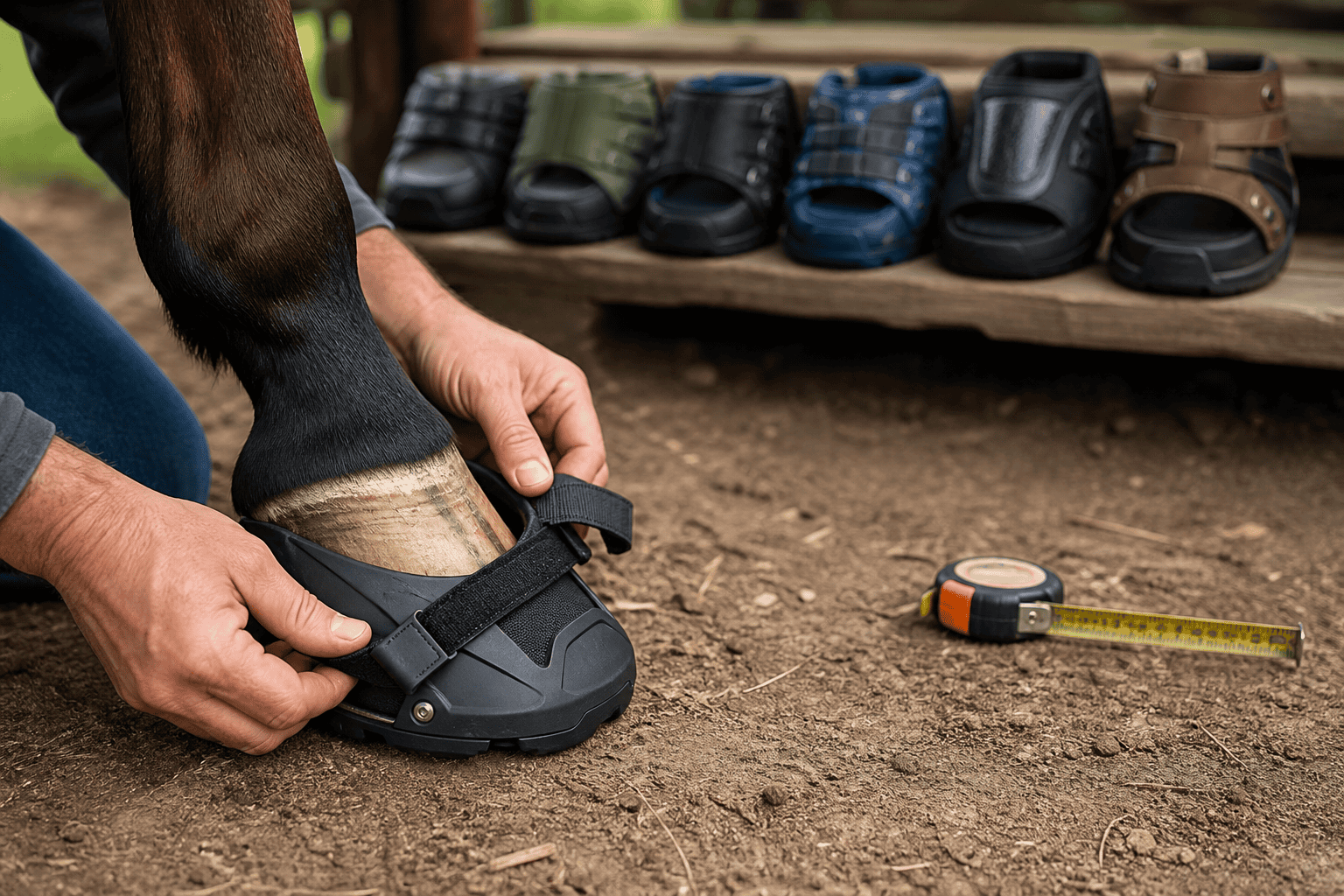
- Trim first, measure second. Measure a freshly trimmed hoof. A hoof measured at week six of a trim cycle is a different hoof from the one at week one, and that gap is where most sizing failures happen.
- Measure width at the widest point of the hoof, in millimetres.
- Measure length from the toe to the buttress line — the back of the weight-bearing surface, not the back of the bulbs.
- Measure all four. Front and hind hooves are rarely the same shape, and on many horses the two fronts differ too.
- Check the shape against the brand. Renegade splits its models by triangular versus round. Scoot Boot rules out flared and vertical walls. Swiss Galoppers rule out club feet. These are not upsells.
What We Could Not Verify
Stated plainly, because a buying guide that hides its gaps is worth less than one that shows them:
- Whether Cavallo sells wear parts separately, and on what terms.
- Retail pricing for any brand here. Hoof boot pricing moves and varies by dealer and region, so we have not printed figures that would be wrong within a season.
- Any independent, third-party durability testing for EasyCare, Scoot Boot, Cavallo, Renegade or Swiss Galoppers. We looked. If it exists, it is not published.
- Real-world lifespan figures from anyone other than the manufacturers.
The Verdict
Six companies, six philosophies, and one shared characteristic worth respecting: all of them are still run by people who make the product, and all of them publish enough for you to check the fit before you spend. That is genuinely uncommon in equestrian retail, and it is the reason no unbranded marketplace boot made this list.
If you want the deepest range and the most therapy options, EasyCare. If you want the lightest boot with the best spare-parts economics, Scoot Boot. If you want a boot that also works over shoes, Cavallo. If you want a US-made boot engineered against twisting, Renegade. If you want the only sole whose performance claim has been tested at a university, Equine Fusion. If you want the longest published service life and you accept that the figure is the company’s own, Swiss Galoppers.
The pattern here is the same one we found in turnout blankets and again in white-label saddle pads: the brands worth buying are the ones that tell you enough to hold them to it.
References
- Scoot Boots — company history, founders and manufacturing: scootboots.com/pages/about-us
- Telstra Best of Business Awards — Scoot Boots, 2018 Tasmanian Business of the Year
- Australian Rural & Regional News — Scoot Boot, 61st Australian Export Awards, December 2023
- EasyCare Inc. — company founding and product line, easycareinc.com
- Equine Fusion — testing conducted with Professor Lars Roepstorff, Swedish University of Agricultural Sciences, using the Orono Biomechanical Surface Tester: eqfusion.com/testing/testing
- Swiss Galoppers — published sole life (approx. 2,000 km), material and manufacturing location: swiss-galoppers.com
- Coast Reporter / Castanet, December 2024 — independent reporting on Cavallo boots supplied for the NFL Christmas Day halftime show
- Horse Canada, January 2025 — Cavallo, Beyoncé Bowl coverage
Hoof & Honest has no sponsorships and no brand deals. Every claim above traces to a published source, and claims we could not verify were left out or labelled as unverified rather than quietly dropped.