The Only 6 Breeches Brands You Can Still Trust
Advertising disclosure: this article contains affiliate links. If you buy through them, this site may earn a commission at no additional cost to you. Hoof & Honest was not paid by any brand named here, and no brand was given advance sight of this article.
A full seat breech at around $200 is supposed to last. Six months in, the silicone on the seat starts lifting at the edges and a seam opens behind the knee. Most riders blame themselves at that point. It must have been the sitting trot, or the detergent, or a saddle that rubs. Then they buy the same pair again, and over a few years that habit costs hundreds of dollars and a seat that slips on the day it needs to hold.
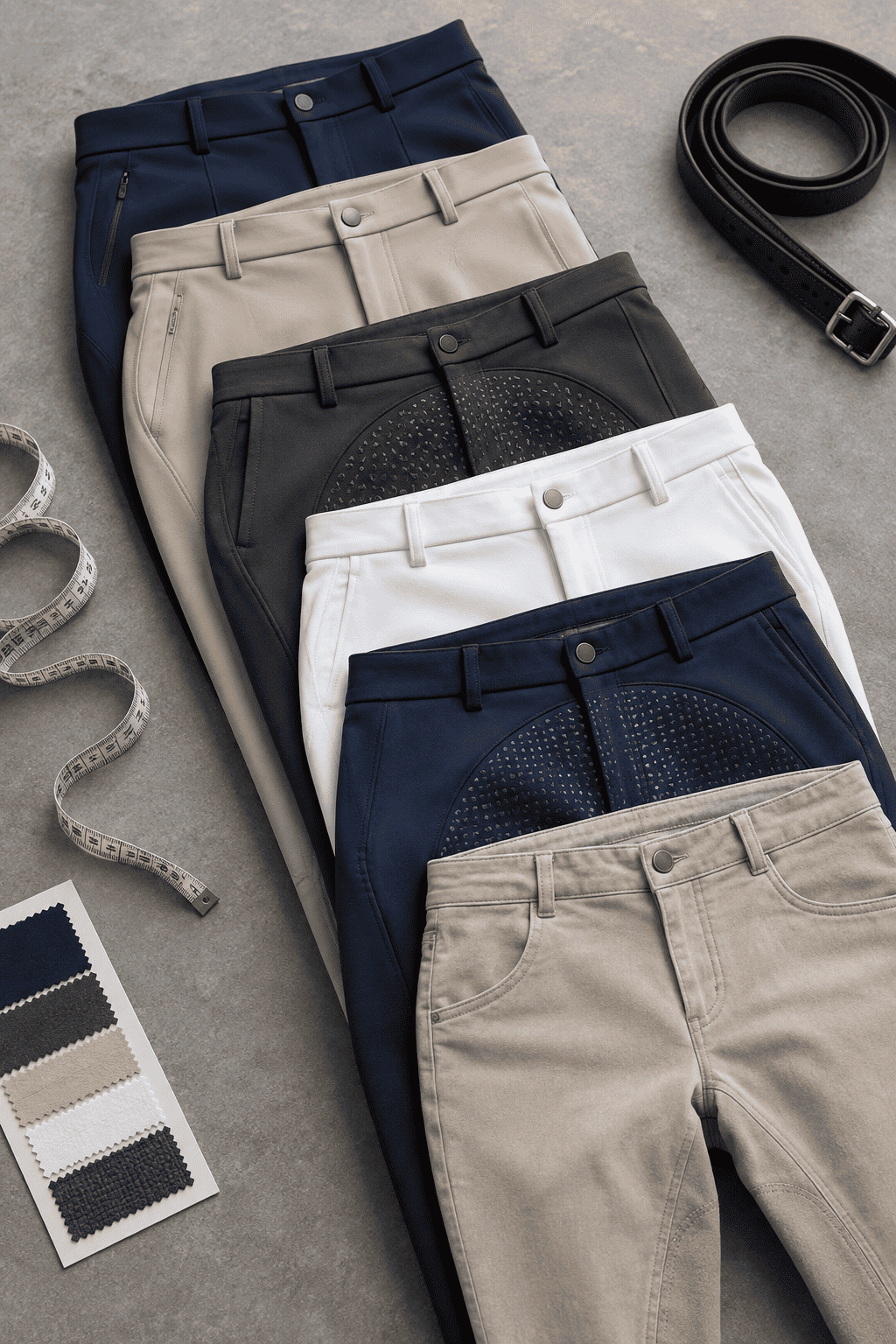
Breeches are the riding gear most of us replace on a schedule, and the marketing around them is mostly adjectives. So this article skips the ads and checks six brands against things a buyer can confirm: who started the company and why, what the breeches are made of, and whether riders who depend on their gear still choose them. Those six are Romfh, Kerrits, Cavalleria Toscana, Ariat, Tailored Sportsman and Pikeur.
All six pass on a traceable history and a plainly stated fabric. Three of them can show documented use at the top level of the sport, and only one, Tailored Sportsman, states that its breeches are made in the USA. Pikeur ranks first because Germany’s national equestrian teams have worn it since 1972. Ariat’s cooling claim is the one technical claim on this list that this review couldn’t find tested by anyone other than Ariat.
How the six were checked
- A history you can trace outside the brand’s own ads. A trademark filing, a founder interview or a retailer’s account counts. A tagline doesn’t.
- A fabric stated plainly. “Four-way stretch with a silicone full seat” counts. “Performance comfort technology” doesn’t.
- Documented use by riders who depend on their gear. Named sponsored riders, a national team or a federation partnership counts. Popularity at the local barn doesn’t, because it can’t be checked.
To make the list, a brand had to pass the first two checks. The third check, together with track record and a stated place of manufacture, decides the order.
The scorecard
| Brand | Founded | History traceable | Fabric stated | Pro use documented | Made where (as stated) | Verdict |
|---|---|---|---|---|---|---|
| 6. Romfh | 1996 (trademark filed) | Yes — USPTO filing, Dover Saddlery history | Yes | No | Not stated | Pass |
| 5. Kerrits | 1986 | Yes — founder interviews, company history | Yes | No | Not stated | Pass |
| 4. Cavalleria Toscana | 2008 | Yes — company profile, federation sponsorship | Yes | Yes — named sponsored riders, Italian federation sponsor (2023) | Italy (American breech) | Pass |
| 3. Ariat | 1993 | Yes — founder profile, company history | Yes, cooling claim untested | Yes — FEI partnership since 2015 | “Imported,” no country named | Pass, with note |
| 2. Tailored Sportsman | 1920 (trademark claim) | Yes — USPTO filings | Yes | No (hunter-ring reputation, not quantified) | USA | Pass |
| 1. Pikeur | 1957 | Yes — company chronicle | Yes | Yes — German national squads since 1972 | Not confirmed | Pass |
The price ladder
| Brand | Model | List price | Seat |
|---|---|---|---|
| Kerrits | GripTek II | About $139 | Full seat, grip |
| Ariat | Tri Factor Grip | $179.95 | Full seat, silicone grip |
| Romfh | Sarafina | About $200 | Full seat, grip |
| Tailored Sportsman | Trophy Hunter (sock bottom) | About $230 | Knee patch |
| Cavalleria Toscana | American | About $327 | Full seat, silicone grip |
| Pikeur | Candela, Lucinda | No US list price found | Full seat, grip |
Prices are list prices at the retailers named in the references, checked in October 2026. Dealers discount often, and colors and sizes can be priced differently.
Which pair fits which rider
| Brand | Best for | Trade-off |
|---|---|---|
| Romfh | Riders the standard size chart doesn’t fit | No stated place of manufacture |
| Kerrits | Schooling breeches on a budget | No documented top-level use |
| Cavalleria Toscana | Competing at a level where the breech has to look sharp all day | Highest price on the list, hard to justify for schooling |
| Ariat | Athletic fabric under tall boots at a mid-range price | Cooling claim untested, no country of manufacture named |
| Tailored Sportsman | The hunter ring and a classic look | Cotton blend, not a cooling knit |
| Pikeur | Riders who want the longest professional track record | No US list price found, smaller men’s range |
6. Romfh: cut for riders the size chart forgot
Laura Romfh grew up in a Florida riding family and was on a horse by the age of two. She studied fashion design at Parsons, designed clothes for surfers, and started her own company at twenty-five because the riding clothes she could buy made no sense to her. Dover Saddlery’s account of the brand puts her complaint bluntly: polos were boxy, and breeches were cut as if for little boys with no curves. The Romfh trademark was filed in December 1996.
Her first product wasn’t a breech. It was a show shirt in Coolmax, the wicking fabric runners and climbers already wore, and by Dover’s telling it was the first shirt of its kind in the riding market. The breeches follow the same thinking. The Sarafina, the model most tack shops stock, sells for about $200 in a soft technical fabric with a contoured waistband and a wide, non-binding cut through the hip. In 2020 Romfh said its breeches went up to a size 40. Anyone who has looked for a full seat above a 32 on a tack shop wall will know how unusual that is.
Romfh sits at number six because it can’t show the professional use the brands above it can, and it doesn’t say where its breeches are made. It earns its place on fit. On a podcast interview, Romfh has said the feedback that matters most to her comes from ordinary riders rather than the show ring, and the size range bears that out.
Check current Romfh Sarafina listings
5. Kerrits: the $139 breech that started with $50 of swimsuit fabric
In 1986, in Hood River, Oregon, Kerri Kent was fed up with swimsuits that didn’t fit. She was a windsurfer and ski racer, so she bought fifty dollars’ worth of fabric at the Jantzen outlet store and sewed her own. Her family skied rather than rode, and as a kid she had cleaned stalls in exchange for riding lessons.
As Kent has told the story in interviews, a 1991 New York Times piece mentioned her wish to make clothes for riders, and the CEO of the equestrian catalog company Eiser’s got in touch. The deal was to sell two thousand pairs of her riding tights before she could keep her own name on them. For the first two years the pants carried another company’s label inside and Kerrits outside, with packets of carrot seeds as hangtags. Kerrits says it brought the first performance riding tights to market that year. It’s still a women-led company designing in the Pacific Northwest.
The GripTek II full seat lists at about $139, the lowest price on this list. Kerrits describes a Coolmax-lined seat that’s needle-punched for airflow and a grip it says holds when wet, in sizes from XS to 2X. A low price here mostly means fewer layers of markup, not a worse breech. If schooling breeches get wrecked every muddy winter anyway, this is the pair that raises the question of why you’d pay more for them. For more brands where a lower price buys the same function, see the underrated tack brands that cost less than you’d expect.
Check current Kerrits GripTek listings
4. Cavalleria Toscana: the priciest pair, worn at the top of show jumping
Cavalleria Toscana is the youngest company here. It was founded in 2008 in Monsummano Terme, a small town in Tuscany, with the stated aim of making technical sportswear look elegant. Ten years in, according to a company profile, it was selling through more than three hundred shops worldwide.
Who rides in it is what moves it up the list. The brand names Scott Brash, Marcus Ehning, Lorenzo De Luca, Harry Charles and Adrienne Sternlicht among its riders, and in 2023 it was a main sponsor of the Italian equestrian federation (FISE). Sponsorship is paid, so it proves nothing about quality on its own. But riders at that level sit in the same pair through warm-up, two rounds, a jump-off and a prize-giving, and a breech that bags at the knee doesn’t stay in that kind of program long.
The American breech is its best-known model. It’s made in Italy in a four-way stretch technical fabric with a silicone grip, and the full seat lists at about $327. That’s more than twice the Kerrits price, and for everyday schooling it’s hard to defend. It makes sense for riders who compete often enough that the breech has to look right in the first class and the last. Where a purchase like this sits against everything else you spend on riding is covered in the seven levels of tack spending.
Check current Cavalleria Toscana listings
3. Ariat: athletic fabric, and a cooling claim nobody else has tested
Beth Cross grew up on a Thoroughbred farm in Pennsylvania, and the company name comes from Secretariat. She pitched the idea of athletic-shoe technology in riding boots to Reebok, and Reebok passed. In 1993 she and her Stanford Business School classmate Pam Parker started Ariat in California instead. Parker left two years later. Boots came first and are still what most riders know the brand for, and the breeches followed on the same idea. Ariat became a partner of the FEI, the international federation for equestrian sport, in 2015.
The Tri Factor Grip full seat is the one to know. Dover Saddlery lists it at $179.95 and describes a mid-weight compression knit with a silicone grip, and Ariat describes its ClimateTEK fabric as responding to body temperature to cool the rider. That cooling claim is Ariat’s own, and this review found no independent testing of it. The Dover listing also says only “Imported,” with no country named.
For riders who want athletic fabric that stays put under tall boots, at a lower price than the Italian option, this is the place to start. If you already ride in Ariat boots, the six riding boot brands that still earn trust puts those boots through the same kind of checks.
Check current Ariat Tri Factor listings
2. Tailored Sportsman: made in the USA under a 1920 trademark
The company’s trademark reads “Est. 1920” and describes it as a manufacturer of English riding habits. In 1920 a habit meant the whole outfit, cut to measure, not just breeches. The business has changed hands since then, and the current Tailored Sportsman company filed its own trademark in 2001. The model names nod to that history: the Trophy Hunter comes in versions numbered 1923, 1924 and 1927, depending on rise and zip.
Tailored Sportsman is the only brand on this list that states its breeches are made in the USA, which is rare in a category whose production mostly left the country long ago. The sock-bottom Trophy Hunter lists at about $230, in a woven cotton blend with four-way stretch and European-style seams down the outside of the leg. It’s the breech you see everywhere on the hunter-jumper circuit, though that reputation is easy to see and hard to measure, so it doesn’t count as documented professional use in the scorecard.
The fair criticism is the fabric. It’s a cotton blend, closer to a classic breech than to athletic tights, so riders who want a cooling knit should look at Ariat or Cavalleria Toscana instead.
Check current Tailored Sportsman listings
1. Pikeur: Germany’s national teams have worn it since 1972
Pikeur started in 1957 as Haefner & Co. in Westphalia and took the Pikeur name in 1964. By the company’s own account, that marked the start of industrial manufacturing of riding clothes in Germany. Before then, proper riding wear there was made to measure. The company is still family-run, by the Brinkmann family, from Werther in Westphalia.
Since 1972 Pikeur has outfitted the German national equestrian squads through the German Olympic Committee for Equestrian Sport (DOKR). It extended that partnership again in December 2024 and says it now dresses around nine hundred people across show jumping, dressage, eventing and driving. At the 2006 World Equestrian Games in Aachen it dressed the entire German team. In 2017 alone, by the company’s count, it supplied 525 people with more than 5,200 pieces of clothing. This is a paid partnership too. But one of the strongest riding nations in the world has kept renewing it for more than fifty years, and that’s the longest documented professional record of any brand here.
The breeches use four-way stretch fabrics, with grip full seats in the Candela and Lucinda lines. The men’s range is smaller than the women’s. Pikeur sits at the premium end, but this review found no US list price to compare directly with the other five.
One claim you’ll read in plenty of places is that Pikeur still sews everything in Germany. This review couldn’t find Pikeur saying that anywhere, so it isn’t repeated here as fact.
How to check a pair of breeches before you buy
- Read the fabric composition label, not the product name. The label tells you what the breech is made of. The name tells you what the brand wants you to feel.
- Look for a named country of manufacture. “Imported” tells you nothing about where or how the pair was made.
- Check the size chart range before you choose a model. Ranges differ widely, from XS–2X at Kerrits to size 40 at Romfh.
- Decide between full seat and knee patch for the riding you actually do. A hunter-ring knee patch and a dressage full seat are different breeches, whatever the price.
- Ask the retailer what happens if the grip lifts early. Keep the receipt and the care label, and ask about returns before you buy rather than after.
- Work out the cost per season. Add up what you spent on breeches over the last three years and divide by the seasons each pair lasted. That number is the real price.
What we could not verify
These gaps are stated here rather than left out.
- Durability. This review found no independent durability or wear testing for any of the six brands. The ranking rests on history, stated materials and documented professional use, not on lab tests.
- Ariat’s cooling claim. ClimateTEK’s cooling effect is Ariat’s own description. No independent test was found.
- Where four of the six are made. Romfh, Kerrits and Pikeur don’t state a place of manufacture that this review could confirm, and Ariat’s retailer listing says only “Imported.”
- Pikeur’s US price. No US list price was found for the Candela or Lucinda lines.
- Tailored Sportsman’s early history. The trademark claims 1920. Where the company started and how ownership passed before the 2001 filing couldn’t be confirmed.
- Kerrits’ founding story comes from Kerri Kent’s own interviews. The 1991 New York Times article and the Eiser’s deal weren’t checked against the original article.
- Prices change often and vary by retailer and color. The figures here are list prices from the sources named, checked in October 2026.
Claims that circulate widely but couldn’t be traced to a source were left out entirely, including Pikeur as a “world market leader” and unnamed rider testimonials.
Related reading
Breeches are one layer of what a rider wears. The five levels of rider protection covers the gear that matters most when something goes wrong, and the rider-to-horse weight math shows why everything you wear and carry counts toward the load on your horse.
References
- Pikeur: Chronicle, company history. pikeur.de
- Pikeur: News, DOKR partnership extended (December 2024). pikeur.de
- Kerrits: About Kerrits. kerrits.com
- NW Horse Source: An Interview With Kerri Kent. nwhorsesource.com
- Horse Illustrated: Kerri Kent interview. horseillustrated.com
- Kerrits: GripTek II Full Seat Breech, specifications, sizes and price (checked October 2026). kerrits.com
- Dover Saddlery: Romfh brand story. doversaddlery.com
- USPTO via Justia: ROMFH trademark, filed December 1996. trademark.justia.com
- Because of Horses podcast: Laura Romfh interview. becauseofhorses.libsyn.com
- Equine Exchange: Romfh, A Fit for All Riders (extended sizing, 2020). equineexchangestore.com
- Retail listing: Romfh Sarafina Full Grip, $199.95 (checked October 2026). walmart.com
- Businesscoot: Cavalleria Toscana company profile. businesscoot.com
- Cavalleria Toscana Group: Fieracavalli 2023 press kit (FISE main sponsor). fieracavalli.it
- Sprucewood Tack: Cavalleria Toscana American Full Seat Breech, list price (checked October 2026). sprucewoodtack.com
- Ariat: company history and FEI partnership. en.wikipedia.org
- EquiSearch: Beth Cross profile. equisearch.com
- Dover Saddlery: Ariat Ladies’ Tri Factor Grip Full-Seat Breech, specifications and price (checked October 2026). doversaddlery.com
- USPTO via Justia: The Tailored Sportsman Est. 1920 trademark. trademarks.justia.com
- USPTO via Justia: Tailored Sportsman LLC trademark (2001). trademarks.justia.com
- Tailored Sportsman: About Us. tailoredsportsman.com
- Farmhouse Tack: Tailored Sportsman 1923 Trophy Hunter, specifications and price (checked October 2026). farmhousetack.com