What a Saddle Is Actually Worth: Price Tiers Explained
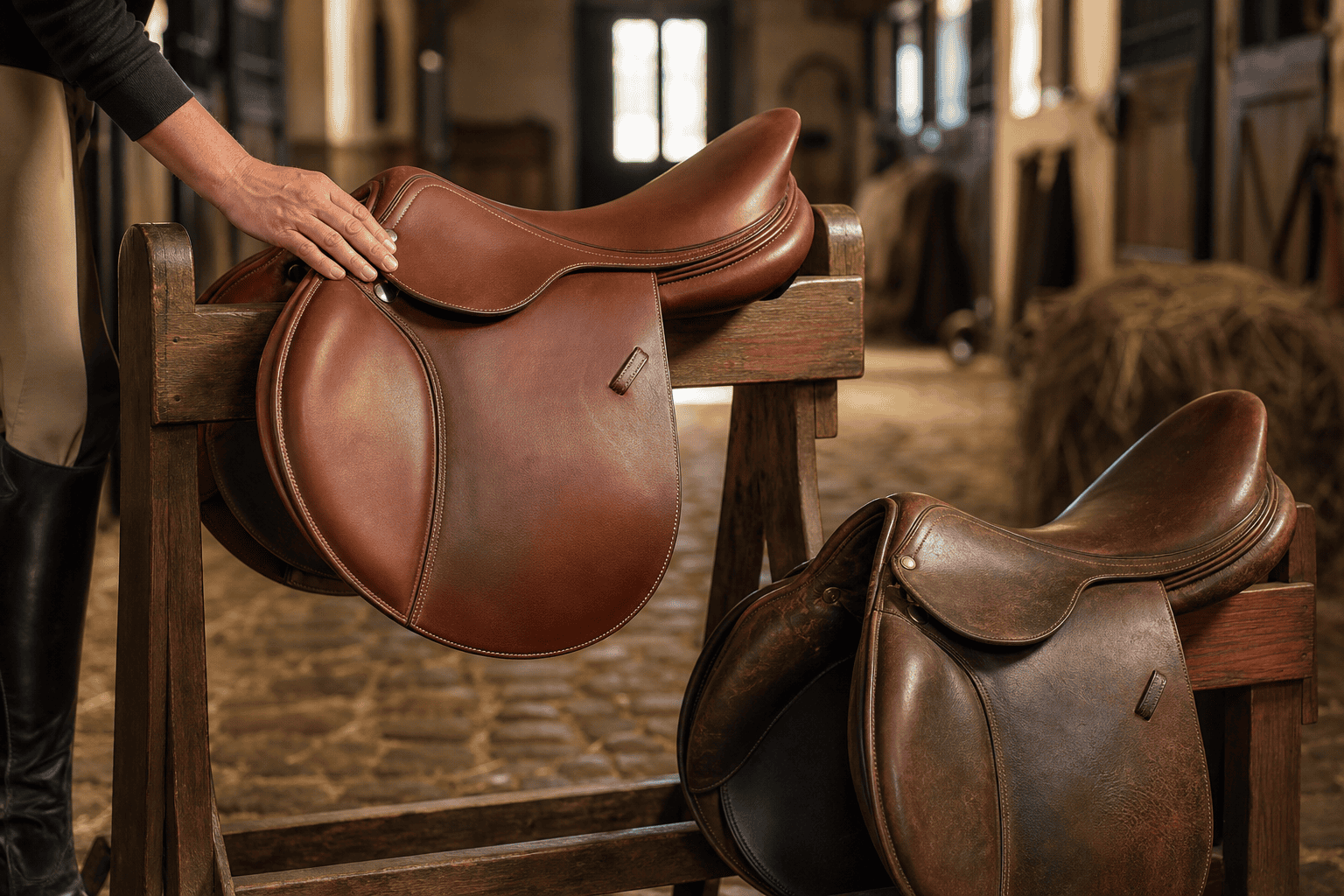
A new jumping saddle from one of the French houses — a CWD or an Antares — runs between five and eight thousand dollars, built to your measurements in a workshop in Nontron or Saumur. Three years later the same saddle, barely marked, sells secondhand for half of that, and often less. A Devoucoux that left the shop at six thousand turns up used at twelve hundred. The leather is the same, the tree is the same, the person who made it is the same. Only the badge has aged.
Most of what a rider pays for at the top of the saddle market has very little to do with the horse. It comes down to the name on the flap, the year stamped into the billet, and the person in the shop working on commission.
The price of a saddle and the fit of a saddle are two different questions, and the market makes its living on riders confusing the two. This is a tier-by-tier account of which is which.
First, the thing that actually decides value
What settles whether a saddle earns its price is the tree — the rigid frame inside that fixes the width and the shape — and whether that width matches the back of the particular horse it will sit on. You cannot see it through the flap. You cannot feel it in a showroom. And it decides everything else.
In one study of riding-sound horses, only about one in ten saddles was free of fit problems, and horses carrying a badly matched tree scored higher for back pain. When a tree is too narrow it stops resting on muscle and starts pressing into it, just behind the shoulder. The horse does the only thing available to it, which is to stop using the muscle. Over a season the muscle wastes, and you are left with those two hollow pockets beside the withers that people put down to age or attitude. It is not age. It is a pressure sore nobody thought to look for.
We go further into the mechanics and the research in our piece on the tree you cannot see. Here we are following the money.
Where the money goes wrong
Buying a French house saddle new
CWD, Antares, Devoucoux, Butet. To be plain about it, these are very good saddles. The leather is excellent and the trees are honestly built. What is not good is buying one new.
The price at the counter is five to eight thousand, and the moment it is ridden it starts losing value faster than a car — down to half within a few years and still falling. A rider who buys new is paying several thousand dollars for the smell of the box, and for the fact that nobody sat in it first.
The fixed tree at a premium price
A great many expensive saddles are built on a single tree that cannot be altered. It fits the horse in the shop, on the day. But a horse does not hold still in its shape — it gains muscle and loses it, ages, changes across the seasons. When the horse changes, the four-thousand-dollar saddle does not, and the rider is back where they began. They paid the top price to rent a fit for one summer.
The pure fashion markup
A saddle sold under a luxury fashion name, at a luxury fashion price. For the horse it is the same tree and the same panel work the middle of the market delivers for a fraction of the money. You are not buying a better ride. You are buying the logo, and the logo does nothing for the animal underneath it.
The commission sale
The most expensive saddle most people ever buy is the one a salesperson on commission talked them into with the horse nowhere in the room. No measurements taken, no back profiled, sold to the rider’s eye and the rider’s seat size in a color they happened to like. That saddle can be any price at all and still be the wrong one, because nothing about the horse ever entered the decision.
The sub-$200 copy
The bottom of the market has its own trap, and it is the one that can genuinely hurt somebody. A saddle with a name you have never heard of, or no name at all, priced under two hundred, that looks in the photograph like the expensive ones.
A good number of these are copies coming out of the same few overseas workshops, and fitters who open them up find softwood trees and webbing held on with staples instead of stitching. A cheap tree cracks. A cracked tree is invisible from the outside and dangerous under a rider, and putting a new one in runs eight hundred to fifteen hundred dollars — more than the saddle ever cost, so nobody does it. The rider did not save money. They bought the thing twice, and the horse carried the difference in its back.
Where the money is well spent
Adjustable-gullet synthetics, a few hundred dollars
The best value in the whole business sits close to the cheapest thing in it. A Wintec or a Thorowgood, synthetic, built around an adjustable gullet. One saddle, a handful of interchangeable plates, refitted in a few minutes when the horse changes shape or the next horse arrives.
The same firm that makes Wintec makes Bates and Arena as well — three names out of one workshop — and the trees carry a guarantee that turns out to be real. Riders have sent in a cracked tree years down the line, on a saddle bought secondhand with no receipt, and had it replaced for nothing. That does not happen with a badge.
Stubben, a step above and worth the step
Built to order in Europe, on a sprung tree with an adjustable steel gullet and a safety bar set into the stirrup, by a family firm that has been doing it since 1894. It is not cheap. But the money goes into the tree and the years of use rather than the name, and a Stubben holds its value instead of falling off the cliff the French saddles fall off.
Handmade British makers, for the hard-to-fit horse
For the wide flat-backed sort, or the high-withered one a standard tree pinches, the answer is Black Country, County or Albion. Wool-flocked panels a fitter can open up and adjust to that exact back, on serious trees, in width fittings the mass brands do not trouble to offer. You are paying a craftsman for adjustability that lasts the horse’s life, and that money stays with you.
The used French saddle
The same depreciation that makes a new French saddle a poor buy is what makes a used one a good one. That identical CWD or Devoucoux, bought secondhand at half the price and checked over by an independent fitter before any money changes hands, is world-class leather and a world-class tree for the cost of a mid-market saddle.
The one condition is the fitter. The single thing you cannot afford to skip is having the tree looked at first.
The best money in the market is not a brand at all
It is the independent fitter who takes no commission, who measures the horse and matches the tree and comes back to check it as the horse changes through the year. A couple of hundred dollars, and it is the thing that turns any decent saddle into the right one.
Skip it, and the finest name in the world is still a guess.
None of this is hidden, exactly. It is just quieter than the showroom, and it does not come stamped on the flap where anyone would think to read it.
Related on Hoof & Honest: the five levels of saddle fit · the seven levels of tack spending · synthetic vs leather saddles · how old is too old for a saddle