Cheap Horse Grooming Brands That Beat the Expensive Ones
The company that makes Mane ‘n Tail also makes Cowboy Magic. It also makes Exhibitor’s. All three sit inside Straight Arrow Products, a family business started in 1970 by Phil and Bonnie Katzev on an Arabian horse farm in New Jersey, and the company still manufactures its own products in Pennsylvania rather than handing the work to a contract filler.
A gallon of Mane ‘n Tail Original Shampoo sells for around $30. Sixteen ounces of Cowboy Magic Detangler sells for around $15. Nobody standing in the aisle is told that both bottles came out of the same operation.
Grooming is the category where the distance between what a product costs and what the horse actually receives from it is widest. The formulas are cheap to make and easy to brand, and a buyer has no practical way to test one bottle against another at home. So the shelf sorts itself by price and by how the label looks, and most people assume those two things are connected.
This is the same structural pattern we traced through saddle pads in why a $30 pad and a $150 pad share a factory. Grooming is where it runs deepest, because the unit prices are small enough that nobody bothers to check.
The only test that matters
Before any brand names, the part about the horse.
Equine skin sits close to neutral. Research presented in the Journal of Animal Science in 2023 measured cutaneous pH across body locations, times of day and weather conditions, and put the mean at 7.14 — drifting from roughly 7.28 in the morning down to 7.01 by evening. Human skin is acidic, generally somewhere between 4.5 and 5.5.
That difference is the whole reason horse shampoo exists as a separate product rather than as a marketing exercise, and it gives you the only test worth applying:
- A shampoo has to clean without stripping the sebum that waterproofs the coat, and leave the skin at an acidity it can return to unaided.
- A brush has to lift dirt off the skin and carry the oil back down the hair shaft.
- A detangler has to cut the friction that snaps hairs when a comb drags through a knot.
Past that, most of what appears on a grooming label is decoration. Price tells you nothing about whether a product passes.
Worth adding, because it undoes more coats than any bad product does: the most common grooming mistake is not buying the wrong bottle, it’s washing too often with the right one. Sebum takes days to come back after a bath. A horse curried daily and washed occasionally is in better condition than a horse washed weekly with the mildest shampoo on the shelf.
What these products actually cost per ounce
The single most useful thing you can do in a tack shop is convert everything to a unit price. Here is what that looks like across the products named in this article. Prices are typical US retail as checked in August 2026, not current prices at any single retailer, and they will move — the ratios are the durable part.
| Product | Size | Typical price | Per ounce |
|---|---|---|---|
| Mane ‘n Tail Original Shampoo | 32 oz | $10.32 | $0.32 |
| Mane ‘n Tail Original Shampoo | 1 gallon (128 oz) | $29.99 | $0.23 |
| Cowboy Magic Detangler & Shine | 16 oz | ~$15 | ~$0.94 |
| Shapley’s Original M-T-G | 32 oz | ~$20 | ~$0.63 |
| Weaver dandy brush | — | $10.69 | — |
| Weaver goat hair / horsehair brush | — | $13.29 | — |
| Weaver Tampico brush | — | $16.39 | — |
| Haas body brushes (range) | — | $22.05–$35.10 | — |
Where to find these. The products named above, linked for convenience. These are affiliate links, which means Hoof & Honest earns a small commission if you buy through one, at no extra cost to you. Nothing was supplied or paid for by a manufacturer, and no brand knows it is on this list.
- Mane ‘n Tail Original Shampoo, 32 oz — the cheapest thing Straight Arrow makes, and the one built to fix a skin problem
- Cowboy Magic Detangler & Shine, 16 oz — the silicone-and-silk formula in the comparison below
- Absorbine ShowSheen Detangler Gel — the separate company running the same silicone stack with argan oil on the front
- Shapley’s Original M-T-G, 32 oz — check the label reads Original rather than M-T-G Plus, which is a different formulation without the four percent sulfur
- Weaver Leather dandy brush and a wooden-block Tampico brush — the natural fibre that keeps its stiffness wet
- Haas body brushes — the premium comparison, for the reasons set out further down
Two things fall out of that table immediately. The gallon of Mane ‘n Tail costs roughly 40% less per ounce than the quart of identical liquid, and the quart is the one stocked at eye level. And the premium brushes cost between 1.7 and 3.3 times the budget equivalents made from the same fibres.
1. Mane ‘n Tail
Mane ‘n Tail exists because of the test above, which is unusual for a grooming product.
In the early 1970s the Katzevs were showing Arabians, and the accepted way to wash a horse was dish detergent. Dish detergent is engineered to dissolve grease, and sebum is grease, so it did the job and left the coat dry, dull and unprotected. Phil Katzev had a background in chemistry. He built a conditioner to counteract what the detergent was doing, and the shampoo followed.
That is an origin story starting from a skin problem rather than from a gap in a catalogue — and today it is the cheapest thing the company makes. Cowboy Magic and Exhibitor’s, produced by the same company under the same quality system, sit several shelves up and several dollars higher. Exhibitor Labs was acquired by Straight Arrow on 22 September 2017; Cowboy Magic was bought from its founding family before that. What the extra buys is positioning.
The detanglers, side by side
The clearest single example in the category. Read the two ingredient decks:
- Cowboy Magic Detangler & Shine: cyclomethicone, dimethicone, panthenol, hydrolysed silk, a UV filter, vitamin E acetate, fragrance.
- Absorbine ShowSheen Detangler Gel (a completely separate company): cyclopentasiloxane, cyclomethicone, dimethiconol, dimethicone, phenyl trimethicone, argan oil, fragrance.
Both are a stack of silicones with one signature ingredient added on top and printed on the front of the bottle. The silicones do the detangling — they coat the hair shaft, drop the friction, and let a comb pass through a knot instead of tearing through it. That matters, because tearing through knots is how tails get thin, and a tail takes years to grow back.
The silk protein and the argan oil are real ingredients, but they sit near the end of the list where concentrations are low, and neither is doing the detangling. One bottle says silk, the other says Morocco, and both are moving the comb with dimethicone.
One safety note that applies to every product in this class. Silicone is slippery by design and should not go anywhere the saddle or the girth sits. A treated wither is a shifting saddle, and a shifting saddle is a sore back — the mechanism we covered in saddle pads you should never buy. That instruction is printed on most of these bottles and read by almost nobody.
2. Wahl
The argument for Wahl is arithmetic rather than chemistry.
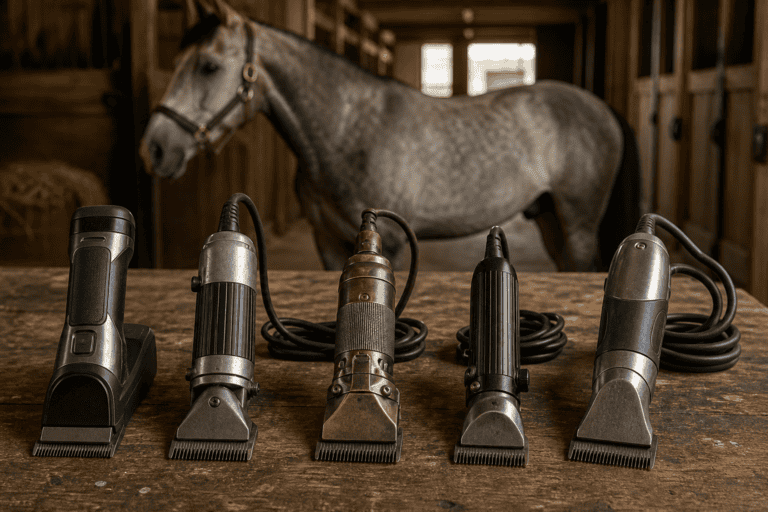
Wahl is a clipper company that has been making animal grooming equipment for more than a century. Its equine shampoos, sold under the Showman name, are supplied as 15:1 concentrates in five-litre containers built for professional grooming rooms. That means 500ml of concentrate makes 7.5 litres of working shampoo. If you are buying clippers rather than shampoo, the five horse clipper brands you can still trust compares them.
A premium ready-to-use bottle is water with surfactant in it, and you are paying to ship the water, store it, and carry it out to the yard. The concentrate is the same product with the water left out, added at the wash bay from a hose that already runs there. Per wash, this is not marginally cheaper — it is cheaper by a different order of magnitude, and the coat cannot tell which bottle the surfactant arrived in.
The caveat is real, and it explains why concentrates have a mixed reputation. Eyeballing a dilution over-concentrates it, and an over-concentrated wash strips more sebum than a correctly mixed one does. A £3 measuring jug fixes that permanently. Most people who tried a concentrate once, disliked it, and went back to ready-to-use had simply mixed it wrong.
3. Weaver Leather
A brush is a handle and a fibre, and the fibre does all the work.
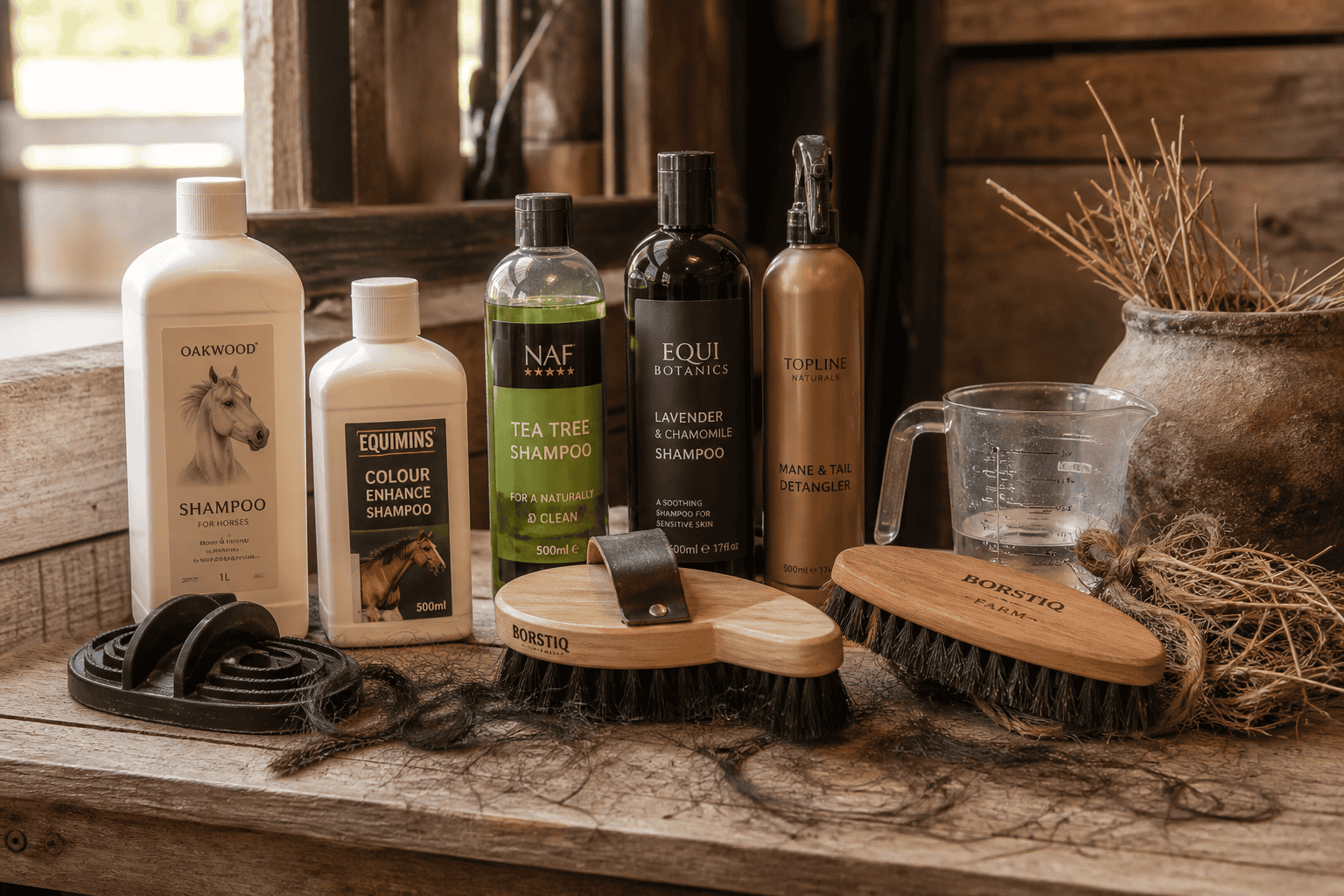
Premium brands cost what they cost partly because natural fibre is expensive, and natural fibre is worth having — it holds oil, moves it along the hair shaft, and doesn’t build the static charge synthetic bristles generate on a dry winter coat. Weaver has been manufacturing for over forty years and sells natural fibre brushes across the same range of materials the premium houses use, at roughly a third to a half of the price.
Tampico deserves a moment, because it is the fibre most people have used without knowing what it is. It’s cut from Agave lechuguilla, a cactus growing in the high-altitude deserts of northern Mexico. The leaf is harvested, the fibres inside are pulled out, dried and cut to length, and what you get is a bristle that keeps its stiffness when wet and springs back to shape afterwards — precisely what you want in a brush that spends half the year in a bucket of muddy water. It is not a budget substitute for something better. It is the same material the better brushes are made of.
A hygiene argument that has nothing to do with price. Fungal and bacterial skin conditions travel on shared bristles, which is why yards that pass one grooming kit down a row of stables tend to pass ringworm down it as well. At $10 a brush, a separate kit per horse is an easy decision. At $35 a brush it stops being one. That is a case where the cheap brand protects the horse better than the expensive brand does.
4. Lincoln
Lincoln repeats the opening pattern on a different continent.
The brand belongs to Battle, Hayward & Bower, a manufacturer operating in the city of Lincoln in England since 1832, from a five-acre site north of the city. Their facilities are registered with the Medicines and Healthcare products Regulatory Agency to produce licensed veterinary pharmaceuticals, which means the site filling a £5 bottle of hoof oil is inspected to the standard required for making animal medicines. That registration is not a badge bought for a brochure — it means documented batch records and inspection of the premises, and it attaches to the facility rather than to any single product line. A shampoo filled in that building is not a licensed medicine, but it is filled inside a system built to make one.
Lincoln itself launched in 1981, in the black bottles with yellow lids that turn up in almost every British tack room. The same company also owns Supreme Products — the brand selling grooming sets in a wooden box with a leather handle at several times the price — along with Hydrophane and Dermoline.
None of this is concealed. The brand families are listed openly on the company’s own website. Very few buyers spend the ten minutes it takes to find that out, because nothing on either package suggests the budget bottle and the luxury box come off the same site.
5. Shapley’s
Shapley’s is here for a different reason than the other four.
Original M-T-G is one of the few products in this category with an ingredient list short enough to read on the bottle: sulfur at 4% as the active ingredient, then mineral oil, zinc stearate, glycerin and rectified cade oil (a distillate of juniper wood with a long history of use on skin). There is no proprietary complex and nothing you have to take on trust. You can read that list, work out roughly what each part is doing, and price it against anything sold as a medicated treatment at four times the cost.
Two honest notes, both of which matter more than the price.
The manufacturer’s material and a great deal of the retail copy around it claims up to three inches of new mane and tail growth in a month. That figure traces back to user reports rather than to any published measurement, and it has no place in a buying decision. We’ve left it out of our own recommendation entirely.
The second is printed on the label. The formula is oil-based, so it can make skin sensitive to sunlight — the instructions tell you to keep the horse out of intense sun after applying, and to patch test first, because sulfur allergies exist and generally show up within 24 to 48 hours. An oil sitting on the coat also collects dust. This is an evening product on a horse coming in, not a morning product on a horse going out to a summer field.
Where the expensive brands genuinely earn it
An article with this title owes you the boundary.
Haas has been making brushes in the same region of Germany for over a century, and the construction is genuinely different. The bristles and the handle are set directly into the body of the brush without glue, screws or nails — so there is no metal to work loose and end up against a horse’s skin, and no adhesive to fail after the brush has been soaked and dried a few hundred times. On a fine-coated horse, a dense natural-bristle body brush at that level brings up a finish a $15 brush does not quite reach. That is a real difference and it is worth real money to the right person.
Natural bristle also carries a maintenance cost nobody mentions at the till. Wooden-backed brushes warp if soaked and left wet, and natural fibre collapses if stored damp. A $35 brush living in an open bucket outside a stable will not outlast a $15 synthetic one. The premium price buys a better tool, not a more forgiving one.
And the order matters more than the brand. A $35 finishing brush laid onto a coat that hasn’t been curried properly achieves very little, because the finishing brush is the last step of a process and the rubber curry at the start is the step that actually lifts the dirt and stimulates the skin to produce oil. Buying the expensive brush before you own the cheap one is the most common way people spend money in this category and get nothing back.
What we left out
Three claims came up during research and did not survive it:
- Three inches of mane growth per month (Shapley’s M-T-G). Traceable only to user reports, not to any published measurement.
- Horse skin pH of 6.3. Published on a shampoo brand’s own blog, and contradicted by the peer-reviewed mean of 7.14. We used the research figure.
- Cowboy Magic’s founding year. Sources split between 1979 and 1995, so we didn’t state one.
If you want the same treatment applied further up the price ladder, what a saddle is actually worth breaks down the tiers, and underrated tack brands that cost less than you expect covers the same argument across leather goods.
Sources
- Discepolo, Perry & Gaare, Fluctuations in Equine Cutaneous pH and Trans-Epidermal Water Loss, Journal of Animal Science, 2023
- Straight Arrow Products — company history and brand families
- Exhibitor Labs acquired by Straight Arrow Products, FOCUS Investment Banking, 22 September 2017
- Cowboy Magic Detangler & Shine — manufacturer ingredient listing
- Absorbine ShowSheen Detangler Gel — ingredient listing
- Battle, Hayward & Bower — company profile and MHRA registration
- Shapley’s Original M-T-G — label ingredients and cautions
- Natural Tampico fibre (Agave lechuguilla) — source and processing
- Haas brush construction — no glue, screws or nails
Hoof & Honest was not paid for this article. No manufacturer paid for a mention here, supplied a product, or saw a draft before publication. Some links on this page are affiliate links, and a purchase made through one earns us a small commission at no extra cost to you. Which products appear was decided before any link was added, and brands that failed our criteria stay unlinked. As an Amazon Associate we earn from qualifying purchases. Every claim above is traced to a primary source, and anything we couldn’t trace, we dropped.