The 5 Levels of Rider Protection (Most Riders Stop at the Helmet)
On September 19, 2026, jockey Martin Garcia went down in a six-horse spill at Churchill Downs. A horse stepped on his face, his back, and his helmet. He came away without a head injury, and told Thoroughbred Daily News, “That helmet definitely saved my life.” He also came away with six broken ribs, four cracked vertebrae, and a punctured lung.
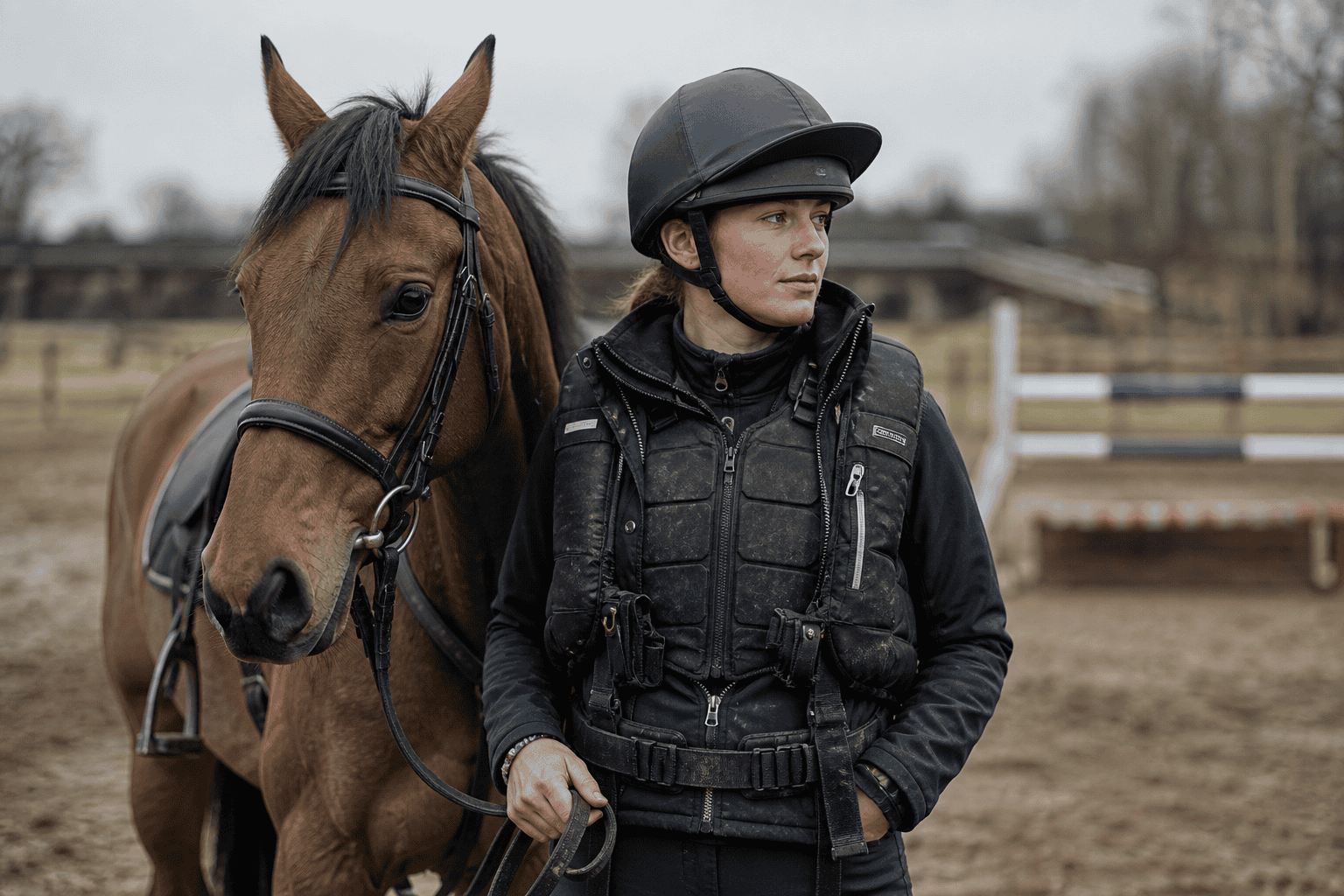
His helmet did everything a helmet can do, which is exactly the point. For most riders, a certified helmet is the only protection they own, and it covers one region of the body. Eventers and cross-country riders, who fall more often and at higher speed than almost anyone, stack their protection in layers: a better helmet, a body protector, often an air vest on top.
This article ranks those five layers, from the bare minimum to the very top, and checks each one against published standards and research rather than marketing. The short version: Levels 5 and 4 (a current ASTM/SEI helmet, then one with a MIPS liner) are the cheapest, best-supported upgrades. Level 3 (Snell E2021) is the strictest helmet test available, carried by only a small number of models. Level 2 (a BETA 2018 Level 3 body protector) covers what no helmet can. Level 1, the air vest, is the layer riders trust most and the one with the weakest independent evidence so far.
The five levels at a glance
| Level | Layer | What it protects against | What to look for | Strength of evidence |
|---|---|---|---|---|
| 5 | ASTM/SEI-certified helmet | Direct, straight-on impacts to the skull | ASTM F1163-15 or F1163-23 with SEI mark | Strong: field data from the US Pony Club |
| 4 | MIPS liner | Rotational force from angled impacts | MIPS plus ASTM/SEI on the same helmet | Lab-based; no equestrian field data found |
| 3 | Snell E2021 helmet | Harder impacts, more angles, higher speeds | Snell E2021 label (not E2016) | Stricter test standard; no field comparison found |
| 2 | BETA 2018 Level 3 body protector | Chest, ribs, spine, organs, soft tissue | Blue/turquoise BETA 2018 Level 3 label | Required for cross-country in British Eventing and UK Pony Club |
| 1 | Air vest | Torso and neck, once the rider leaves the saddle | NF S72-800 certification; worn over a body protector | Weak and mixed (see Level 1) |
Why one helmet is not the finish line
The case for helmets is not in question. Medical examiner reports cited by university extension programs attribute 60 percent or more of horse-related deaths to head injuries. A 2021 analysis of ten years of the US National Trauma Data Bank (Mutore et al., 2007–2016) found that head and neck injuries accounted for nearly 75 percent of equestrian deaths, and concluded that the risk of hospital admission from equestrian injuries is higher than from football, motor racing, or skiing.
The same analysis found that the most frequent injury region was not the head at all. It was the thorax. A helmet answers for the injury most likely to kill you, and leaves the injury most likely to happen untouched. Concussion is common even among experienced riders: in a 2014 survey of 94 competitive riders in Wellington, Florida, 44 percent reported at least one concussion during their riding career.
Level 5: An ASTM/SEI helmet, the floor most riders treat as the ceiling
ASTM F1163 is the specification riding helmets are tested against, and the Safety Equipment Institute (SEI) certifies helmets that pass it. Under the current version, helmets are conditioned at ambient temperature, cold, heat, and after water immersion, then impacted on a flat anvil and an equestrian hazard anvil. Per published test parameters for F1163-23, the flat-anvil drop is from 1.8 meters, roughly six feet, and a helmet fails if more than 300 g reaches the headform.
The field results are the reason this level matters. After the United States Pony Club required ASTM-certified helmets in 1990, a surveillance study (Nelson et al., 1994) recorded a 26 percent decline in head injuries, a 62 percent decline in facial injuries, and a 29 percent decline in concussions over the following two years. The American Medical Equestrian Association estimates that ASTM/SEI helmets have reduced all riding-related head injuries by 30 percent and severe head injuries by 50 percent; extension sources that cite this figure note it is an estimate rather than the result of a formal study.
How to check your current helmet
- Read the label under the liner. The US Pony Club lists ASTM F1163-15 and ASTM F1163-23 with the SEI mark as the current acceptable versions. Anything older should be retired.
- Find the manufacture date. SEI-certified helmets carry it under the headliner alongside the SEI seal.
- Replace after any fall where the helmet hit something. The foam crushes to absorb the impact and does not recover, even when the shell looks intact.
- Replace every five years regardless, the interval most manufacturers and safety organizations recommend, because glues, resins, and plastics degrade with sweat, heat, and UV.
The limit of this level is built into the test. The ASTM drop is linear: the helmet falls straight onto the anvil, and the standard sets no limit on rotational acceleration. That is the gap Level 4 exists to close.
Level 4: MIPS, built for the way riders actually fall
Riders rarely hit the ground head-first and straight down. In a University of Kentucky trauma registry review (2003–2007), falling off was the most common injury mechanism, at 54 percent of cases, and falls from a moving horse tend to produce angled impacts. An angled impact makes the head rotate, and rotational acceleration is what strains brain tissue.
MIPS (Multi-directional Impact Protection System) is a low-friction layer between the helmet’s foam and the comfort padding. According to MIPS, it lets the head move 10 to 15 millimeters (up to about half an inch) relative to the helmet in any direction during an angled impact, which is intended to reduce the rotational motion passed to the brain. MIPS states that the system weighs 25 to 45 grams, roughly one to one and a half ounces, depending on the helmet. If you are counting every ounce your horse carries, it barely registers next to the other numbers in the real math on rider-to-horse weight.
From the outside, a MIPS helmet looks identical to a standard one. What matters is that it carries both layers: the liner and a current ASTM/SEI certification.
| Helmet | MIPS | ASTM/SEI certification (as published) | Other certifications listed |
|---|---|---|---|
| One K CCS with MIPS | Yes | ASTM F1163-23 / SEI | EN 1384:2023 (per retailer listing) |
| Charles Owen MyPS | Yes | ASTM F1163-23 / SEI (wide-peak version, per Charles Owen) | PAS 015:2011 and VG1 Kitemarks, VG1 CE |
| Tipperary Windsor MIPS | Yes | Tipperary states all its helmets are SEI-certified to F1163-23 | Not checked |
| Uvex Exxential II MIPS | Yes | ASTM/SEI per secondary sources only | Not checked |
We did not find equestrian field data showing how much MIPS reduces concussions among riders. Figures such as “up to 40 percent” circulate widely but we could not trace them to a primary equestrian source, so they are not repeated here. What is established is the mechanism and the gap it addresses: the standard ASTM test does not measure rotation.
Level 3: Snell E2021, the strictest helmet test few models carry
The Snell Memorial Foundation has tested helmets independently since 1957. The US Pony Club describes Snell’s equestrian standard as the most rigorous available, with impacts at different angles and higher speeds. Snell’s current equestrian standard, E2021, took effect on October 1, 2021.
In 2023, US Equestrian amended rule GR801.2 to accept Snell-certified helmets alongside ASTM/SEI for competition, effective December 1, 2023. The Snell Foundation’s own announcement says the board approved helmets certified to both E2016 and E2021. The US Pony Club is stricter: since its December 2024 policy update it lists only E2021, and calls E2016 helmets out of date.
| Standard | Accepted by US Equestrian | Accepted by US Pony Club | Notes |
|---|---|---|---|
| ASTM F1163-23 / SEI | Yes | Yes | Current version |
| ASTM F1163-15 / SEI | Yes | Yes | Still accepted |
| Snell E2021 | Yes | Yes | Current Snell equestrian standard |
| Snell E2016 | Yes (per Snell’s announcement) | No | Treated as out of date by the Pony Club |
Snell publishes every model it has certified. Its current E2021 list includes helmets from ARRO, Champion, Charles Owen (the 4Star skull cap), and Gatehouse, among others. ARRO states that it is the only equestrian helmet to carry both Snell certification and MIPS; that is the manufacturer’s claim, and we did not independently confirm that no other model does.
Why so few models? Manufacturers choose which standards to test against, and an ASTM/SEI label already qualifies a helmet for US competition. Independent testing that goes beyond the minimum is rare across tack generally; the same pattern shows up in the five levels of leg protection, where only a couple of boot makers publish independent impact results at all.
Level 2: A BETA 2018 Level 3 body protector
This is where protection leaves the head. Garcia’s injuries were all below the helmet: ribs, vertebrae, lung. A body protector is a foam garment certified to absorb impact across the chest, back, and ribs, and the most widely recognized certification comes from BETA, the British Equestrian Trade Association.
The current BETA 2018 standard has three levels. British Eventing describes Level 3 as the level recommended for working with horses and for jumping and eventing, protecting the chest, ribs, abdomen, and internal organs against impact and soft-tissue injury. The levels are color-coded on the label, and the colors changed between the 2009 and 2018 versions, which is where many riders get caught out.
| BETA level | Intended use | 2018 label color | 2009 label color |
|---|---|---|---|
| Level 1 | Licensed jockeys only | Green | Black |
| Level 2 | Lower-risk riding; jockeys where specified | Orange | Gold |
| Level 3 | General riding, jumping, eventing, working with horses | Blue / turquoise | Purple |
From January 1, 2024, British Eventing, British Riding Clubs, and the Pony Club in the UK stopped accepting the purple 2009 Level 3 label; British Eventing granted a grace period to April 8, 2024 because of supply problems. BETA itself has said riders may keep using 2009 protectors for general riding where no rule applies. BETA and retailers recommend replacing a body protector every three to five years, because the foam degrades.
- Check the label: BETA 2018, Level 3, blue or turquoise.
- Get it fitted: BETA recommends fitting by a trained retailer. It should sit snug without restricting movement in the saddle.
- Replace on schedule: three to five years depending on use and care, or sooner after a heavy fall.
Level 1: The air vest, the layer with the weakest evidence
An equestrian air vest is tethered to the saddle by a lanyard. When the rider separates from the horse, the lanyard pulls, a CO2 canister fires, and an airbag inflates around the torso and, on many models, the neck. “My air vest saved my life” is the phrase Point Two, one of the best-known makers, says it hears from riders, and it features prominently in the company’s marketing.
| Model | Published inflation time | Hold time | Certification listed | Source |
|---|---|---|---|---|
| Point Two (ProAir, Hunter Showjumper) | 60–80 milliseconds | 15–20 seconds, then deflates over 2–3 minutes | CE (per retailers) | Point Two |
| Hit-Air Advantage H2 | About 0.09 seconds | Not published in sources reviewed | CE, NF S72-800:2022 | Hit-Air retailer listing |
NF S72-800 is a French standard written specifically for equestrian airbags. Hit-Air’s retailers describe it as the first and only such standard; we report that as their description.
What the independent research found
| Study | What was tested | Finding |
|---|---|---|
| Transport Research Laboratory for British Eventing (2016) | A horse carcass dropped onto a crash-test dummy wearing a BETA 2009 Level 3 body protector, with and without an air jacket | Estimated probability of severe chest injury fell from 94% to 81% with the air jacket. Fatal and serious injuries still highly likely if a horse lands on the rider. |
| Nylund et al., universities of Melbourne and Sydney (2019) | FEI eventing competition falls, 2015–2017 | Riders wearing air jackets had 1.74 times the odds of serious or fatal injury. The authors state this does not show the vests cause harm; riders taking more risk may be more likely to wear one. No evidence the vests reduced injury. |
Neither study proves air vests are useless, and the TRL test shows a measurable effect in one crush scenario. But the independent evidence is far thinner than the testimonials, and that is worth knowing before an air vest goes to the top of a spending list. Where safety gear sits in an overall budget is a separate question, covered in the seven levels of tack spending.
If you wear one, set it up correctly
- Wear it over a BETA 2018 Level 3 body protector, never instead of it. Eventing rules that permit air vests for cross-country require this combination.
- Set the lanyard length for your riding position, so it fires on a genuine separation and not a lean.
- Replace the canister after every deployment, and have the vest serviced as the maker specifies (Point Two lists annually or after six inflations).
- Remember what it can’t do. It only works once you leave the saddle, so it offers nothing during groundwork or a kick on the ground.
Where to spend first
Ranked by how well the evidence supports each layer, the order is not the same as the ranking above. A current ASTM/SEI helmet, replaced on schedule, has the strongest field record. Adding MIPS addresses a gap the standard test doesn’t measure. A BETA 2018 Level 3 body protector covers the injury region trauma data shows is hit most often. Snell certification is a stricter test worth choosing if you ride at speed over fixed obstacles. The air vest is the last layer, not the first, and the one to buy with the clearest eyes.
What we could not verify
- The full length of Snell’s E2021 equestrian list. The list page was not accessible during research, so we name confirmed brands only and give no total count.
- The exact date of US Equestrian’s Snell approval. The rule-change document shows board approval on June 20, 2023, effective December 1, 2023; Snell’s announcement dates it to July 24, 2023.
- The origin year of ASTM F1163 (commonly given as 1988) and the ASTM/SEI status of the Uvex Exxential II MIPS were confirmed through secondary sources only.
- Concussion-reduction percentages for MIPS in riding. No primary equestrian source found; none given.
- Widely repeated claims left out: that the skull can shatter at around 7 km/h, that a rider with one head injury has a 40 percent chance of a second, and that 81 percent of riders will be injured. We found no primary source for any of them.
References
- ASTM International — F1163-23, Standard Specification for Protective Headgear Used in Horse Sports and Horseback Riding. astm.org
- Equestrian STAR: oblique impact testing of equestrian helmets (ASTM F1163-23 test parameters, 300 g limit). ncbi.nlm.nih.gov
- United States Pony Clubs — “Understanding Equestrian Helmet Safety Standards,” September 2024. ponyclub.org
- United States Pony Clubs — 2025 safety policy updates (Policy 0810), December 2024. ponyclub.org
- Utah State University Extension — “Helmets, Heads, and Health for Horse Enthusiasts” (Nelson et al., 1994 USPC surveillance data). usu.edu
- University of Connecticut, Department of Animal Science — Riding Helmet Safety (AMEA estimates; medical examiner data). uconn.edu
- Mutore, K. et al. (2021) — “Hearing hoofbeats? Think head and neck trauma: a 10-year NTDB analysis of equestrian-related trauma in the USA,” Trauma Surgery & Acute Care Open 6:e000728. pubmed
- Ritchie, D. et al. (2014) — “Concussion History and Knowledge Base in Competitive Equestrian Athletes,” Sports Health. ncbi.nlm.nih.gov
- University of Kentucky Trauma Registry review of mounted and unmounted equestrian injuries, 2003–2007. ncbi.nlm.nih.gov
- Mips — Equestrian helmets (10–15 mm movement, 25–45 g weight). mipsprotection.com
- Charles Owen — MyPS with Mips product page. charlesowen.com
- Tipperary Equestrian — Standards and certifications; Mips collections. tipperaryequestrian.com
- Dover Saddlery — One K CCS with MIPS product listing (ASTM F1163-23/SEI). doversaddlery.com
- Snell Memorial Foundation — news archive (USEF recognition, July 2023; E2021 effective October 1, 2021) and E2021 certified equestrian helmet list. smf.org
- US Equestrian — GR801.2 rule change, tracking #030-22 (Snell helmet certification). usef.org
- ARRO Helmets — manufacturer site (Snell E2021 and MIPS claim). arrohelmets.com
- Thoroughbred Daily News — “After Churchill Downs Spill, Martin Garcia Says He Is Lucky To Be Alive,” September 2026. thoroughbreddailynews.com
- British Eventing — “BE body protector rule update – 1st January 2024” and grace period update. britisheventing.com
- Your Horse — BETA clarification on 2009 body protectors. yourhorse.co.uk
- Racesafe — Body protector buying guide (BETA 2018 label colors). racesafe.co
- Point Two — Equestrian air vests (inflation, hold time, servicing). pointtwousa.com
- Riding-safe.com — Hit-Air Advantage H2 listing (NF S72-800:2022, deployment time). riding-safe.com
- Nylund, L. E. et al. (2019) — “Do riders who wear an air jacket in equestrian eventing have reduced injury risk in falls? A retrospective data analysis,” Journal of Science and Medicine in Sport. sciencedirect.com
- Horse & Country — report on the British Eventing / Transport Research Laboratory air jacket study. horseandcountry.tv
Hoof & Honest was not paid for this article, holds no sponsorship or brand relationship with any helmet, body protector, or air vest maker named in it, and no brand was given advance sight of it. This article contains no affiliate links. Every factual claim traces to the published sources above; claims that could not be verified are either left out or labeled as such.