Is Your Horse Drinking Enough This Winter? The 5 Levels of Winter Water
Advertising disclosure: this article contains affiliate links. If you buy through them, this site may earn a commission at no additional cost to you. Hoof & Honest was not paid by any brand named here, and no brand was given advance sight of this article.
A horse can go a whole winter without his water freezing once and still end up with an impaction colic from not drinking enough of it. The tank heater kept the ice off, and that is all it was built to do.
The most common floating stock tank de-icer, a fifty-dollar unit sold at every farm store, switches on when the water cools to 35°F. In two cold-weather trials at the University of Pennsylvania’s New Bolton Center, ponies drank about 40% more when their water was warmed than when it sat near freezing. Most winter water equipment is designed to stop ice. Very little of it is designed to change the temperature that decides how much a horse actually drinks.
We ranked five winter water setups, from breaking ice by hand to measured water with measured salt, against two questions: can the horse reach open water at every hour of the night, and is it water he will drink a full day’s worth of? Only the top two levels pass both. The setup in the study that came closest to a fully heated system cost almost nothing, and the most expensive option on the list removes the one early warning most owners have.
The Scorecard
| Level | Setup | Open water all night | Water warm enough to drink well | You can see how much he drank | Passes |
|---|---|---|---|---|---|
| 5 | Unheated bucket or tank, ice broken by hand | No | No | Yes (bucket) | No |
| 4 | Tank de-icer | Yes | No — held near 35°F | Rarely (large tank, shared) | No |
| 3 | Heated bucket or heated automatic waterer | Yes | Partly | Bucket yes, automatic waterer no | No |
| 2 | Hot water added twice a day, no cold source beside it | Depends on the container | Yes | Yes | Yes |
| 1 | Warm water in readable buckets, intake recorded, salt fed | Yes | Yes | Yes, written down | Yes |
How Much Water a Horse Needs in Winter
Winter changes where the water comes from. The University of Minnesota Extension puts summer pasture at 60 to 80% moisture and dried hay and grain at under 15%. On hay, nearly the whole requirement has to come out of the bucket.
| Figure | Value | Source |
|---|---|---|
| Daily water, 1,000 lb adult horse | At least 10–12 gallons | University of Minnesota Extension |
| Recommended winter water temperature | 45–65°F | University of Minnesota Extension |
| Moisture in pasture vs. hay | 60–80% vs. under 15% | University of Minnesota Extension |
| Body weight lost after 24 hours without water | About 4% (about 40 lb on a 1,000 lb horse) | Iowa State University Extension |
| Body weight lost after 48 hours without water | About 6.8% | Iowa State University Extension |
| Extra intake on warmed vs. near-freezing water (ponies) | 38–41% | Kristula & McDonnell, 1994 |
Montana State University Extension adds a timing problem: as hay goes up in cold weather, so does the water a horse needs. The extra hay most owners feed during a cold snap lands on the same nights the water is coldest. Iowa State’s guidance names a lack of fresh, unfrozen water as the leading cause of winter colic from intestinal impaction.
Level 5: Breaking Ice by Hand
An unheated bucket or tank and someone with a hammer at six in the morning and again at dinner. It costs nothing but time, and for the minutes after the ice is broken, the horse has open water. Ice reforms between visits, and the water under it is the near-freezing condition the ponies in the Pennsylvania trials drank least of.
What about snow? The one published case is a herd of forty Icelandic horses in Norway that went more than a week with snow as their only water after their stream froze. Bloodwork on day nine was normal. Those horses were eating grass silage, a wet feed, and were already used to eating snow. The authors also noted that a horse’s gut holds a reserve of water that can delay the outward signs of dehydration. A horse on dry hay is not the horse in that report, and the case does not support snow as a plan.
Level 4: The Tank De-Icer
For keeping water open, a de-icer works. The Farm Innovators H-4815 is a typical example: 1,500 watts, thermostatically controlled to switch on when the water cools to 35°F, listed for metal tanks only, and sold for roughly $37–50 at retailers checked in October 2026. Using a floating de-icer in a plastic or rubber tank requires a separate guard.
That 35°F switch-on point is the problem. The water is open, and it is held at about the temperature the trial ponies drank least of. A de-icer delivers level five around the clock.
Safety, from Stable Management’s guidance on tank heaters:
- Plug every tank heater into a ground-fault (GFCI) outlet.
- Prefer a heater that sits submerged and clamped to the side; a horse can grab a floating unit and pull it out of the tank.
- Standing water or ice around the tank can make a horse more sensitive to stray current from a faulty element.
Owner reports describe horses that touch the water and back away when a heater leaks current, which is easy to mistake for a horse that isn’t thirsty. Those reports are anecdotal; we found no published study measuring the threshold horses react to.
Check current submergible tank de-icer prices on Amazon
Check current outdoor GFCI adapter prices on Amazon
Level 3: Heated Buckets and Heated Automatic Waterers
Both keep water open and slightly warmer than a de-icer does. Both still fall short of the 45–65°F range Minnesota Extension recommends for part of every cycle, and each one has a separate weakness.
| Product | Capacity | Heater | Thermostat | Main limit |
|---|---|---|---|---|
| Farm Innovators H-4815 floating de-icer | Tanks 70–250 gal (metal) | 1,500 W | On at 35°F | Water held near freezing |
| Allied Precision 20FB heated flat-back bucket | 5 gal | 115 W | On about 38°F, off about 50°F (retailer listing) | Half a day’s water |
| Nelson 700 series heated automatic waterer | Refills on demand | 250 W or 325 W optional heater kit | Included with heater kit | No way to see intake |
The heated bucket. The Allied Precision 20FB holds five gallons and draws 115 watts. Its product copy states that the water will not feel warm to the touch; it is a de-icer built into a bucket. Five gallons is half of what a 1,000 lb horse needs in a day, so one heated bucket in a stall overnight can run dry before morning. Hang two.
Check current Allied Precision heated bucket prices on Amazon
The heated automatic waterer. Nelson’s 700 series, with its optional heater kit, solves capacity completely: the bowl refills as the horse drinks. It also erases the only measurement most owners ever had. A bucket shows how much went in. A bowl that refills itself shows nothing unless a water meter is fitted to the line. Reduced drinking is the warning sign every winter colic guide tells owners to watch for, and this is the one setup where you cannot see it. Nelson sells through dealers; one dealer listing we found priced the heated stainless wall-mount model at about CA$1,079 before installation.
Level 2: Hot Water Twice a Day, Nothing Cold Beside It
Kristula and McDonnell’s 1994 study at New Bolton Center ran two trials in cold weather. Eight ponies on continuously heated water drank 41% more than on near-freezing water. Six different ponies whose buckets were simply filled with hot water twice a day drank 38% more. Because the ponies differed between trials it is not a head-to-head test, but three percentage points is the gap between a heated system and a kettle with two trips to the barn. Most drinking in both trials happened within three hours of feeding, so warm water does the most good when it goes out with the hay.
The second half of this level is removing the alternative. Sue McDonnell, a co-author of the study, later answered a reader in The Horse whose horses walked past warm buckets to drink from an icy stream. The article’s summary: a horse offered both may choose the cold one, but will most likely drink more in total when warm water is the only water available. A heated tank beside a creek can sit nearly untouched all winter.
Older horses. Oklahoma State University Extension notes that geriatric horses can be more prone to dehydration in winter, partly because icy water may bother their teeth. For an older horse, warm water at feeding time is closer to a requirement than a courtesy.
The turnout side of the same problem, including why hay matters more than any rug when the temperature drops, is covered in our five levels of winter turnout.
Level 1: Measured Water and Measured Salt
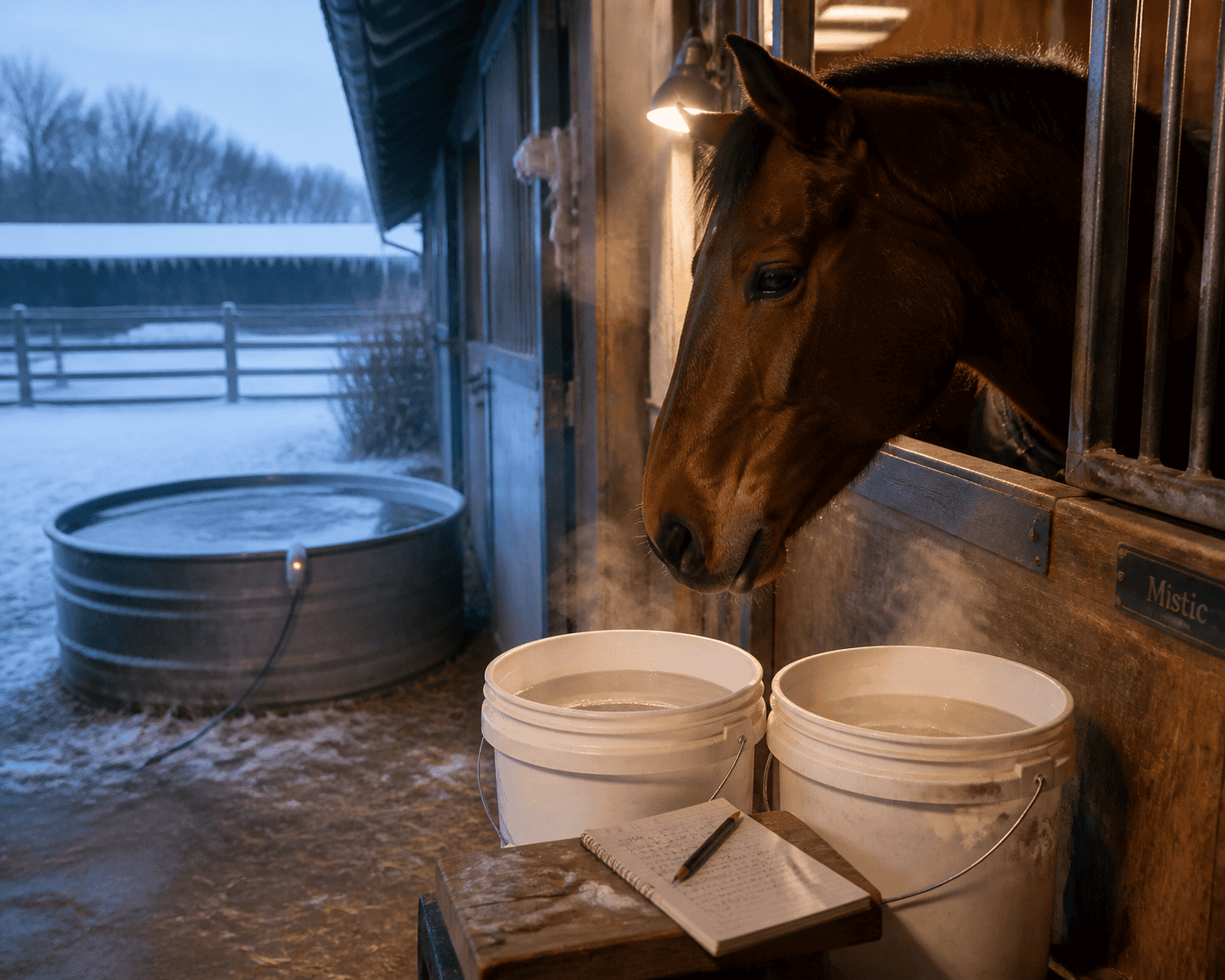
Warm water in a container you can read, and a number written down. Two five-gallon buckets filled and emptied is a gauge. A horse that normally finishes both and leaves one half full on a cold Tuesday is showing you a problem before anything else does.
Salt is the other half, because thirst follows sodium. The National Research Council puts a resting horse’s need at roughly one ounce of salt a day, about two tablespoons. A 2025 study gave sixteen horses either a salt block or loose salt in a pan for alternating weekly periods. The form made no meaningful difference to how much they ate; the individual horse did. Intake ranged from 2 to 135 grams a day, and more than half the horses fell short of their requirement either way. The study’s conclusion was to add salt to the daily ration for horses that don’t take enough voluntarily.
Check current plain loose salt prices on Amazon
Salt is one of the few additions that earns its place in a feed room; most of what sits next to it does not, as we found in seven supplements your horse doesn’t need.
A Winter Water Routine That Reaches Level 1
- Use containers you can read. Two five-gallon buckets per horse in the stall, heated or not.
- Add hot water at morning and evening feeding. Top up so the water is clearly above freezing when the hay goes out.
- Remove the cold alternative where you can, or make the warm source the closer one.
- Record what was drunk at each refill. A notebook on the stall door is enough.
- Feed salt in the ration, about two tablespoons a day for a resting horse, rather than relying on a block alone.
- Raise water with hay. When you add hay for a cold snap, expect the horse to need more water that same night.
- Put every heater on a GFCI outlet and check it before the first freeze.
- Call your vet if intake drops noticeably and doesn’t recover, or if manure output falls or the horse shows any sign of colic.
What We Could Not Verify
- The exact temperature the warmed water reached in the 1994 Kristula and McDonnell trials. It is not stated in the published abstract, so we have not printed a target number from it.
- The Allied Precision 20FB’s thermostat switching points (about 38°F on, 50°F off) come from a retailer listing, not from Allied Precision directly.
- Any published research on the level of stray voltage at which horses refuse to drink. Evidence for this is owner and electrician reports only.
- The extrapolation from ponies to horses. The 40% figure was measured in ponies; applying it to a 1,000 lb horse is our estimate, not a measured result.
- Prices. Retail prices were checked in October 2026 and change often.
The Verdict
Every heated product on this list solves freezing. None of them guarantees a horse drinks enough, and the most expensive one hides whether he did. The setup that came closest to a fully heated system in the only controlled study was hot water carried out twice a day, in a bucket you can read. If you already have a de-icer, keep it; it keeps the water open. Then add warm water at feeding, take away the icy alternative, feed salt in the ration, and write down what goes into your horse each day.
A water plan only works if the horse can also get to it. If he lives out in a blanket, our turnout blanket brand guide covers what holds up through a full season.
References
- Kristula MA, McDonnell SM. Drinking water temperature affects consumption of water during cold weather in ponies. Applied Animal Behaviour Science 41 (1994): 155–160. doi.org/10.1016/0168-1591(94)90020-5
- Mejdell CM, Simensen E, Bøe KE. Is snow a sufficient source of water for horses kept outdoors in winter? A case report. Acta Veterinaria Scandinavica 46 (2005): 19. doi.org/10.1186/1751-0147-46-19
- The effect of form on equine salt intake (2025). PubMed 42082008
- University of Minnesota Extension. Caring for your horse in the winter
- Iowa State University Extension. Make sure horses have water in the winter
- Montana State University Extension. Winter care of horses
- Oklahoma State University Extension. Optimizing water intake
- McDonnell S. Water temperature and horse drinking behavior. The Horse, November 2019
- Stable Management. Unfrozen water: heaters for water tanks
- Farm Innovators H-4815 product specifications, Tractor Supply listing, checked October 2026
- Allied Precision 20FB heated flat-back bucket specifications, Valley Vet listing, checked October 2026
- Nelson Manufacturing. 700 Series automatic horse waterers: model specs
Hoof & Honest was not paid for this article and has no sponsorships or brand deals. Every claim above traces to a published source, and claims we could not verify are labelled as unverified rather than quietly dropped. This article is not veterinary advice; if your horse shows signs of colic, call your vet.