12 Western Saddle Brands Ranked Worst to Best
Advertising disclosure: this article contains affiliate links, placed only on the brands we would put on our own horses (numbers 9 through 1). If you buy through them, this site may earn a commission at no additional cost to you. Hoof & Honest was not paid by any brand named here, and no brand was given advance sight of this article.
Two saddles can carry the exact same famous name stamped into the leather. On this site we have called one of them the strongest western saddle brand you can buy. The other one sits at number ten on this list. Most buyers can’t tell them apart, and the difference comes down to a single word on the maker’s stamp.
That is the western saddle market in one example. Brands have been foreclosed on, resold, licensed and reunited, and the name on the seat no longer tells you much by itself. What does tell you something is what a company is willing to put in writing: where it builds, who builds the tree, and how long it stands behind that tree.
We ranked twelve western saddle brands on exactly those three questions. Genuine Billy Cook from Sulphur, Oklahoma ranks first. Two brands appear on a Hoof & Honest list for the first time: Double J Saddlery at number five and Bob’s Custom Saddles at number three. The bottom three are the brands whose paperwork either contradicts itself, puts conditions on the warranty, or no longer points to the maker whose name it carries.
How the twelve were ranked
- Where it’s built, stated plainly. “Made in Maryville, Tennessee” counts. “Designed in Texas” doesn’t.
- Who builds the tree. The tree is the part of a saddle you can’t inspect in a store and the part that decides how it sits on a horse’s back. A shop that builds its own trees, or names the tree it uses, scores higher.
- A warranty in writing. A published tree warranty, with its length and conditions, counts. A warranty we couldn’t find doesn’t count against a brand outright, but it loses ties.
This is an editorial ranking based on published sources, not a lab test. No saddle here fits every horse, and a well-built saddle on the wrong back still does damage. If you haven’t checked your horse’s fit recently, start with the five levels of saddle fit.
The scorecard
| Rank | Brand | Where it builds (as stated) | Tree | Tree warranty found |
|---|---|---|---|---|
| 12 | Hilason | “Designed in Texas”; wholesale tack listings say India | Proprietary flex tree; treeless listings contradict themselves | Not found |
| 11 | King Series (Tough-1) | Not stated | Rawhide-wrapped fiberglass (some models) | 5 years, labor charge, registration card required |
| 10 | Billy Cook Saddlery (Greenville) | Greenville, Texas | Not stated | Not found |
| 9 | Big Horn | Not clearly stated | Fiberglass-covered wood (several models) | Not found |
| 8 | Fabtron | Maryville, Tennessee | Ralide on many models; maker not named | 5 years |
| 7 | Tucker | Yoakum, Texas | Fiberglass-reinforced covered wood | 10 years tree, 1 year workmanship |
| 6 | Martin Saddlery | Greenville, Texas | Built in-house | Lifetime per a retailer; not published by Martin |
| 5 | Double J Saddlery | Yoakum, Texas | Built in-house | Not found |
| 4 | Circle Y | Yoakum, Texas | Built in Yoakum; Flex2 and Kevlar-reinforced | 10 years (Flex2 trail); lifetime (Kevlar) |
| 3 | Bob’s Custom Saddles | Not confirmed | Not named | Not found |
| 2 | Cactus Saddlery | Greenville, Texas | Not named | Not found |
| 1 | Genuine Billy Cook | Sulphur, Oklahoma | Handmade to order | Registration offered; terms not found |
What a saddle costs at each end of the list
| Brand | Model | Listed price | Where listed |
|---|---|---|---|
| Fabtron | Supreme Lady Trail, 15″ | About $995 | Amazon (via Cowboy Way, August 2026) |
| Circle Y | Topeka Flex2 Trail | $2,699 | SmartPak / Schneider’s |
| Circle Y | Nikki Reed Bayou River Flex2 Trail | $3,499 | circley.com |
| Cactus Saddlery | Relentless Rough-Out Team Roper | $4,549 | NRS |
| Bob’s Custom Saddles | 16″ Petal Shamrock Lady Reiner | $7,446 | NRS |
Prices were checked in October 2026 and change often by model, tooling and retailer. For what the extra money actually buys at each tier, see what a saddle is actually worth.
12. Hilason: the Texas tack shop with an export label
Hilason presents itself as a Houston, Texas tack shop, and its saddle listings lean on it. They say “designed in Texas,” “genuine American cowhide,” and put “American Leather” in the product names. The company says more than 20,000 riders own a Hilason saddle and calls itself the fastest-growing saddle brand in the USA.
On Faire, the wholesale marketplace stores buy from, Hilason’s own listings for its American Leather headstall, its saddle pads and its flank cinches all give India as the country of manufacture. We found no listing that confirms where its saddles are assembled, so we don’t claim it. But the pattern is clear: the leather may be American, and the wording invites you to assume the rest is too.
The bigger problem is on the saddle pages themselves. Several treeless models are described as having no rigid wooden or synthetic tree, and then, further down the same listing, as having “4-way flex tree movement.” A saddle either has a tree or it doesn’t. A product page that can’t keep that straight is not one to trust with a horse’s spine.
The check: before buying any budget saddle, ask the seller in writing where it was assembled and who made the tree. A real answer takes one sentence.
11. King Series by Tough-1: the bargain saddle that comes with homework
King Series saddles come from JT International, the company behind Tough-1, and sell through farm stores at entry-level prices. Some models, like the Royal King Bryson barrel saddle, ride on a rawhide-wrapped fiberglass tree with quarter horse bars.
The ranking comes down to the warranty. JT International covers its trees for five years against breakage from defects in normal use. If a tree breaks, the company will repair or replace it for a labor charge, so the owner still pays. And the warranty only applies if the buyer has filled in and returned the saddle registration card. Lose the card and the five years are gone.
That isn’t a scam. It’s a cheap saddle with cheap promises, and the fine print is honest about how cheap. The check: the day any new saddle arrives, register it and photograph the card and the receipt.
10. Billy Cook Saddlery, Greenville: the famous name that walked out the door
Billy Cook opened his saddle shop in Greenville, Texas in 1953 and built 75 saddles that first year. Through a partnership with Potts-Longhorn, production reached 1,200 saddles a year by the end of the 1950s.
In the 1980s recession, the bank foreclosed on Potts-Longhorn, and the Billy Cook name went with the business rather than the man. After the bank resold it in 1990, a different company continued making saddles in Greenville as “Billy Cook Saddlery.” Those saddles carry the name lawfully. They just don’t come from the shop Billy Cook went on to run himself, and the name is a large part of what a buyer pays for.
Plenty of riders are happy with their Greenville saddles, and this ranking isn’t a verdict on any single one. It reflects that the most valuable thing on the saddle, the name, no longer points to its maker.
The five-second Billy Cook check
- Turn the saddle over and find the maker’s stamp.
- “Billy Cook Saddlery, Greenville, Texas” is the Greenville line.
- “Billy Cook Maker” with Sulphur, Oklahoma is the genuine shop at number one.
- If you’re unsure, ask whether the seller is an authorized Genuine Billy Cook dealer, or contact the Sulphur shop directly.
9. Big Horn: the budget saddle that outlives its price tag
From here up, every brand is one we would put on our own horses. Big Horn is the first, and it’s one we’ve already called a goldmine in underrated tack brands that cost less than you expect.
Big Horn built its name on leather-and-Cordura hybrids and on fitting horses the bigger names often ignore. Its draft horse saddle uses a fiberglass-covered wood tree with bars designed for draft horses, an extra-wide gullet and a dual-density memory foam seat, at about 30 pounds. Owners on riding forums report riding Big Horns they bought in the 1990s.
It sits at nine because the paperwork is thin. The Big Horn name has been held by American Saddlery, Inc. since trademark filings in 1977, and we couldn’t find a clear, current statement of where today’s saddles are built or how long the tree is covered. Great value, fuzzy paperwork.
The check: with any hybrid saddle on a stand, press hard on the seat. A sound tree feels like one solid piece; any creak or give in the middle is a reason to walk away. And watch the used market, where a well-kept older Big Horn is one of the better deals in western saddles. Draft and draft-cross owners should also read saddles for hard-to-fit horses.
Check current Big Horn saddle listings
8. Fabtron: the Tennessee workhorse nobody brags about
Fabtron has been in business since 1977 and builds in Maryville, Tennessee. Its line is mostly leather-and-Cordura hybrids, lightweight trail and gaited saddles that typically weigh around 20 to 22 pounds. Many ride on Ralide trees, a molded polyethylene tree that saves weight, and Fabtron’s listings carry a five-year tree warranty. The Lady Trail model builds in a five-inch cantle for lower-back support.
A stated factory, a stated tree type and a stated warranty: three things the brands below it couldn’t all give us. One limit, as we noted in the six western saddle brands you can still trust: Fabtron doesn’t publicly name its tree supplier.
The check: for a gaited or round-backed horse, ask about gullet height and bar angle, not just width. Fabtron’s gaited models list a raised front and a seven-inch gullet.
Check current Fabtron saddle listings
7. Tucker: the trail saddle built by people who ride the trail
Tucker builds trail saddles and nothing else, handmade in Yoakum, Texas. The Heritage Cheyenne weighs about 21 pounds and uses a three-way adjustable in-skirt rigging, so the cinch can sit where a particular horse’s barrel needs it. Some models come with a dedicated mule tree. Tucker’s patented Gel-Cush seat is built for long days.
Retail listings state a 10-year warranty on the tree and one year on workmanship, double the five years Fabtron and the King Series put on their trees. Tucker is part of Circle Y Saddles. Its founder, Steve Tucker, went on to lead Circle Y and was killed in a plane crash in 2021.
The check: ride any trail saddle for at least an hour before committing, then look under the pad. Even sweat means even pressure. Dry spots mean the saddle is pressing harder somewhere else.
Check current Tucker saddle listings
6. Martin Saddlery: the shop that builds the part nobody sees
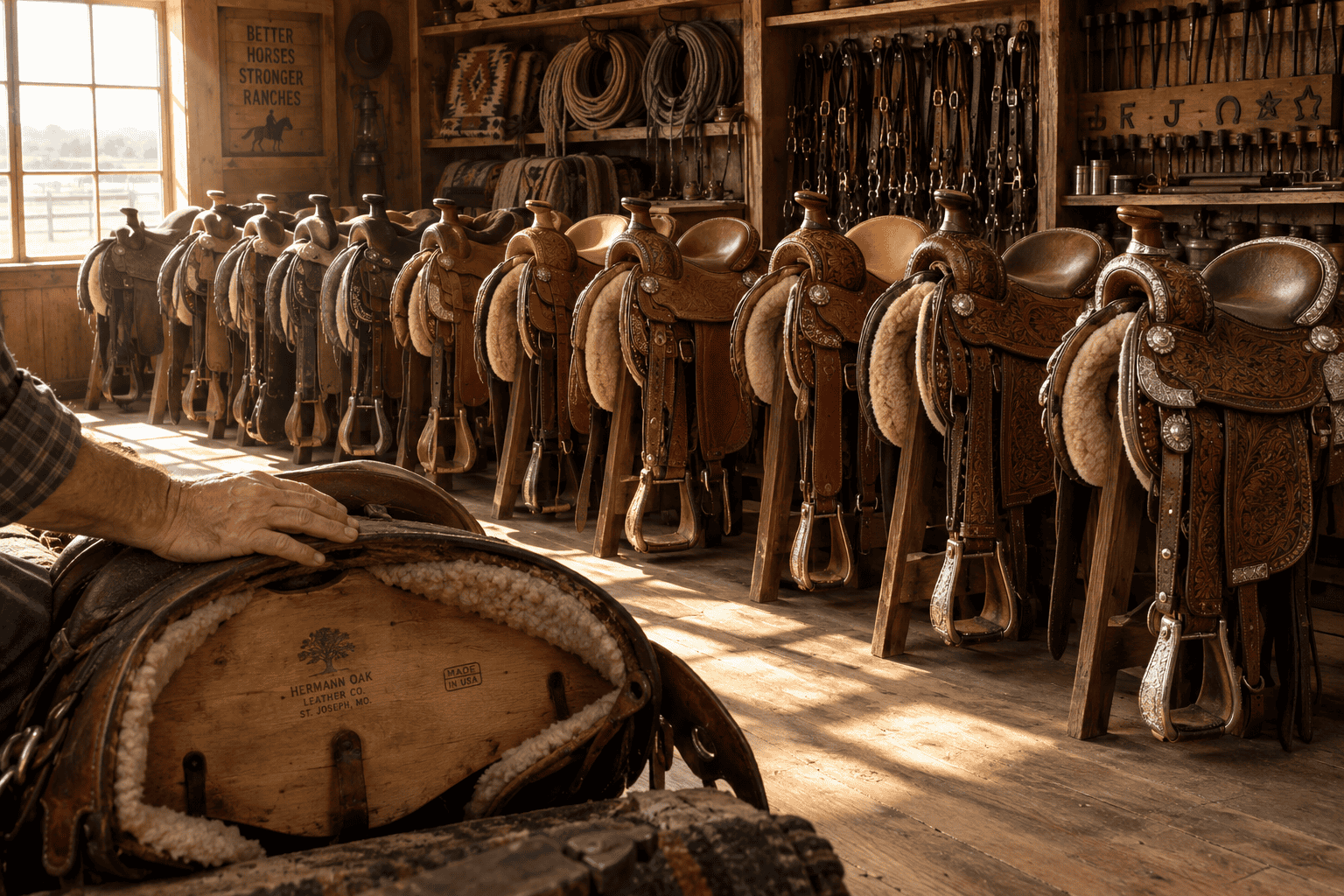
Martin builds in Greenville, Texas, under Equibrand, the holding company that also owns Classic Rope, Classic Equine and Cashel. It makes its own trees in-house, which very few production saddle companies still do, and builds its saddles from Hermann Oak leather and real sheepskin. Its patented Adjustable Rigging lets the cinch and rigging position move to suit the horse rather than forcing the horse to suit the saddle.
Since 2023 Australian saddle maker Brodie Powell has run production, continuing a line that runs back through Eddy Powell and the late Brian Peterson. Retailer Teskey’s lists Martin’s Axis tree with a lifetime guarantee, but we could not find those terms published by Martin itself, so get them in writing from your dealer.
Martin lands at six only because the five above it each offer something it doesn’t. If you ride several different horses in one saddle, the Adjustable Rigging may still make it your best pick. The check: ask any saddle maker who built the tree. If they can answer with their own name, you’ve found something rare.
Check current Martin Saddlery listings
5. Double J Saddlery: the shop a Circle Y veteran built across town
Double J is new to our lists. John DeBord founded it in Yoakum, Texas in 1991, after roughly 17 years at Circle Y, where he helped grow production to around 500 saddles a week. Then he set up shop in the same town and started competing with his former employer.
Double J builds its own saddle trees in its own factory, each made to its own specifications, and covers them in Hermann Oak skirting leather with custom-designed stainless steel hardware. The company says it makes everything in-house and imports nothing, and three generations of the DeBord family work in the business. Its Pozzi Pro barrel saddles were designed with Brittany Pozzi Tonizzi, a two-time world champion barrel racer, with moderate swells and a higher cantle for security through the pattern.
Why not higher? We couldn’t find a published warranty to set next to Circle Y’s, and on this list a warranty in writing wins ties. The check: if you run barrels, sit the saddle and lean into an imaginary first turn. If your thigh hits the swell before your seat settles, the swells are too big for how you ride.
Check current Double J Saddlery listings
4. Circle Y: the Yoakum shop that never left Yoakum
Leland Tucker founded Circle Y in Yoakum, Texas in 1960, and more than 65 years later its saddles are still made there. Circle Y’s product pages say each saddle and its tree are handmade in Yoakum.
Its patented Flex2 tree pairs a rigid high-density bar that carries the rider with a flexible low-density bar that gives where the horse moves. Every tree is coated in Circle Y’s DURAhide finish. Flex2 trail saddles carry a 10-year tree warranty, and the Kevlar-reinforced trees in its roping saddles carry a lifetime warranty against breakage within intended use. Workmanship on the Flex2 trail saddles is covered for one year.
In 2023 Kaspar Companies, a family business led by descendants of the Welhausen family that founded Tex Tan in Yoakum in 1919, bought Circle Y. In 2024 the company bought back the Tex Tan name, bringing two of the oldest Texas saddle names back under one roof, a few miles from Double J.
The check: if you dally or pony horses off your saddle, ask for a reinforced tree. Circle Y steers that kind of work toward its fiberglass- and Kevlar-reinforced trees.
Check current Circle Y saddle listings
3. Bob’s Custom Saddles: the show-pen specialist
Bob’s Custom Saddles is the second new name on our lists, and it plays in a different league. It builds reining, cutting, working cow horse, ranch versatility and show saddles, and says it has carried more premier horsemen to world, futurity and derby championships than any other custom saddle maker. That is the company’s own claim, and we couldn’t verify it independently.
What can be checked is the material list: hand-picked top-grain Hermann Oak leather, real sheepskin, and hand-engraved sterling silver or silver overlay. So can the price. A 16-inch Bob’s lady reiner lists at $7,446 at NRS, with its tree and gullet dimensions printed on the spec sheet.
It sits at three because it’s a specialist. For a reining spin or a cutting stop it may be the best tool on this list, but most riders don’t need a seven-thousand-dollar show saddle to ride fence lines. The check: with any high-end show saddle, ask for the tree and gullet numbers first and the silver last.
Bob’s sells through specialist dealers rather than general marketplaces, so there’s no affiliate link here. NRS is one dealer that lists current models.
2. Cactus Saddlery: built with the people who rope
Cactus was established in 2003 and makes its saddles and strap goods by hand in Greenville, Texas. Its own site names it the official saddle provider of the NIRA, college rodeo’s governing body, and of the World Series of Team Roping. The company says its endorsee team holds more than 40 world championship titles.
Its Relentless roping saddles carry Trevor Brazile’s name, the cowboy with more PRCA world titles than anyone in history, and retailer specifications list Hermann Oak leather, double stitching and a genuine wool-skin lined skirt. The Relentless Rough-Out Team Roper lists at $4,549 at NRS.
It isn’t first because Cactus is built around rodeo, especially the roping box. If that’s your life, it may be your number one. The check: sit the saddle and swing. A good roping saddle lets you get forward into the pocket without the horn fighting your thighs.
Older retailer copy still lists Cactus as the PRCA’s official saddle. Cactus’s current site no longer says so, so we don’t repeat it.
Check current Cactus Saddlery listings
1. Genuine Billy Cook: the signature that followed the man
Here’s the other half of the story from number ten. After losing his name in Greenville, Billy Cook went back to building saddles under his own name. In 1988 he incorporated Billy Cook Harness & Saddle Manufacturing, Inc., and shortly afterward moved the business to Sulphur, Oklahoma, where it still is.
Cook died in October 2019, and the shop carried on. Jody Ramer, who started working alongside Cook in 1991, has run saddle production since 2018, and Rutilo Osornio, with the shop since 1979, oversees tack. The shop builds handmade saddles from stock models to custom orders, calls itself the official saddle of the Wrangler National Finals Rodeo, and in 2025 sponsored high-point trophy saddles at the AQHA Versatility Ranch Horse Championships.
It ranks first because it’s the one brand on this list where the name, the maker and the saddle still point to the same place: a working ranch, roping and trail saddle, built in the shop Billy Cook chose. That is the same verdict as in our earlier western saddle ranking, and nothing we found since has changed it.
The check: look for “Billy Cook Maker” and Sulphur, Oklahoma on the stamp, register the saddle with the shop after purchase, and for custom orders go to the shop directly rather than a reseller who might stock the Greenville line.
Check current Genuine Billy Cook listings
Which saddle fits which rider
| If you mainly… | Look at first | Why |
|---|---|---|
| Trail ride on a budget | Fabtron, Big Horn | Light hybrids; Fabtron states factory and tree warranty |
| Log long trail or endurance miles | Tucker, Circle Y Flex2 | Built for the trail, 10-year tree warranties |
| Ride several horses in one saddle | Martin | Patented Adjustable Rigging |
| Run barrels | Double J Pozzi Pro, Circle Y | In-house trees, discipline-specific designs |
| Show in reining or cutting | Bob’s Custom Saddles | Show-pen specialist, Hermann Oak leather |
| Rope competitively | Cactus, Genuine Billy Cook | Competition designs, roping-specific builds |
| Ranch, rope and trail in one saddle | Genuine Billy Cook | Handmade working saddles from the maker’s own shop |
How to check any western saddle before you buy
- Read the maker’s stamp, not the seat. The stamp tells you who built it and where.
- Ask who built the tree. A shop that names its tree, or builds it, is telling you something a logo can’t.
- Get the tree warranty in writing, with its length, what it covers, and whether there’s a labor charge or registration requirement.
- Register the saddle the day it arrives, and keep photos of the card and receipt.
- Press the seat on a stand. Any creak or give in the middle is a reason to walk away, new or used.
- Check sweat patterns after an hour’s ride. Dry spots under the pad mean uneven pressure. Why the tree you can’t see decides everything explains what’s behind them.
What we could not verify
- Where Hilason saddles are assembled. India is the stated origin for its headstalls, pads and cinches on Faire; we found no listing stating it for saddles.
- Where King Series and current Big Horn saddles are built, and Big Horn’s current tree warranty.
- Martin’s lifetime Axis tree guarantee, listed by a retailer but not found in Martin’s own published terms.
- Warranty terms for Double J, Bob’s, Cactus and Genuine Billy Cook.
- Bob’s Custom Saddles’ founding date and workshop location. Sources disagree, so we left both out, along with its championship claim beyond stating it as the company’s own.
- Cactus’s world-title count comes from the company and its retailers; we did not tally it independently.
- Durability. No independent durability testing was found for any brand on this list.
If a manufacturer can document any of these, we’ll update this article.
Related reading
The five lightest horse saddle brands · the five levels of saddle pad · the rider-to-horse weight math · American-made tack brands still worth trusting
References
- Faire: Hilason American Leather headstall wholesale listing (country of manufacture). faire.com
- Hilason: treeless western saddle product listing. hilason.com
- Farm & Fleet: Tough-1 Royal King Bryson Barrel Saddle, JT International warranty terms. farmandfleet.com
- Genuine Billy Cook: “Billy Cook’s Story.” genuinebillycook.com
- AQHA: Genuine Billy Cook Saddles to provide trophy saddles to ranch horse competitors (2025). aqha.com
- Cowboy Way: Billy Cook saddles and the two Billy Cook lines. cowboyway.com
- USPTO via Justia: American Saddlery, Inc. trademarks (Big Horn, 1977). trademarks.justia.com
- Tack Shack of Ocala: Big Horn Draft Horse Saddle specifications. tackshackocala.com
- Cowboy Way: Fabtron saddles (Maryville, Tennessee; since 1977). cowboyway.com
- SmartPak: Tucker Heritage Cheyenne Trail Saddle, specifications and warranty. sstack.com
- Western Horseman: “The Best Seat in the House: Inside Martin Saddlery.” westernhorseman.com
- Shop Talk Magazine: “Martin Saddlery” (Equibrand, in-house trees, Hermann Oak). shoptalk-magazine.com
- Teskey’s: Martin Saddlery brand page (Axis tree, Adjustable Rigging). teskeys.com
- Double J Saddlery: About Double J. doublejsaddlery.com
- Double J Saddlery: “For 20 Years, More Than Just Great Saddles.” doublejsaddlery.com
- Cowboy Way: Double J Pozzi Pro barrel saddles. cowboyway.com
- Circle Y: About Circle Y (Kaspar Companies, Tex Tan). circley.com
- Circle Y: “Saddle Trees Built for Performance and Comfort” (Flex2, Kevlar lifetime warranty). circley.com
- Circle Y: Kinsley Flex2 Trail (saddle and tree handmade in Yoakum). circley.com
- NRHA: Bob’s Custom Saddles. nrha.com
- NRS: Bob’s Custom Saddles 16″ Petal Shamrock Lady Reiner, price and specifications (checked October 2026). nrsworld.com
- Cactus Saddlery: company homepage (official saddle provider for NIRA and WSTR). cactussaddlery.com
- NRS: Cactus Saddlery Relentless Rough-Out Team Roper, price and specifications (checked October 2026). nrsworld.com