6 Cowboy Boot Brands Robbing You Blind (And 6 Worth Every Penny)
Advertising disclosure: this article contains affiliate links, placed only on brands that passed. If you buy through them, this site may earn a commission at no additional cost to you. Hoof & Honest was not paid by any brand named here, and no brand was given advance sight of this article.
Boot Barn sells a Cody James Ace western boot for $169.99 whose own product page contradicts itself. The sales paragraph promises “double-stitched welt construction.” A few lines further down, the spec list says “lightweight cement construction.” Cement means the sole is glued on, and the two lines can’t both describe the same boot.
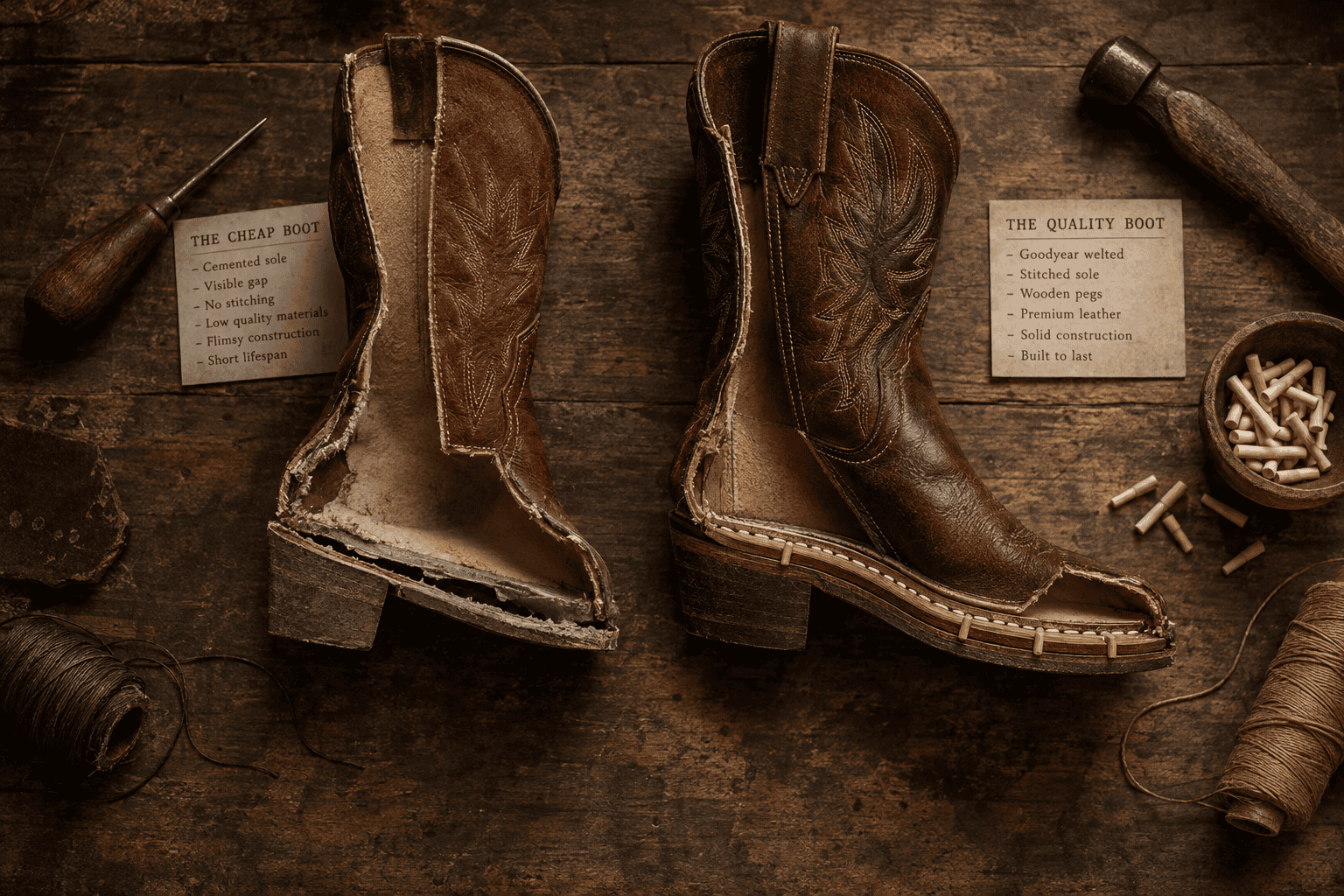
That difference decides how long the boot lasts. A stitched (welted) or pegged sole can be cut off by a boot shop and replaced when it wears through. A glued sole usually can’t be replaced in a way that’s worth paying for, so when the sole fails the boot is finished, and you buy another one. The marketing paragraph is written to sell the boot, and the spec line tells you how it’s built.
So this article checked twelve cowboy boot brands against three questions a buyer can answer from a product page or a boot tag. Six don’t earn their price: Durango, Laredo, Cody James, Shyanne, Justin and Tony Lama. Six do: Ariat, Tecovas, Anderson Bean, Black Jack, Rios of Mercedes and Lucchese. The cheapest passing boot costs about $15 more than the first failing one at full price. And one of the most famous names in western boots went on the record in 2004 with an eight-word quote about where its boots are made.
This article covers western boots. For English riding boots, tall boots and paddocks, see the six riding boot brands you can still trust, which also explains why Lucchese uses lemonwood pegs.
How the twelve were checked
Every check below can be done in a browser or a boot store. None of them relies on how a boot looks or feels in the first five minutes.
- Stitched, pegged or glued? Going by the spec line or construction details, not the sales paragraph. If the two disagree, that counts against the boot.
- Leather all the way up? The shaft, the tall part that wraps the calf, counts. A leather foot with a synthetic shaft is a partial leather boot.
- Made where the label suggests? When a brand sells a hometown and a founding year, is the boot actually built there, and does the company say so?
A boot didn’t fail for being glued or imported. Plenty of honest boots are both, and they’re priced like it. A brand landed on the first list when its price, its copy or its heritage story promised more than its own spec line or label delivered.
Welted, pegged or glued: what each one means for you
| Construction | How the sole is attached | Resoleable? | What to look for on the listing |
|---|---|---|---|
| Goodyear welt | Sole stitched to a leather strip (the welt) that runs around the edge of the boot | Yes | “Goodyear welt” in the spec list |
| Three-quarter welt | Welt stitched around the front and sides; heel built on separately | Yes | “3/4 welt,” normal on cowboy boots |
| Channeled welt | Stitching sits in a groove cut into the leather insole, for a lower profile | Yes | “Channeled welt,” usually with a leather insole |
| Pegged | Lemonwood or brass pegs fix the outsole to the rest of the boot | Yes | “Lemonwood pegs” or “hand-pegged” |
| Cement | Sole glued on | Usually not practical | “Cement construction” |
“Double-stitched welt” or “double row sole stitch” on a listing doesn’t by itself tell you the sole is welted. A decorative stitch line can run around a cemented sole. If the spec list says cement, believe the spec list.
The scorecard
| Brand | Boot checked and list price | Stitched or glued? | Leather all the way up? | Made where the label suggests? | Verdict |
|---|---|---|---|---|---|
| Durango | Rebel 12″, $184.99 regular | Double-row sole stitch listed; welt type not stated | No: faux shaft | Not stated | Doesn’t earn full price |
| Laredo | Boys’ Collared, $74.95 | Not stated | No: copy says leather, spec says man-made leather | Not stated | Copy contradicts spec |
| Cody James | Ace, $169.99 | Copy says welt, spec says cement | Full-grain upper | Not stated | Copy contradicts spec |
| Shyanne | Stryde, $174.99; Rival, $169.99 | Rival: cement | Leather upper (Rival) | Not stated; Stryde may ship as Rank 45 | Name isn’t doing any work |
| Justin | Brand-level check | Varies by model | Varies by model | El Paso factory exists; 75–80% of Justin-brand boots made overseas in 2004 (newest figure found) | Read the tag |
| Tony Lama | Brand-level check | Varies by model | Varies by model | “Many” products made in El Paso; 35–40% outsourced in 2004 | Read the tag |
| Ariat | Heritage Roughstock, $199.95 | Goodyear welt | Yes: full-grain foot and upper | Build location not published | Pass |
| Tecovas | Cartwright, $375 | 3/4 Goodyear welt, leather sole | Yes: cowhide or goat options, cowhide lining | Dress boots start in León, Mexico, per Tecovas | Pass |
| Anderson Bean | Example: NRS Ride Ready, $519.99 list | Channeled welt, lemonwood pegs | Yes: all-leather per retailer, cowhide lining | Yes: Mercedes, Texas | Pass |
| Black Jack | Buffalo boot for Pinto Ranch, $495 regular | Welted, 60 lemonwood pegs, leather sole | Yes: buffalo foot, leather shaft | Yes: El Paso, Texas | Pass |
| Rios of Mercedes | Elk Bottom Roper, $595 | Hand-pegged, hand-stitched | Yes: handmade leather boot | Yes: Mercedes, Texas | Pass |
| Lucchese | Range checked, not one model | Brass or lemonwood pegs; resoleable per Lucchese | Yes on the models reviewed | Yes: El Paso, Texas | Pass |
“Not stated” means the retailer or brand page checked didn’t say. It doesn’t mean the company is hiding anything. Prices were checked in October 2026 and change often; several of these boots were out of stock at the time.
The six that don’t earn their price
1. Durango: leather right up until it isn’t
Tractor Supply lists the Durango Men’s 12 in. Rebel at a regular price of $184.99. Its description says the boot is “made with a full-grain leather foot, collar and pull straps with a faux shaft.” The shaft is the tall part that wraps your calf, and on this boot it isn’t leather. Underneath there’s a rubber outsole, a molded EVA midsole, a fiberglass shank and a one-year limited warranty.
None of that is a problem on a work boot priced for it, and in October 2026 the Rebel was on sale for $147.99. At full price, though, the Ariat Heritage Roughstock further down this list costs about $15 more and is full-grain leather on both the foot and the upper, with a Goodyear welt.
2. Laredo: the listing that can’t agree with itself
Boot Barn lists the Laredo Boys’ Collared Western Boot at $74.95. The sales copy runs under the heading “Durable Leather Construction.” The spec list underneath says “Made of man-made leather with sanding and cut-outs.” The same paragraph also calls the boot a Dan Post, although the brand on the listing is Laredo.
A kid’s boot doesn’t need exotic leather, and most children outgrow a pair long before it wears out. The problem is that a parent reads the headline, and the headline describes a different boot from the one in the box. It’s the cheapest boot here, and it’s the clearest example of a pattern that runs through this whole list.
3. Cody James: one name, two different soles
Cody James is Boot Barn’s own house brand. The Ace western boot, $169.99 with a full-grain leather upper, is the boot from the top of this article: welt in the paragraph, cement in the spec list. The same label also sells a Men’s Square Toe Western Boot with a full-grain leather foot and shaft and a Goodyear three-quarter welt, listed at $209.99.
So the Cody James name covers a stitched boot you can resole and a glued boot you mostly can’t, $40 apart. Boot Barn has a clear reason to want you trusting the name anyway. In the fiscal year that ended March 28, 2026, its exclusive brands made up 40.8% of total sales, and the company says they earn a margin roughly 1,000 basis points (about ten percentage points) higher than the outside brands on the same shelves.
That’s the same economics described in how a $30 saddle pad and a $150 one can come from the same factory: when a store owns the label, the label is where the margin is.
4. Shyanne: order one name, receive another
Shyanne is Boot Barn’s women’s western line. The Shyanne Stryde performance boot lists at $174.99, and its product page says it “may ship with Shyanne or RANK 45 branding.” Both are Boot Barn labels. You can order one and open a box with the other name stamped on the boot, and it’s the same pair either way.
Elsewhere in the range, the Shyanne Rival lists at $169.99 with a leather upper, a rubber outsole and cement construction. That puts a glued sole within about $30 of the welted Ariat. If the store treats the brand name as interchangeable, there’s no reason for you to pay extra for it.
5. Justin: the heritage brand and the 2004 quote
Justin calls itself “The Standard of the West” and dates its history to H.J. Justin building boots on the Chisholm Trail in 1879. Justin Brands is owned by Berkshire Hathaway, and its family includes Tony Lama, Nocona and Chippewa. In July 2020, the company closed its Justin and Chippewa factories in Cassville and Carthage, Missouri, and nearly 300 workers lost their jobs, many of them furloughed since March. Justin still has a factory in El Paso, Texas.
In December 2004, a Christian Science Monitor reporter toured the El Paso plant Tony Lama founded, guided by his grandson Rudolph Lama, then managing international sales for Justin Brands. The paper reported that between 75 and 80% of the Justin Boots brand was being made overseas. At one point Lama interjected: “Much cheaper, if they are made in China.”
That figure is more than twenty years old. This review found no newer breakdown published by the company, so it’s presented here as the most recent number available, not as today’s share. Either way, the tag inside the shaft tells you where your pair was made.
6. Tony Lama: one careful word
Justin Industries bought Tony Lama in 1990. In the same 2004 article, Rudolph Lama said 35 to 40% of the Tony Lama line was outsourced. Today, Tony Lama’s made-in-the-USA page says the company is proud of its El Paso factory, “where many Tony Lama products are made.”
“Many” isn’t “all,” and the page doesn’t say which ones. The El Paso story is on every box, but the shelf price doesn’t change with the country on the tag. Before paying for El Paso, reach inside the shaft and read the label.
The six worth the money
1. Ariat Heritage Roughstock: the most boot for the money
The Heritage Roughstock lists at $199.95. Ariat’s product page describes a full-grain leather foot and upper, a leather lining, and Goodyear welt construction joining the sole to the upper. The outsole is Ariat’s barnyard-acid-resistant Duratread rubber, and the Pro Performance insole is removable. Ariat doesn’t publish where the boot is made, and the rubber sole makes it a barn boot rather than a dress boot. Next to the faux-shaft Durango at full price, though, about $15 more buys leather all the way up and a stitched sole.
Check current Ariat Heritage Roughstock listings
2. Tecovas Cartwright: the boot to wait for
Paul Hedrick founded Tecovas in Austin in 2015, selling directly to customers. Its original boot, the Cartwright, costs $375, and the product page lists a leather sole and three-quarter Goodyear welt construction. Tecovas says each of its boots is made by hand in more than 200 steps, and that its dress boots begin in León, Mexico. In March 2026, a markdown plus an extra discount code brought the Cartwright to about $233, which puts a welted, leather-soled boot close to the price of the glued ones above.
Check current Tecovas listings
3. Anderson Bean: built before “performance” was on the box
Rios of Mercedes launched the Anderson Bean line in the 1980s and builds it at its factory in Mercedes, Texas. Retailer listings describe solid leather insoles, leather heel counters, spring steel shanks, channeled welt construction, lemonwood pegs and full leather cowhide lining. Western stores design their own Anderson Bean styles with the factory, and some visit Mercedes every year to choose leathers. Prices vary widely by leather and retailer; one NRS Ride Ready model lists at $519.99. Almost every component on that spec sheet is the kind a boot shop can repair.
Check current Anderson Bean listings
4. Black Jack: big-name training, smaller name
Gerardo “Jerry” Guerra, the seventh of fourteen siblings, moved from Ciudad Juárez to El Paso as a child when his father, a boot worker, took a job there. He worked his way up the floor at Lucchese to plant manager, left after a merger, and opened Black Jack in El Paso in 1996. Four of his brothers joined him, and two of his daughters work there now. The company describes a 100-step handmade process. A buffalo boot Black Jack makes for Pinto Ranch lists a leather insole and outsole, a steel shank and 60 lemonwood pegs, at a $495 regular price. You get the training without paying for the famous name.
Check current Black Jack listings
5. Rios of Mercedes: the boot you can send home
Rios traces its roots to 1853 in Mexico, making cavalry boots for the Mexican military. Joe and Trainor Evans bought the business in 1975. The boots are made under one roof in Mercedes, Texas, and described as hand-lasted, hand-stitched, hand-pegged and hand-finished. When customers wear through the soles, they send the boots back for a complete re-craft; in 2023 the company said it handled about 15 to 20 pairs a day. An Elk Bottom Roper lists at $595 at Pinto Ranch.
Check current Rios of Mercedes listings
6. Lucchese: the factory with the biggest customer in Texas
Brothers Salvatore and Joseph Lucchese founded the company in San Antonio in 1883, and it moved its operations to El Paso in 1986. A February 2026 report puts the factory at around 240 artisans making about 400 pairs a day. The company’s director of product development and men’s design says 150 to 200 hands touch every pair. Lucchese uses brass or lemonwood pegs depending on the style, typically about 45 lemonwood pegs per boot, and says pegging lets its bootmakers resole a boot when the soles wear out. Prices run from hundreds to thousands of dollars depending on the leather. Its most visible customer is Big Tex at the State Fair of Texas, who wears Lucchese boots in a size 96.
Check current Lucchese listings
Same money, different boot
| Boot | List price | Sole attachment | Shaft |
|---|---|---|---|
| Cody James Ace | $169.99 | Cement per spec | Full-grain upper |
| Shyanne Rival | $169.99 | Cement | Leather upper |
| Shyanne Stryde | $174.99 | Not stated | Genuine leather |
| Durango Rebel 12″ | $184.99 | Welt type not stated | Faux |
| Ariat Heritage Roughstock | $199.95 | Goodyear welt | Full-grain leather |
| Cody James Square Toe | $209.99 | Goodyear 3/4 welt | Full-grain leather |
In this band, a $30 to $40 step up is often the difference between a glued sole and a stitched one. Note that the Cody James Square Toe passes the same checks the Ace fails. The problem with Cody James isn’t that every boot is bad. It’s that the name doesn’t tell you which one you’re buying.
How to check a cowboy boot before you pay
- Scroll past the paragraph to the spec list. Look for “Goodyear welt,” “channeled welt,” “pegged” or “cement.” If the paragraph and the specs disagree, believe the specs.
- Check the shaft material, not just the foot. “Leather foot” or “faux shaft” means the tall part is synthetic.
- Read the tag inside the shaft. It takes four seconds and shows the country of manufacture, which the box often doesn’t.
- Look at the sole edge. A welted boot has a visible strip of leather stitched around the edge. A pegged boot has small wooden or brass pegs on the bottom.
- Ask whether the maker resoles or recrafts. Rios of Mercedes and Lucchese both say they do. A boot nobody can resole has a fixed lifespan.
- Don’t pay for the name on the strap. As the Shyanne listing shows, a store may treat its own names as interchangeable.
What we could not verify
- Current offshore share at Justin and Tony Lama. The 75–80% and 35–40% figures come from a December 2004 news report. No newer company figure was found.
- Where Durango, Laredo, Cody James, Shyanne and Ariat boots are made. The product pages checked didn’t say.
- Which Cody James listing is accurate. The Ace page states both a welt and cement construction. This review relies on the spec line and didn’t inspect the boot.
- Brand-reported details. Black Jack’s 100-step process, Tecovas’s 200-plus handmade steps, Rios of Mercedes’s re-craft volume (stated in 2023), and Lucchese’s staffing and output come from the companies or their retailers.
- Anderson Bean construction is taken from retailer listings rather than a page published by the maker.
- Prices and stock were checked in October 2026. Several boots, including the Cody James Ace, the Laredo boys’ boot and the Rios Elk Roper, were out of stock or partly out of stock at the time.
Related reading
The same price-versus-proof test runs through the six bit brands robbing you blind, and the six worth every penny, and the seven levels of tack spending shows where extra money stops buying anything you or your horse can notice.
References
- Boot Barn: Cody James Ace Western Boots, construction and price, bootbarn.com (checked October 2026).
- Boot Barn: Cody James Men’s Square Toe Western Boots, Goodyear three-quarter welt, bootbarn.com (checked October 2026).
- Boot Barn: Laredo Boys’ Collared Western Boots, bootbarn.com (checked October 2026).
- Boot Barn: Shyanne Stryde Women’s Western Performance Boots, bootbarn.com (checked October 2026).
- Boot Barn: Shyanne Rival Women’s Western Boots, bootbarn.com (checked October 2026).
- Retail TouchPoints: Boot Barn full-year results, fiscal year ended March 28, 2026 (May 15, 2026). retailtouchpoints.com
- Tractor Supply: Durango Men’s 12 in. Rebel Western Boots, tractorsupply.com (checked October 2026).
- Justin Boots: The Standard of the West, justinboots.com.
- Justin Boots: company history and El Paso factory, justinboots.com.
- KY3: Justin Boots factories in both Cassville, Carthage close down (July 6, 2020). ky3.com
- Missourinet: Justin Boots factories closing in southwest Missouri (July 7, 2020). missourinet.com
- Kniazkov M. Even the cowboy boot now sports “Made in China.” Christian Science Monitor, December 27, 2004. csmonitor.com
- Tony Lama: Made in the USA, tonylama.com.
- Tony Lama: company history, tonylama.com.
- Ariat: Heritage Roughstock Western Boot. ariat.com
- Ariat store listing: Heritage Roughstock, MSRP $199.95. stores.ariat.com
- Tecovas: The Cartwright (checked October 2026). tecovas.com
- Tecovas: Our Story. tecovas.com
- Men’s Journal: Tecovas Cartwright sale (March 4, 2026). aol.com
- Mercedes Economic Development Corporation: Mercedes-made Anderson Bean boots gain national following. mercedesedc.com
- NRS: Anderson Bean Ride Ready boot, construction details and price (checked October 2026). nrsworld.com
- Pinto Ranch: Spotlight on Black Jack Boots. pintoranch.com
- Dallas Market Center: Black Jack Boots exhibitor profile. dallasmarketcenter.com
- Pinto Ranch: Black Jack Men’s Buffalo Cowboy Boots, construction and price (checked October 2026). pintoranch.com
- The Texas Bucket List: Rios of Mercedes Boot Company (October 2023). thetexasbucketlist.com
- Pinto Ranch: Rios of Mercedes Elk Bottom Roper Boots (checked October 2026). pintoranch.com
- Lucchese: The Process. lucchese.com
- Lucchese: A Study in Detail, Part 1: Lemonwood Pegs. lucchese.com
- Leatherbiz: The mayor who owns 90 pairs of Lucchese boots (February 18, 2026). leatherbiz.com
- Elliman Equestrian: Lucchese Bootmaker (Winter 2026). elliman.com
- KENS 5: Made in S.A. on the Road, Lucchese Boot Company (price range). kens5.com
- National Cowboy & Western Heritage Museum: Salvatore “Sam” Lucchese (Big Tex’s size 96 boots). nationalcowboymuseum.org