12 English Saddle Brands Ranked Worst to Best
Advertising disclosure: this article contains affiliate links, placed only on brands ranked number nine through one that are sold through retailers we can link to. If you buy through them, this site may earn a commission at no additional cost to you. Hoof & Honest was not paid by any brand named here, and no brand was given advance sight of this article.
A brand-new English saddle listed online for a hundred and forty dollars can look almost exactly like a three-thousand-dollar saddle in the photos: the same shiny flaps, the same knee rolls, the same neat stitching. The difference is inside, in the tree. Fitters who open saddles like that report softwood frames, webbing held on with staples instead of stitching, and stuffing that balls up under pressure. When a tree like that twists or cracks, nothing shows on the outside. The horse feels it first, as a hard spot pressing into the muscle beside the spine with every stride.
Further up the price ladder the problem changes shape but doesn’t go away. The name on the flap tells you less than you’d expect. Two of the best-known French saddle brands answer to the same owner. A synthetic saddle that usually costs less than a thousand dollars has a longer published tree warranty than most custom saddles costing eight times as much. And the most famous saddle name in the world turns out to be cheaper than its reputation.
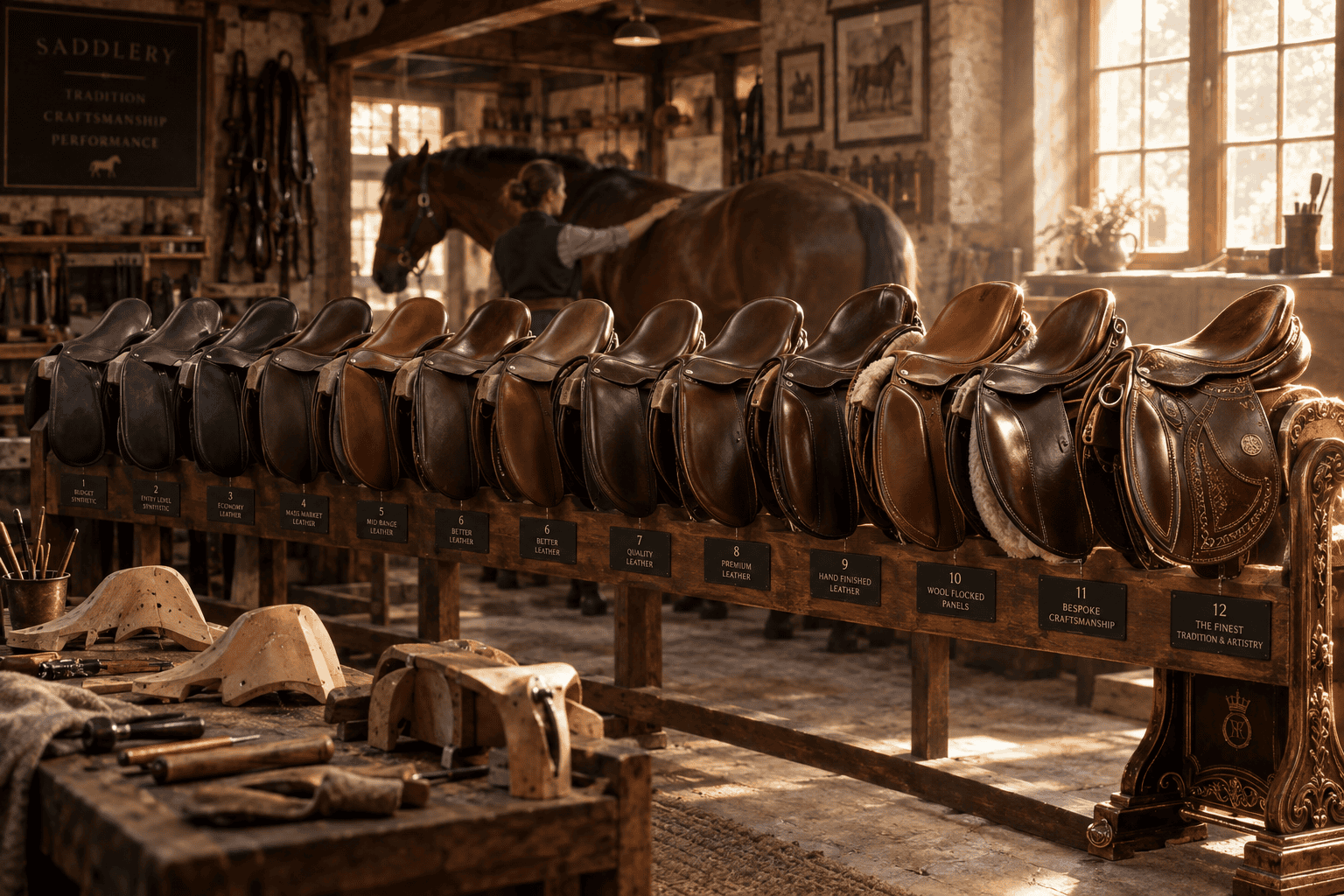
We ranked twelve English saddle brands on what the horse actually gets for the money. Stübben ranks first and County Saddlery second. Two budget adjustable saddles, Thorowgood and Wintec, rank above the French custom houses Antarès and Voltaire. CWD and Butet, at three and four, are sister companies under LIM Group. Hermès sits outside the twelve as an honorable mention, for reasons explained at the end.
How the twelve were ranked
- The tree, and who stands behind it. What the frame is made of, and whether the maker publishes a tree warranty with a length attached.
- Whether the saddle can follow the horse. A changeable gullet, a tree that can be widened, and panels a local fitter can adjust. Wool flocking scores higher than foam or sealed air, because a fitter in your barn aisle can add, remove and rebalance it.
- What the price is paying for. Construction and adjustability, or a name that loses much of its value the first time the saddle is ridden.
This is an editorial ranking based on published sources, not a lab test. No saddle fits every horse, and a beautifully made saddle on the wrong back still does damage. If you haven’t checked your horse’s fit recently, start with the five levels of saddle fit.
The scorecard
| Rank | Brand | Where it’s made (as stated) | Width adjustment | Panels | Tree warranty found |
|---|---|---|---|---|---|
| 12 | No-name budget imports | Not stated | None | Unknown stuffing | None |
| 11 | Henri de Rivel (HDR) | “Imported” (Dover listing) | Gullet plates on IGP models | Foam | Not found |
| 10 | Pessoa | Argentina (Ruiz Diaz) | X-Change gullet plate | Varies by model | Not found |
| 9 | Collegiate | Not stated | Changeable gullet | Flocked on some models | 10 years |
| 8 | Voltaire Design | France | Adjustable tree (since 2019); semi-custom gullet plate | Foam as standard | Not found |
| 7 | Antarès | France (Charente-Maritime) | Custom and semi-custom tree widths | Foam as standard | Not found |
| 6 | Wintec | Perth-based company; factory not stated | Easy-Change gullet, rider-swappable | CAIR air panels / risers | 10 years tree, 2 years materials |
| 5 | Thorowgood | Walsall, England | Adjustable gullet bar | British wool | Not found |
| 4 | Butet | Saumur, France | Custom tree widths | Wool on request | Not found |
| 3 | CWD | Nontron, France | Custom; carbon and Kevlar tree | Foam as standard | Not found |
| 2 | County Saddlery | Walsall, England | Own laminated beechwood trees | Pure wool | Not found in published terms |
| 1 | Stübben | Germany, Switzerland, Spain | Steel head plate; widening and replacement via repair center | Varies by model | Not found |
What each brand costs new
| Brand | Example | Price (USD) | Source |
|---|---|---|---|
| No-name imports | New, unbranded | Under $200 | Marketplace listings |
| Wintec | 500 All Purpose | Under $1,000 | Retail listings |
| Thorowgood | T8 Compact GP | About $1,050 | Converted from a CA$1,460 retail listing |
| Henri de Rivel | Advantage / Synergy close contact | $1,000–$1,490 | Dover Saddlery |
| Collegiate | Graduate close contact | About $1,400 | Schneider’s (list price) |
| Pessoa | Gen-X Elita II | About $3,500 | US retailer listing |
| Antarès / CWD (new) | Custom jumping saddle | $5,000–$8,000 | Hoof & Honest price-tier analysis, July 2026 |
| County Saddlery | New, standard or custom | About $6,000–$8,000 | Rider reports, 2025 |
| CWD | Custom Mademoiselle | About $8,000–$9,000 | Rider reports, 2021 |
| Hermès (honorable mention) | Cavale, Vivace, Arpège, Faubourg | About $8,400–$9,500 | Converted from Hermès’s euro list prices |
Prices were checked in October 2026 and move with model, options, retailer and exchange rates. Two figures, County and CWD, come from rider reports on the Chronicle of the Horse forum rather than published price lists, because neither brand publishes custom pricing. For what each price tier actually buys, see what a saddle is actually worth.
12. No-name budget imports: the saddle with nobody to call
Unbranded English saddles turn up on auction sites and marketplace listings brand new for well under two hundred dollars, described as handcrafted, premium leather, top quality. Riders and fitters who have taken them apart describe trees that were never engineered for a horse’s back, staples where stitching should be, and stuffing that clumps.
The country of origin isn’t the problem. Several saddles further up this list are built outside the US. The problem is a saddle with no maker you can look up, no warranty, and nobody to call when the tree fails. A cracked tree is invisible from the outside, and replacing one costs more than the saddle did, so nobody does it.
The check: ask the seller in writing who made the tree and what the warranty on it is. A real maker answers both in a sentence. If the saddle is new, under $200 and carries no name you can trace, a used saddle from almost any brand below is the safer buy for a few hundred dollars more.
11. Henri de Rivel: the lesson-barn saddle that knows its job
Henri de Rivel, usually shortened to HDR, is a label sold through Dover Saddlery. Its close contact and all-purpose saddles list at roughly $1,000 to $1,490, built on molded polymer trees with foam panels, and Dover’s listings describe them simply as imported. They’re common in lesson programs, and for a beginner, a school string, or a rider who needs something serviceable for a season, that’s a fair job for them.
What the price doesn’t buy is room to adjust. Foam can’t be reflocked to follow a changing back. Some HDR models take interchangeable gullet plates in five widths, which helps with width but not with panel shape. Dover’s return policy allows saddles back within 90 days, with the refund prorated for use.
The check: use that 90-day window. Have an independent fitter look at the saddle on your horse in the first few weeks, not the first few years.
HDR is a Dover house label and Dover doesn’t run an open affiliate program, so there’s no link here.
10. Pessoa: a good saddle with a name surcharge
Pessoa saddles carry the name of Nelson Pessoa, the Brazilian show jumper whose son Rodrigo went on to win Olympic gold, and the line was built on Nelson’s designs. Since the early 1990s they have been made in Argentina by Ruiz Diaz, the same saddlemaker that builds the PDS dressage saddles developed with Carl Hester.
Many models use the X-Change adjustable gullet plate, and a spare plate costs around $80. Pessoa sponsored the USEF Hunter Seat Medal Finals for well over a decade, which tells you its target rider: hunter and equitation competitors who want a balanced position over fences.
It ranks tenth on price. Current models such as the Gen-X Elita II list around $3,500 new, more than three times a Thorowgood or a Wintec with the same basic idea of a swappable gullet. A good part of the difference pays for the name.
The check: look used. The secondhand market for Pessoa stays busy, and a saddle a few years old often sells for well under half its new price. Confirm the saddle comes with an X-Change plate in your horse’s width.
9. Collegiate: the quiet ten-year tree warranty
From here up, every brand is one we’d put on a horse. Collegiate is the first. The Graduate close contact lists at about $1,400 with an Argentinian leather seat, buffalo leather flaps for grip, a changeable gullet, and a published warranty of ten years on the tree and two years on the saddle. Some models, including the Esteem dressage saddle, come with traditional flocked panels a fitter can adjust.
That ten-year tree warranty is the number to notice. Plenty of saddles costing several times more don’t put any figure on how long the frame should last. You won’t get the suppleness of French calfskin, but a rider moving up from a lesson saddle gets a legitimate saddle and money left over for a proper fitting.
The check: Collegiate saddles are compatible with specific gullet series. If yours has a colored gullet inside, it takes Collegiate Series III gullets; check before ordering spares.
Check current Collegiate saddle listings
8. Voltaire Design: not from California, and not easy to adjust
Voltaire is often described as a California brand. It was founded in 2010 in the French Basque Country near Biarritz, and its saddles are made in France. The California link comes from the launch: the first saddles were rolled out at the Menlo Charity Horse Show, and the company built its name in the US before turning back to Europe. In 2013 Beezie Madden won the FEI World Cup Final in a Voltaire.
The saddles are highly customizable, recognizable by the blue stripes underneath, and in 2019 Voltaire introduced an adjustable tree. A semi-custom line adds a gullet head plate riders can adjust themselves. The craftsmanship isn’t the issue.
What holds it at eight applies to most of the French houses. Standard panels are foam, which doesn’t pack down unevenly the way wool can but also can’t be reshaped by whichever fitter lives near you. Bigger changes can mean panels going back to France, and like any French saddle bought new, it loses value quickly once ridden.
The check: ask the rep who adjusts this saddle in your area, and how long it takes. Get the answer in writing.
7. Antarès: the bigger French house you hear less about
Antarès was founded in 2000 by five equestrian professionals in Charente-Maritime, on France’s west coast. According to French business press, it makes around 4,200 custom saddles a year, exports about two-thirds of production, and sends roughly half of those exports to the US and Canada. It has had its own tree maker in Argentina since 2015, its leather has come from the same Basque tannery since the beginning, and eventer Phillip Dutton has ridden for the brand since 2023. More affordable semi-custom and off-the-rack saddles are sold under sister brand names.
It ranks above Voltaire on scale and track record, and below the adjustable saddles for the same reasons: foam panels as standard, a new price in the $5,000 to $8,000 range, and a steep drop once it’s ridden. Riders on the Chronicle of the Horse forum who prefer wool say much the same about Antarès.
The check: semi-custom options let you set seat size, flap length and tree width. Settle tree width with an independent fitter before the order, not after delivery.
6. Wintec: the synthetic that beats two French custom houses
Wintec belongs to Saddlery Brands International, formerly Bates Australia, a family company based in Perth that has made saddles since 1934 and also makes Bates and Arena saddles. Wintec launched in the mid-1980s around one idea: a saddle made from synthetic material instead of leather. Where current Wintec saddles are manufactured isn’t stated on the sources we checked, so we don’t claim it.
The part that matters for the horse came in 1998: the Easy-Change gullet system, which lets the rider swap the plate at the front of the tree with a screwdriver and change the width in minutes. In 2000 came CAIR panels, which replace traditional stuffing with air, and later a riser system for adjusting the panels. Wintec’s published warranty covers tree breakage for ten years and materials and workmanship for two.
Wintec has been the official saddle sponsor of the United States Pony Clubs and the American Riding Instructors Association. Some traditionalists judge synthetics on sight. The horse doesn’t.
Two limits keep it at six. A gullet plate changes width at the withers, not the overall shape of the tree, so a horse whose problem is shape still needs a different saddle. And air panels offer only the adjustment the manufacturer designed into them.
The check: Wintec and Bates gullets are a separate system from Thorowgood’s. When buying used, confirm which gullet the saddle has and budget for a spare width either side of your horse’s current fit.
Check current Wintec saddle listings · Wintec Easy-Change gullets
5. Thorowgood: adjustable width and wool at a budget price
Thorowgood saddles are made in Walsall, England, the West Midlands town that has built saddles for centuries, and they combine two things rarely found together at this price: an adjustable gullet bar and panels flocked with British wool. The bar unbolts and swaps, so width can follow the horse. The wool means a fitter can add, remove and rebalance flocking for a horse that carries one shoulder fuller than the other, which air and foam can’t do.
A T8 Compact GP listed at CA$1,460 at a Canadian retailer, roughly $1,050. That’s the whole argument: width you change yourself, panels a fitter can reshape, built in England, for a fraction of a French custom saddle. We covered the system in more detail in saddles for hard-to-fit horses.
The check: Thorowgood uses an R-bar on general purpose and dressage trees and an S-bar on pony, cob and flat-back models. Secondhand listings often ship with the wrong bar or none, so confirm before money changes hands.
Check current Thorowgood saddle listings
4. Butet: the small Saumur workshop with a big owner
Frédéric Butet founded Butet in the mid-1980s in Saumur, home of the Cadre Noir, France’s national riding school. The brand built its reputation on light, close-contact saddles with an understated look, and they are still made in Saumur. Butet will build wool-flocked panels on request, which makes it one of the easier French saddles to keep adjusted over the years, and that is why it sits above Antarès and Voltaire.
It’s smaller than its reputation. When it changed hands in 2018, French business press reported a workshop of about 40 people selling around 70 percent of its saddles abroad. The buyer was LIM Group, based in the Dordogne. That name comes back at number three.
The check: if you order new, ask for wool panels explicitly. If you buy used, ask whether the panels are wool or foam before you assume a local fitter can adjust them.
Butet sells through reps and dealers rather than general marketplaces, so there’s no affiliate link here.
3. CWD: the best French buy, if you buy it used
Laurent Duray founded CWD in 1998, at 22, in Nontron in the Dordogne. In April 2013 CWD and Devoucoux came together in the group now called LIM, which bought Butet in 2018 and the British maker Albion after that. According to a December 2025 press release from investor Unigrains, LIM owns five saddle brands, CWD, Devoucoux, Butet, Albion and Bruno Delgrange, with more than 800 employees. LIM says each brand keeps its own identity and workshop. But a rider test-riding a CWD, a Butet and a Devoucoux side by side isn’t comparing rival companies.
| Brand | Base | Joined LIM |
|---|---|---|
| CWD | Nontron, Dordogne | Founding brand (group formed 2013) |
| Devoucoux | Basque Country | 2013 |
| Butet | Saumur | 2018 |
| Albion | Walsall, England | After 2018 |
| Bruno Delgrange | Not stated | Listed in group by 2025 |
CWD controls more of its own product than almost anyone on this list. The group owns tanneries in France and Portugal producing chrome-free vegetable-tanned leather, runs its own school for saddlemakers, and builds saddles on carbon and Kevlar trees that keep the weight under 8 kilograms, about 18 pounds. CWD says around 40 percent of Olympic riders compete in its saddles. That’s the company’s own figure, so treat it with caution, but even approximately it means more reps, more fitters who know the saddle and a deeper used market than any other French brand.
Price and depreciation keep it at three. Riders report paying around $8,000 to $9,000 for a custom CWD, and like every French saddle it loses value fast once ridden. That same drop makes a used CWD one of the best buys in English saddles: half the price or less for world-class leather and a world-class tree.
The check: have a used CWD checked on your horse by an independent fitter, not by the rep who sold it, and ask what panels it has before assuming it can be adjusted locally.
CWD sells through its own reps, so there’s no affiliate link here.
2. County Saddlery: wool, beechwood, and a fitter’s saddle
The company buyers deal with is based in Maryland, but the saddles are built in Walsall, England, where County Saddlery Limited is registered. County says it is one of the few saddle companies that makes its own trees. They are laminated beechwood, the panels are flocked with pure wool, and County openly refuses to move to synthetic trees and foam.
For the hard-to-fit horse, the wide flat-backed type or the high-withered one a standard tree pinches, that’s what solves the problem: a fitter can shape the panels to that exact back and keep reshaping them as the horse builds muscle, ages or drops weight. Owners of lean, high-withered horses in particular have been loyal to County for years.
It isn’t cheap. Riders on the Chronicle of the Horse forum reported paying roughly $6,000 to $8,000 for a new County in 2025, which is French-saddle territory. The difference is what the money buys. With a French saddle bought new, much of it goes to the name and disappears in the first years. With a County, it buys adjustability that can last the horse’s working life.
The check: wool compacts and can bunch. Book the fitter back after roughly 20 to 30 hours of riding once the flocking settles, then at least once a year. Skipped, a wool saddle can end up harder on the horse than the foam one you passed on.
County sells through its own representatives, so there’s no affiliate link here.
1. Stübben: the family maker that scores on every count
Johannes Stübben founded his saddlery in Krefeld, on Germany’s Lower Rhine, in 1894. The workshop was destroyed in the Second World War and rebuilt by the family afterward, and Stübben is still a family business, with production in Germany, Switzerland and Spain according to the Handmade in Germany manufacturers’ association.
Until the war, saddles rarely carried model names, only the maker’s name and a serial number. When Stübben entered the American market in the early 1950s, its wholesalers asked for names to help sell them, and the first was the Siegfried, after the hero of the Nibelung saga. The Siegfried went on to become one of the best-selling saddle models in the world.
Stübben ranks first because it scores on all three criteria. The tree is built on a steel head plate, and according to a representative of Stübben’s North American repair center in Virginia, a tree can be widened once by up to two centimeters there, or replaced outright in one of seven sizes. The family has stood behind the same saddles for well over a century. And used Stübbens hold their value far better than French saddles bought new, so the money doesn’t disappear the first time you ride. Stübben also made our trusted lists for girths and bridles.
The check: panels vary by model. Some current Stübben jumping saddles, including the Portos Extra Deluxe, use memory foam panels rather than wool. Ask what’s inside before you buy, and on an older saddle, look on the off-side billet cover for the serial number and tree width in centimeters.
Check current Stübben saddle listings
Honorable mention: Hermès, surprisingly cheap and still not on the list
Hermès started in 1837 as a harness and saddle workshop in Paris, and the horse came long before the handbag. In 1962 the American Olympic rider Bill Steinkraus worked with Hermès on what became the first close-contact saddle, the Steinkraus Hermès, and for most of the 1960s, 70s and 80s it was the saddle of choice for top hunter and equitation riders. Every Hermès saddle is still built from start to finish by a single artisan in about 30 hours of work, after a saddle expert measures the rider and scans the horse’s back with an Equiscan.
The surprise is the price. Hermès lists its current saddles, the Faubourg, Cavale II, Vivace and Arpège, between €7,500 and €8,500, roughly $8,400 to $9,500 at October 2026 exchange rates. That’s about what riders report paying for a custom CWD, and not far above a new County.
So why isn’t it in the twelve? Hermès lists fourteen partner riders across all four Olympic disciplines. Fewer saddles in circulation means fewer fitters who know them, a thin used market, and a saddle built to fit exactly one horse, which makes little sense if you ride a different horse every few years. A correctly fitted Stübben or County does the same job on the horse’s back. With a Hermès the price isn’t the problem. What you mostly pay for is the name.
Which saddle fits which rider
| If you… | Look at first | Why |
|---|---|---|
| Ride several horses in one saddle | Wintec, Thorowgood | Rider-swappable gullets under about $1,000 |
| Have a horse whose shape keeps changing | Thorowgood, County | Wool panels a fitter can reshape |
| Have a hard-to-fit, high-withered or flat-backed horse | County | Own beechwood trees, pure wool, fitter-led |
| Want French close contact on a budget | Used CWD or Butet | Steep depreciation works in the buyer’s favor |
| Are moving up from a lesson saddle | Collegiate | Ten-year tree warranty at about $1,400 |
| Want one saddle for decades | Stübben | Widenable tree, repair center, holds value |
How to check any English saddle before you buy
- Ask who made the tree and what the tree warranty is, in writing, with its length and conditions.
- Ask what’s inside the panels: wool, foam or air. Only wool can be reshaped by any qualified fitter.
- For a gullet-plate saddle, confirm the system (Wintec/Bates, Thorowgood R-bar or S-bar, Pessoa X-Change, Collegiate series) and which plate is fitted.
- For a custom saddle, ask who adjusts it locally and how long a panel change takes.
- Have an independent fitter check it on your horse before money changes hands, especially on a used saddle.
- Check sweat patterns after an hour’s ride. Dry spots under the panels mean pressure is concentrated somewhere. Why the tree you can’t see decides everything explains what’s behind them.
What we could not verify
- Tree warranties for HDR, Pessoa, Voltaire, Antarès, Thorowgood, Butet, CWD, County and Stübben. None were found in published terms. Some riders report lifetime tree warranties on County and CWD saddles; we could not confirm the terms.
- Where current Wintec and Collegiate saddles are manufactured.
- Stübben’s tree widening limits come from a forum post by a person identifying himself as running Stübben’s US repair center, not from published company terms.
- CWD’s Olympic share is the company’s own figure, reported in French business press.
- Antarès production and export figures come from French business press summaries, not company filings.
- New prices for Voltaire, Butet and Stübben, which vary by model and custom options and aren’t published as fixed list prices.
- Whether Wintec’s Pony Club and ARIA sponsorships are current.
- Durability. No independent durability testing was found for any brand on this list. Our view that used Stübbens hold value better than new French saddles reflects used-market listings, not a measured study.
If a manufacturer can document any of these, we’ll update this article.
Related reading
12 western saddle brands ranked worst to best · the five levels of saddle pad · the five lightest horse saddle brands · the rider-to-horse weight math
References
- Hermès: Bespoke equestrian, saddle range and prices (checked October 2026). hermes.com
- Hermès: “A saddle made to your measurements” (single artisan, nearly 30 hours, Equiscan). hermes.com
- Chronicle of the Horse: “The Steinkraus Hermès — The Saddle Of Champions.” chronofhorse.com
- Handmade in Germany: Joh’s Stübben (founded 1894, Krefeld; production sites). handmade-in-germany.org
- InCollect: vintage Stübben Siegfried listing (company history, Siegfried model naming). incollect.com
- Chronicle of the Horse forum: “Stubben Tree Adjustment” (December 2023, repair center representative). forum.chronofhorse.com
- Dover Saddlery: Stübben Portos Extra Deluxe (memory foam panels). doversaddlery.com
- County Saddlery: official site (laminated beechwood trees, pure wool flocking). countysaddlery.com
- Companies House: County Saddlery Limited, Walsall (company 02909358). gov.uk
- Chronicle of the Horse forum: “New County Saddle Pricing” (rider reports, July–August 2025). forum.chronofhorse.com
- Le Monde du Droit: CWD and Devoucoux combine in Leather in Motion group (April 2013). lemondedudroit.fr
- Le Journal des Entreprises: Butet acquired by LIM Group (2018). lejournaldesentreprises.com
- Equestrian Trade News: “French group acquires British saddle company” (Albion). equestriantradenews.com
- Unigrains: LIM Group press release, five saddle brands and 800+ employees (December 2025). unigrains.fr
- Le Moci: LIM Group, founder Laurent Duray, tanneries and saddler training. lemoci.com
- Le Journal des Entreprises: CWD and Olympic riders, carbon-Kevlar trees under 8 kg. lejournaldesentreprises.com
- Chronicle of the Horse forum: CWD pricing (rider reports, April 2021). forum.chronofhorse.com
- Antarès Sellier: history and 25th anniversary. antares-sellier.com
- Businesscoot (summarizing Les Echos, 2024): Antarès production and exports. businesscoot.com
- Phelps Media Group: Voltaire Design’s first ten years. phelpsmediagroup.com
- British Showjumping: Voltaire Design founded 2010 near Biarritz; semi-custom gullet. britishshowjumping.co.uk
- Horse Network: Voltaire’s launch at the Menlo Charity Horse Show. horsenetwork.com
- Wintec: published warranty terms. wintec-saddles.com.au
- Wikipedia: Wintec and Bates Australia / Saddlery Brands International. wikipedia.org
- Greenhawk: Thorowgood T8 Compact GP (Made in England, 100% British wool, R-bar gullet). greenhawk.com
- Schneider’s: Collegiate Graduate Close Contact Saddle (price, warranty). sstack.com
- Equestrian Trade News: Ruiz Diaz manufactures Pessoa and PDS saddles. equestriantradenews.com
- US Equestrian: Pessoa sponsors the Hunter Seat Medal Finals (2012). usef.org
- Dover Saddlery: Henri de Rivel Advantage Close Contact Saddle (price, polymer tree, return policy). doversaddlery.com
Hoof & Honest was not paid by any saddle maker for this article and holds no sponsorship with any brand named. Claims trace to the published sources above; where a figure comes from rider reports or a company’s own statement, the article says so, and claims we could not verify were left out or listed above.