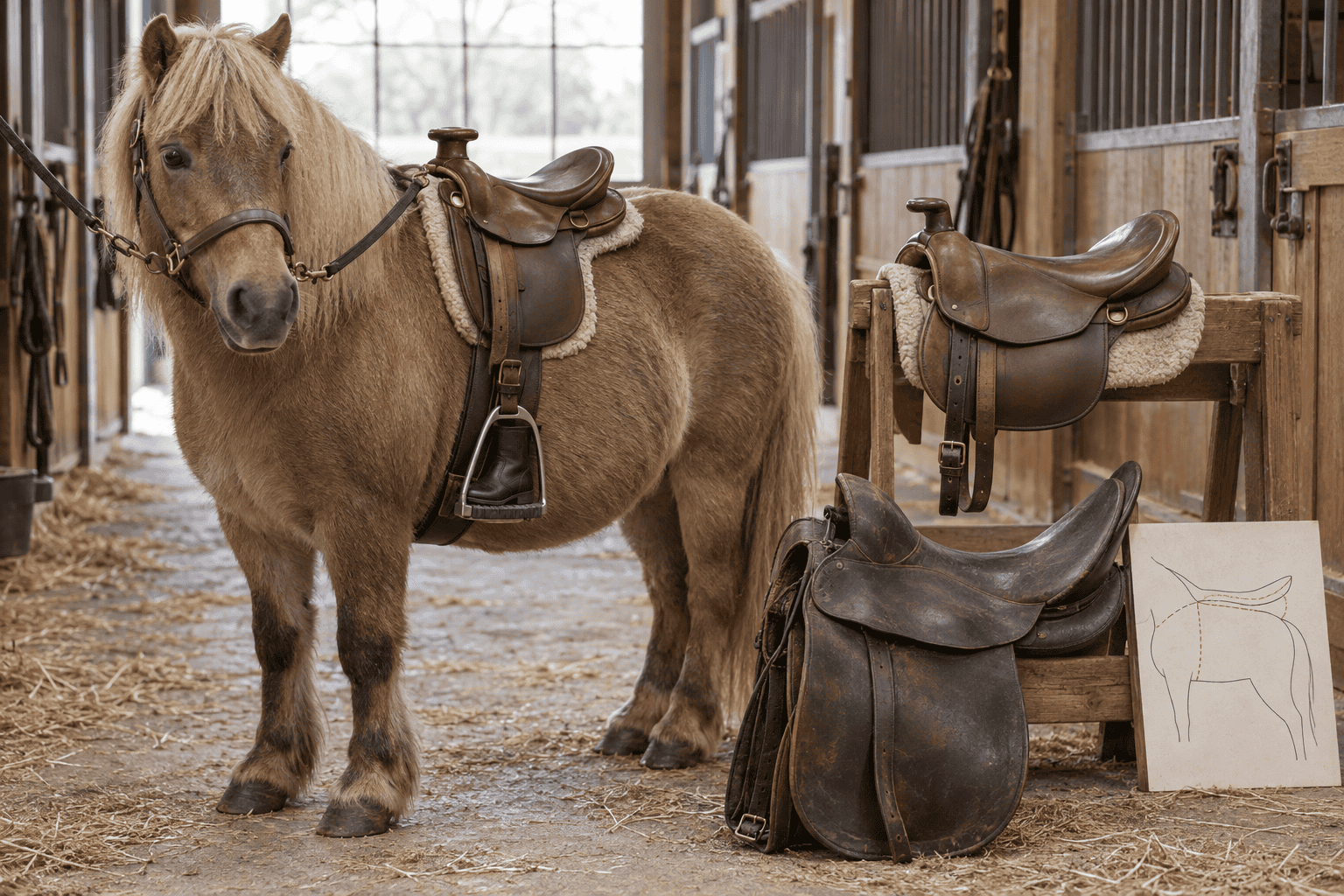
5 Kids’ Saddles Your Pony Secretly Hates (And 5 It’ll Thank You For)
A small pony that humps its back, won’t pick up a canter, or dumps a child the moment things get exciting usually gets one word at the barn: ponytude. Sometimes that is fair. Sometimes the pony is reacting to a saddle that presses where a saddle should never press, and the saddle doing it is the one the family was proudest to find. It was free, or it was a bargain, or it came in a starter set with a matching pad.
We assessed ten common kids’ saddle choices against four criteria. Five fail. Five pass. The failures are mostly categories rather than brands, because the most common problems with children’s saddles are length, width and what is hidden inside, not the logo on the flap. One of the passes costs less than a pizza, and the best all-round pick changes width with a hex key.
The four criteria
- Length. The saddle stays inside the pony’s saddle support area and does not extend onto the loin.
- Width. The tree or bars can match a wide, low-withered pony instead of perching on it.
- Child safety. The setup stays stable under an unbalanced child and does not raise the risk of a foot being trapped.
- Verifiable construction. You can find out what the tree is and who made it.
Scorecard: ten kids’ saddle choices against four criteria
| Choice | Length | Width | Child safety | Construction known | Verdict |
|---|---|---|---|---|---|
| Hand-me-down adult saddle | Fail | Depends | Depends | Usually | Fail |
| Oversized seat bought to grow into | Fail | Depends | Fail | Usually | Fail |
| Bareback pad with stirrups | n/a | n/a (no tree) | Fail | n/a | Fail |
| Too-good-to-be-true bargain leather saddle | Unknown | Unknown | Unknown | Fail | Fail |
| Narrow saddle on a wide pony | Depends | Fail | Depends | Depends | Fail |
| Round-skirted youth western on the right bars | Pass | Pass | Pass | Pass | Pass |
| Wintec Kids saddle | Pass* | Check on pony | Pass | Pass | Pass |
| Pony saddle with a balance handle (or a grab strap) | Pass* | Check on pony | Pass | Pass | Pass |
| Good used pony saddle, fitter-checked | Pass* | Pass* | Pass | Pass | Pass |
| Thorowgood T4 Pony | Pass | Pass | Pass | Pass | Pass |
* Passes when the saddle has been checked on the individual pony. No saddle passes on paper alone.
The five your pony secretly hates
Nothing in this section carries a purchase link. We do not link to choices we are telling you to avoid.
1. The hand-me-down adult saddle
The old seventeen-inch saddle comes off the rack, the new pony arrives, and on it goes. It feels thrifty. For the pony, it is a length problem.
Every horse and pony has a saddle support area that ends at the last rib. Master saddler Jochen Schleese explains that a saddle extending past it puts pressure on the lumbar region, and that a horse ridden in a saddle that is too long often tightens its lower back and hollows away from the pressure, and in extreme cases bucks to get the weight off. Michigan State University Extension gives the equivalent warning for western saddles: long bars on a short-backed horse put too much pressure over the loin and kidney area.
The 30-second check: find the last rib, follow it up to the spine, and see where the saddle’s panels or bars end. If they extend behind that line, the saddle is too long for that pony.
2. The oversized seat bought to grow into
A bigger seat usually means a longer saddle. Experienced riders on the Chronicle of the Horse forum describe the result on medium and small ponies: the cantle ends up over the loin, flips up over fences and comes back down on it, and with regular use the pony gets sore and starts behaving in ways that get blamed on temperament. That is a rider report, not a study, but it is the same length problem as number one, arriving through a different decision.
The child pays as well. A small rider in a seat that is too big slides around and grabs for balance, and the nearest thing to grab is the reins, which means the pony’s mouth. For western saddles, a common sizing rule of thumb is about four inches between the fork and the front of the rider’s body, with the rider’s seat resting against the back of the saddle.
3. The bareback pad with stirrups
It looks like the gentlest option there is. That is the trap. Without a tree, nothing keeps the pad in place when a rider puts more weight into one stirrup, and the pad can roll. If a foot is still in the stirrup when it does, a fall can turn into a drag.
EquiSearch’s tack testers stated that they consider stirrups on a bareback pad inherently unsafe, because a pad is far more likely to slip than a saddle. Riders who have used them repeatedly also report white hairs appearing just behind the withers, where the stirrups attach and the weight concentrates. That second point is anecdotal; the first needs no study to understand.
The free fix: take the stirrups off. A plain pad at a walk on a lead rope still builds a child’s balance.
4. The too-good-to-be-true bargain leather saddle
Tooled leather, pad and girth included, for a couple of hundred dollars. The listing photos show everything except the one part that decides the pony’s comfort: the tree.
Riders who watched cheap imported saddles opened up on saddle-fitting courses have described trees built from scraps of wood, broken spring trees and protruding nails. We could not establish how common that is, and we are not claiming every inexpensive saddle is built that way. What is well documented is what a broken tree does. At a Society of Master Saddlers fitting course, master saddler Laurence Pearman said a broken tree can make a saddle suddenly drop down in front with little or no wither clearance, that you may hear squeaking or feel movement, and that a broken tree should never be repaired or welded.
The check: ask the seller what the tree is made of and who made it. A seller who cannot answer has answered. For a full inspection routine, see our guide to checking a saddle tree before you buy.
5. The narrow saddle on the wide pony
Many small ponies are deceptively wide, with round barrels and barely any withers. Michigan State University Extension notes that horses with flatter withers can often wear saddles that are too narrow, which makes the saddle sit too high in front, pinch and create a sore back.
The usual response is a thicker pad. The same guidance is direct about that: saddle pads are not meant to fix an ill-fitting saddle. Check the saddle with no pad. From the side it should sit level, not tipped up at the front, and a flat hand slid underneath should meet even pressure along the full length.
The five it’ll thank you for
Some links in this section are affiliate links. Hoof & Honest is a participant in the Amazon Services LLC Associates Program and earns from qualifying purchases. This costs you nothing and did not affect which choices appear here. The five failures above carry no links.
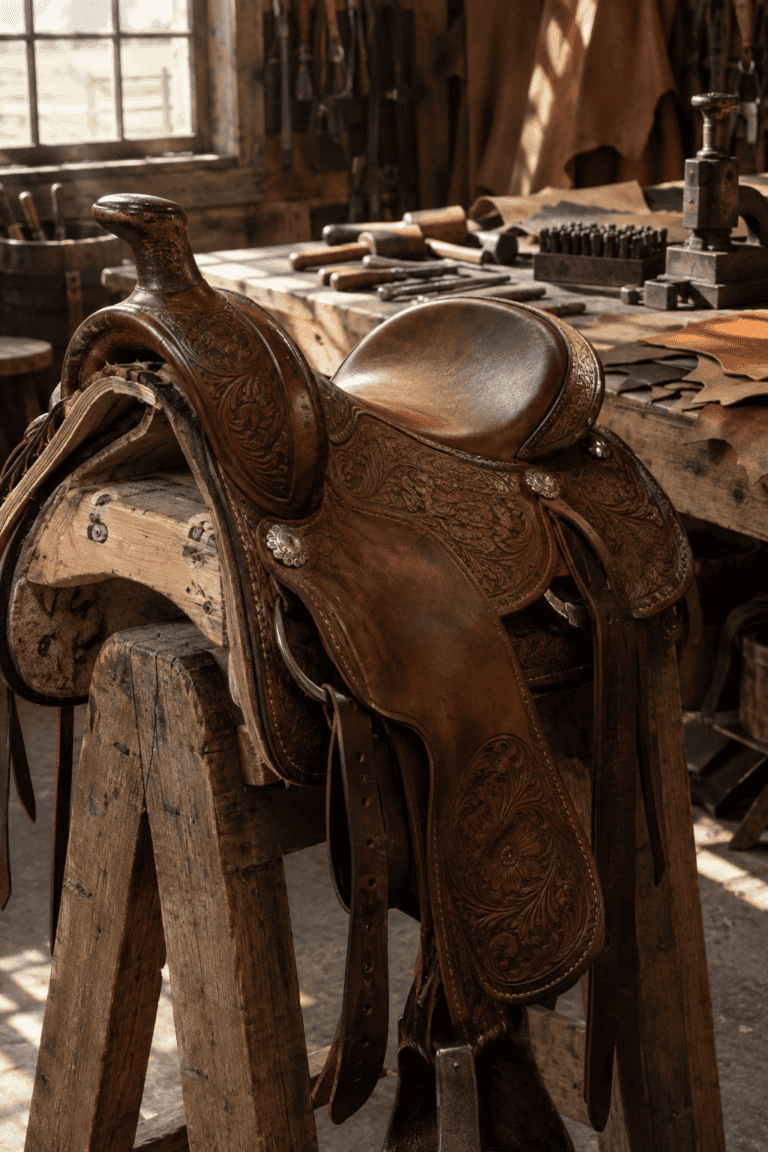
6. The round-skirted youth western saddle on the right bars
Schneiders describes youth western saddles as usually twelve to fourteen inches in the seat, and youth saddles are typically built with shorter skirts than adult ones. The skirt shape matters on a pony. Michigan State University Extension warns that square-cut skirts on some stock saddles can irritate the flanks of short-backed horses; a round skirt simply ends sooner.
Then check the bars. Riders who fit ponies regularly point out that a pony that looks small can still need full quarter horse bars. With the child mounted, Michigan State’s guidance for a stock saddle is about two inches of clearance between the withers and the gullet. A round-skirted youth western saddle is only a pass once those two checks are done on your pony.
7. The Wintec Kids saddle
A synthetic saddle made for children. One retailer’s starter pack lists the stirrup leathers and cage stirrups as included, along with removable panels underneath to improve stability on the pony. Retailers sell synthetic children’s saddles like this on the basis that they are light enough for a child to tack up alone, which is half of what a first pony is supposed to teach.
A cage stirrup closes off the front so a small foot cannot slide all the way through. Size still matters: The Pony Club’s stirrup rule requires 7 mm (about a quarter of an inch) of clearance on each side of the boot. Test with the child’s actual riding boot. The Wintec Kids saddle still needs to be checked on the pony, with no pad, like any other saddle.
8. The pony saddle with a balance handle
An English saddle gives a child nothing to hold. When a pony spooks, small hands grab the reins, and every grab lands in the pony’s mouth. Some makers build the answer into the saddle. Italian saddler Prestige’s Happy Pony Small has a deep seat, blocks positioned for children aged roughly seven to nine, and a small balance handle at the front.
If your saddle has no handle, a grab strap for the front D-rings does the same job for less than the price of a pizza. Teach the child to hook a finger through it whenever they feel themselves tip, and keep the reins quiet. If your bit choices are part of the same question, see the bits that most often cause trouble.
9. The good used pony saddle, fitter-checked
Children outgrow pony saddles long before they wear them out. Parents on the Chronicle of the Horse forum report that a well-made pony saddle bought used can often be resold for about what they paid. One parent described a small Stübben as well made and very comfortable; others named close contact pony saddles from Beval and Collegiate. These are parent reports, not tested resale data.
The point for the pony is where the savings go: into a qualified fitter checking the saddle on that pony before the child rides. Before buying, press on the saddle and listen and feel for the squeaking or movement Pearman links to a broken tree, and check underneath for even flocking with no lumps.
10. The Thorowgood T4 Pony
The one choice that answers the length problem in number one and the width problem in number five at once. Retailer listings describe a short panel design that enables it to fit short-backed ponies, panels flocked with 100% British wool, and seat sizes scaled from a very young child on a first pony to a teenager or petite adult.
The width is changeable. Thorowgood’s system uses a hex key to remove the front panel screws, the panel slides off the tree point, and four bolts release the gullet bar so a different width can go in. For the T4 Pony, retailers list widths from narrow-medium to extra-extra-wide, so the saddle can follow the pony as its shape and muscling change. The Cheshire Horse lists it at $849. In our English saddle brand ranking, Thorowgood finished above two French custom houses. Have a fitter set the first width, then recheck whenever the pony changes shape. Find the Thorowgood T4 Pony saddle here.
Five checks before your child rides
- Find the last rib and confirm the saddle ends before it.
- Set the saddle on with no pad and confirm it sits level from the side.
- Slide a flat hand underneath and feel for even pressure along the whole length.
- For a western saddle, check about two inches of wither clearance with the child mounted.
- Put the child’s riding boot in the stirrup and confirm about a quarter of an inch of space on each side.
These checks catch the obvious problems. They do not replace a qualified fitter; for what a professional fitting covers, see the five levels of saddle fit.
What we could not verify
- No published study ranks children’s saddles. The fit principles here come from saddlers and extension guidance written for horses generally; we applied them to ponies.
- How common poor trees are in cheap imports is unknown. The descriptions come from riders on fitting courses, not a survey.
- White hairs under bareback-pad stirrups are a rider report, not a measured finding.
- Used pony saddle resale values and the brand mentions in number nine come from parent forum posts. We could not confirm a specific Stübben pony model name, so none is given.
- We could not confirm whether the Wintec Kids saddle uses the Easy-Change gullet system, so this article makes no width-adjustment claim for it.
- No safety stirrup is independently proven safest. There is no standardized test for stirrup release, as Chronicle of the Horse has reported.
- Prices are US retail as listed in October 2026 and change with stock.
The bottom line
Every one of the five failures was chosen for the child or the budget. Every one of the five passes was chosen for the pony first. A kids’ saddle has two riders to fit, and only one of them can tell you where it hurts.
References
- Schleese, J. Saddle Fit / Saddle Length: How Long Is Too Long? Schleese Saddlery. schleese.com
- Schleese, J. Why does my saddle shift forward? Dressage Today. dressagetoday.com
- Michigan State University Extension. Saddle fitting. canr.msu.edu
- The Horse. Seven Common Saddle Faults (Laurence Pearman, Society of Master Saddlers Introduction to Saddle Fitting Course, 2015). thehorse.com
- EquiSearch. No Saddle? No Problem (2005). equisearch.com
- Equine Ink. No stirrups on bareback pads, please (rider report, 2008). equineink.com
- The Pony Club. Stirrup Rule. pcuk.org (PDF)
- Chronicle of the Horse. Opinion: How To ‘StirrUp’ Riding Instructors Everywhere. chronofhorse.com
- The Cheshire Horse. Thorowgood T4 All Purpose Pony Saddle; Thorowgood S-Bar Changeable Gullet. cheshirehorse.com
- Bonnetts Saddlery. Thorowgood gullet plates (S-bar), gullet change steps. bonnetts.com.au
- Ohlala Equestrian. Wintec Children’s Starter Saddle Pack. ohlala-equestrian.com
- Prestige Italia. Happy Pony Small product sheet. prestigeitalia.com (PDF)
- Schneiders Saddlery. Western Youth Saddles. sstack.com
- Chronicle of the Horse forum threads (rider and parent reports): How will my saddle affect my pony?; Does the pony saddle fit?; child pony saddle help. 1, 2, 3
- New Rider forum. Saddle innards (rider reports from a saddle-fitting course). newrider.com
Disclosure
Hoof & Honest was not paid by any saddle maker for this article, and no brand was given advance sight of it. No products were supplied. Claims trace to the published sources above; where a claim comes from rider or parent reports, the article says so, and claims we could not verify are listed above. Research completed October 2026.