6 Bit Brands Robbing You Blind (And 6 Worth Every Penny)
Advertising disclosure: this article contains affiliate links, placed only on the six brands that passed. If you buy through them, this site may earn a commission at no additional cost to you. Hoof & Honest was not paid by any brand named here, and no brand was given advance sight of this article.
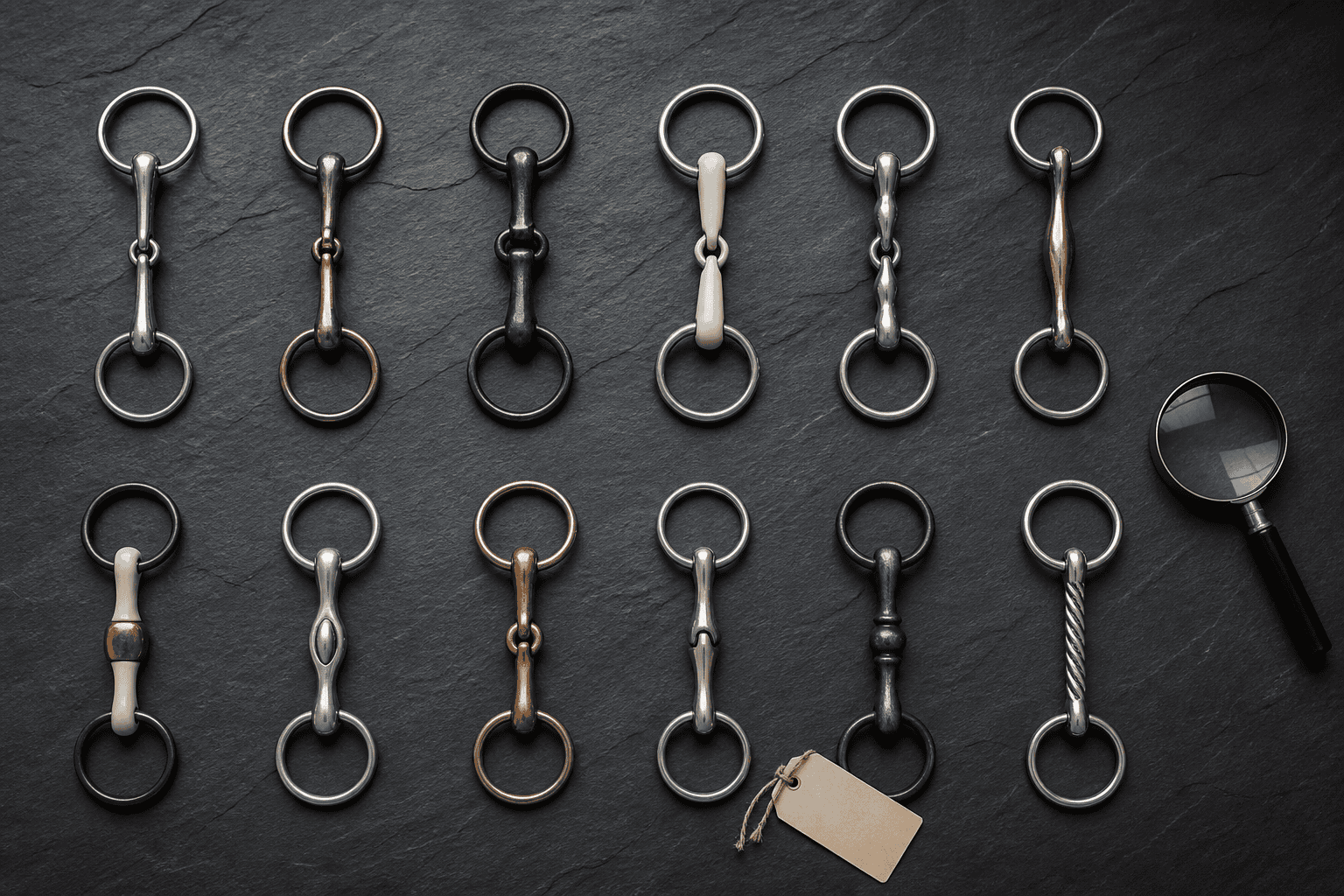
A Shires loose ring snaffle with a copper lozenge costs about $40. A Herm Sprenger KK Ultra in Sensogan, 16 mm, costs $211.90 at a large US retailer. Both are double-jointed loose rings with a lozenge in the middle, and hanging side by side in a tack room, most riders would have to read the tag to tell them apart. Nothing on either box tells you whether the extra $170 buys something your horse can feel or pays for a sentence of marketing.
The horse is the one that finds out. Most riders go through several bits before one works, and the drawer of rejects is usually several hundred dollars of guesswork. So this article looked past the box copy at twelve bit brands and asked one question: for whatever a brand charges above plain stainless steel, is there something a buyer can check?
Six brands couldn’t back up their price: Shires, Stübben (STEELtec), Winderen, Fager, Myler and Neue Schule. Six could: Korsteel, JP Korsteel, Beris, Trust, Bombers and Sprenger. Two of the cheapest bits in the review are on the passing side, and the $212 Sprenger from the opening passes too, though not for the reason printed on its packaging. Along the way, one “secret” alloy turned out to be described, in plain numbers, in a patent its maker let lapse in its home country.
This article is about price and disclosure. For what different mouthpieces do inside the mouth, see the bits your horse secretly hates, and the ones it will thank you for. For sizing and fit, see the five levels of bit fit.
How the twelve were checked
Every check below can be run from a browser before a bit ever goes in a horse’s mouth. A brand didn’t need all four. It needed its price premium to line up with at least one thing it could show.
- A disclosed mouthpiece material. The metals named, not “premium alloy.” A patent that describes the alloy counts as partial disclosure.
- A named place of manufacture. Where the bits are made, stated by the maker or its authorized distributor, not just where the brand is headquartered.
- Design protection that still exists. If a brand leans on “patented,” the patent has to be in force somewhere that matters.
- A guarantee with money behind it. A published warranty or guarantee that puts the company’s own cost on the line.
Claims about taste, salivation or “acceptance” didn’t count for anything, because no brand in this review published evidence for them. The section on what the research says explains why.
The scorecard
| Brand | Example bit and US price found | Material disclosed | Build location stated | Patent / guarantee | Verdict |
|---|---|---|---|---|---|
| Shires | Copper lozenge loose ring, $35–40 | Partly: sweet iron or stainless with copper lozenge | Not found | None found | Doesn’t justify premium |
| Stübben (STEELtec) | Sweet Copper loose ring, about €65 | Named (“Sweet Copper”), no composition | Not found for bits | None found | Doesn’t justify premium |
| Winderen | Ported mullen loose ring, €145 | Partly: synthetic gel over stainless core | Not found | 1-year warranty | Doesn’t justify premium |
| Fager | Titanium loose ring (Annie), $175 | Yes: titanium | Not found (“designed in Sweden”) | None found | Doesn’t justify premium |
| Myler | Loose ring comfort snaffle MB 02, $125.95 | Varies by model | Partly: US line in Marshfield, Missouri, plus a separate import line | Patents found have all expired | Doesn’t justify premium |
| Neue Schule | Verbindend 16 mm loose ring, $195 | No: “high copper alloy,” composition unpublished | Not found | EP patent lapsed in UK and Ireland; still renewed in France and Germany | Doesn’t justify premium |
| Korsteel | Stainless French link loose ring, $39.99 | Yes: stainless steel | Not found | No premium charged | Pass (baseline) |
| JP Korsteel | Stainless French link loose ring, $26–35 | Yes: stainless steel | Not found | No premium charged | Pass |
| Beris | Double-jointed loose ring, about $81 | Yes: food-safe plastic compound | Yes: Germany | None found | Pass |
| Trust | Inno Sense loose ring from about $175 | Yes: sweet iron, synthetic or leather, named per model | Yes: handmade in the Netherlands | None found | Pass |
| Bombers | Ported barrel loose ring, $165.99 | Yes: stainless, sweet iron, brass; moulded range with steel cable core | Yes: Merrivale, KwaZulu-Natal, South Africa | Lifetime guarantee on manufacturing defects (metal bits) | Pass |
| Sprenger | KK Ultra Sensogan 16 mm loose ring, $211.90 | Yes: metals named for Aurigan and Sensogan | Company factory in Iserlohn since 1887 | Aurigan patent registered 1993 | Pass |
“Not found” means this review looked on the brand’s own pages and major retailer listings and didn’t find the information. It doesn’t mean the brand is hiding it. Prices were checked in September 2026 and change often.
Same shape, different price
The double-jointed loose ring is the most common snaffle in a tack room, which makes it the fairest place to compare what the money buys.
| Bit | Mouthpiece | US price found | What the extra money verifiably buys |
|---|---|---|---|
| JP Korsteel French link loose ring | Stainless, curved, double-jointed | $26–35 | Nothing extra charged |
| Shires copper lozenge loose ring | Sweet iron or stainless, copper lozenge | $35–40 | Copper lozenge |
| Korsteel French link loose ring | Stainless, double-jointed | $39.99 | Nothing extra charged |
| Beris double-jointed loose ring | Synthetic, double-jointed | About $81 | Synthetic mouthpiece, made in Germany |
| Neue Schule Verbindend 16 mm | Copper alloy, center lozenge | $195 | Warm copper alloy; composition unpublished |
| Sprenger KK Ultra Sensogan 16 mm | Copper-manganese-zinc alloy, center lozenge | $211.90 | Warm copper alloy with named metals, documented alloy history |
Designs differ in details like mouthpiece curve, lozenge angle and ring size, so these aren’t identical bits. The point is the spread: roughly an eightfold gap between the cheapest and the most expensive way to put a double-jointed snaffle in a horse’s mouth.
What the research says about bit metals
Almost every brand in this review, on both sides of the verdict, sells its material on one of two promises: the bit makes the horse salivate and accept it better, or the bit warms to mouth temperature faster. Only one of those has evidence behind it.
| Claim | Who makes it here | Evidence found | Verdict |
|---|---|---|---|
| Copper or sweet iron increases salivation or chewing | Shires, Stübben, Sprenger, Beris, Trust, Bombers | No study found that tests it. A 2005 study of 12 cantering horses found wearing a bit did not increase swallowing compared with a head collar, which the authors said argues against increased salivation. Copper was not tested. | Unsupported; treat as marketing |
| Copper alloys warm faster and run warmer | Neue Schule, Sprenger | A 2025 study of 58 carriage horses in Vienna found copper bits ran warmest: median 31.9 °C vs 29.5 °C for steel, with a larger gap in winter. | Supported |
| Alloy doesn’t leach ions or taste | Neue Schule | No published data found | Unverified |
| Titanium is lighter | Fager | Titanium is a little over half the density of steel, so the same shape weighs about 40% less. No study found on whether horses notice. | Physically true; benefit unmeasured |
The 2005 study also included a Myler correctional ported barrel bit, the only condition in which swallowing actually dropped. The authors suggested the design might restrict tongue or jaw movement. With 12 horses and one model, that isn’t a verdict on Myler, but it is the only independent measurement of a Myler bit this review found.
The six that didn’t justify their price
Shires: the cheapest place to pay for the salivation claim
Shires Equestrian has been based in Leominster, Herefordshire, since 1968 and has held a Royal Warrant as a supplier of equine equipment. Its copper lozenge loose ring costs $35 to $40. The listing says the copper helps encourage mouthing, and the sweet-iron version adds that sweet iron oxidizes into a taste horses enjoy and increases salivation.
This is the smallest overcharge in the review. A JP Korsteel stainless French link costs $26 to $35, so the few extra dollars buy a copper lozenge and a claim with no evidence behind it. Neither the listing nor Shires’ own site said where the bit is made. If your horse goes well in one, there’s no reason to replace it.
Stübben (STEELtec): a saddle maker’s name on the same promise
Stübben was founded as a saddlery in Krefeld in 1894 and now has its head office in nearby Kempen. Its published history covers saddle production in detail. Its bits are sold as STEELtec, and a STEELtec loose ring in “Sweet Copper” runs about €65, with other snaffles past €130. The product copy says Sweet Copper stimulates salivation and tastes pleasant.
That’s roughly double the Shires price for the same claim. This review found no statement from Stübben on where STEELtec bits are made and no published composition for Sweet Copper. Stübben’s long record is real, but it’s a record in saddles.
Winderen: a good idea most buyers won’t use
Winderen mouthpieces are a synthetic gel over a stainless steel core, in a 14 mm “slim” and an 18 mm “comfort” version. The system is modular: any Winderen mouthpiece fits any Winderen cheek piece, so a rider who swaps mouthpieces as a horse changes only buys the rings once. For that rider, the maths can work.
Most buyers purchase one complete bit, and a ported mullen loose ring with bit guards lists at €145 on Winderen’s own shop. Beris sells a double-jointed synthetic loose ring for about $81 and states it’s made in Germany. Winderen’s shop is operated by a company registered in Poland and doesn’t say where the bits are produced. It does say the gel is “readily accepted even by sensitive horses,” which is untested, and the warranty is one year.
Fager: “science” without a study
Fager is a Swedish-designed brand built around titanium. A titanium loose ring such as the Annie or Bianca is $175, and much of the range sits between about $195 and $305. Titanium’s weight advantage is real physics.
The problem is the language around it. Fager’s philosophy page says its designs are “fully backed by current and ongoing scientific research” carried out with veterinarians, and its brand copy promises it will “always prove our point with science.” None of the Fager pages or retailer listings reviewed here named a study, a researcher or a result, and none said where the bits are manufactured.
Myler: the patents have run out
Myler was founded by three brothers, Ron, Bob and Dale Myler, and its US-made bits are handmade in Marshfield, Missouri. The loose ring comfort snaffle MB 02 costs $125.95 at a large US retailer.
Myler bits are often described as patented. This review found three Myler patents: US 4,884,390 (filed 1988), US 5,062,255 (filed 1989) and US 6,202,393 (filed 1999, covering cheek rings with flush slots). All three have expired, the last in 2019. A newer filing may exist that this review didn’t find, but on the public record the exclusivity is gone. There is also a separate Myler-Toklat import line, and the retail listing checked didn’t say which line a buyer receives. Ask before you pay US-made prices.
A figure circulates for the percentage of horses that “improve” in a Myler. This review couldn’t trace it to any study, so it isn’t repeated here.
Neue Schule: the secret alloy in the patent file
Heather Hyde founded Neue Schule in the UK after running one of the country’s first bit-hire services in the late 1990s. Its signature material is Salox Gold, which Neue Schule describes as “a metal alloy unique to Neue Schule,” a high copper alloy that “reaches mouth temperature quickly” and “doesn’t leach ions.” It doesn’t publish the composition. A 16 mm Verbindend loose ring costs $195.
The European Patent Office file is more specific. In September 2008, Neue Schule Ltd filed European patent application EP 2191027, “Equestrian bit mouthpiece from copper alloy,” naming Graham Hugh Cross as inventor. The claims cover a mouthpiece alloy of 65–80% copper, 0–2% tin and the remainder zinc, with a preferred version of 70–73% copper, about 1% tin and 28% zinc. Copper and zinc in those proportions belong to the family of alloys generally called brass.
Neue Schule has never confirmed that Salox Gold matches the patent’s recipe, so this article doesn’t claim it does. What the record shows is that this is the alloy the company chose to protect. The patent was granted in May 2013. Protection lapsed in the UK and Ireland for non-payment of renewal fees within about two years, and it’s still being renewed in France and Germany.
The warmth claim holds up, per the 2025 temperature study above. The ion claim has no published data behind it. Against the Sprenger at a similar price, the difference is disclosure: Sprenger names the metals in its alloys and the town it has worked from since 1887. Neue Schule names neither.
The six worth the money
Korsteel: the baseline
Korsteel is part of WeatherBeeta’s product line. A stainless steel French link loose ring costs $39.99. The only claim on the listing is about geometry, that the double joint avoids the nutcracker action of a single joint, which you can check by holding the bit up. This review didn’t find where Korsteel bits are made. At this price there’s no premium to justify, which makes it the benchmark every other bit here should be measured against.
Check current Korsteel French link listings
JP Korsteel: a real design at no premium
The JP line was developed with John Patterson, an Australian racehorse trainer and jockey, and its mouthpieces are curved rather than straight. A stainless JP French link loose ring was listed at $25.99 to $34.99, less than both the plain Korsteel and the Shires. If you’re still working out which mouthpiece shape your horse prefers, it’s the cheapest way to find out. Manufacturing location wasn’t found here either.
Check current JP Korsteel listings
Beris: the synthetic bit with a stated origin
Beris is carried by Waldhausen, a German company based in Cologne, and its bits are sold as made in Germany. The mouthpieces are a food-safe plastic compound that Beris says slides smoothly rather than dragging like rubber. A double-jointed loose ring was listed at about $81. Beris also says horses will “often be encouraged to chew and salivate more,” which falls under the unsupported claims above. Like any synthetic mouthpiece, a Beris bit should be checked for chew damage more often than steel.
Check current Beris bit listings
Trust: expensive, and you can see where it goes
Trust was started by Teun van Riel, who sold bits from a mobile tack shop at European competitions, and his brother Bas, who brought manufacturing experience. Design happens at the company’s office in Oisterwijk, and the bits are handmade in the Netherlands, in more than 2,000 mouthpiece and cheek combinations across sweet iron, the synthetic Inno Sense and leather. US prices run from about $175 for a loose ring to $450 for a leather pelham. For a horse with an unusual mouth, that range comes close to made to order.
Check current Trust bit listings
Bombers: a guarantee you can hold them to
Bombers started with one man making bits in his garage and is now a team of about 30, including family members, in Merrivale, KwaZulu-Natal, South Africa. Bombers says every bit is still welded, formed and ground by hand there, and it offers a lifetime guarantee against manufacturing defects on its stainless steel, sweet iron and brass bits. The ported barrel loose ring is $165.99. Its moulded range runs a flexible stainless steel cable through an FDA-approved synthetic mouthpiece. The sweet iron salivation copy can be ignored. The guarantee can’t, and it’s what you’re paying for.
Check current Bombers bit listings
Sprenger: why the $212 bit passes
Hermann Sprenger founded a factory for horse and harness fittings in Iserlohn in 1872, and the company has operated from the same address on Alexanderstraße since 1887. It’s now run by the fourth generation of the family and employs about 170 people. In 1993 it introduced Aurigan, a patent-registered alloy of copper, silicon and zinc. In 2013 it followed with Sensogan, which Sprenger describes as copper, manganese and zinc with a lower copper release. The KK Ultra line dates from 1999.
Sprenger also says Sensogan “stimulates the horse’s chewing activity,” and that claim is as unsupported here as anywhere else. The warming claim is backed by the 2025 study. Set the chewing claim aside and what’s left is a company that names the metals in its mouthpiece, has a documented patent history for the alloy behind it, and has worked from the same Iserlohn address since 1887. That is what the extra money over the Shires buys.
Check current Sprenger KK Ultra listings
How to check a bit before you pay a premium
- Find the metal, not the brand name for it. “Sweet Copper,” “Salox Gold” and “Sensogan” are trade names. Look for the actual elements on the maker’s own pages, or in a patent file.
- Look for the country of manufacture on the product page or packaging, not the About page. Where a company was founded and where its bits are made are separate claims. Why that matters is covered in how a $30 pad and a $150 pad can come from the same factory.
- If a brand says “patented,” look the patent up. Google Patents and Espacenet show the filing date and whether it has lapsed. US patents generally last 20 years from filing.
- Ignore salivation and acceptance claims when comparing prices. No brand in this review published evidence for them.
- Read the warranty. A lifetime guarantee on manufacturing defects is worth more than a paragraph about taste.
- Fit first. The most expensive bit in the wrong size is worse than a $30 bit that fits. Start with the five levels of bit fit.
What we could not verify
These gaps are stated here rather than left out.
- Salox Gold’s composition. The patent describes a copper-tin-zinc alloy. Neue Schule has not confirmed that Salox Gold uses that recipe.
- Manufacturing locations for Shires, Stübben STEELtec, Winderen, Fager, Korsteel, JP Korsteel and Neue Schule bits weren’t found on the brands’ own pages or the retailer listings checked. Sprenger’s entry reflects the company’s long-standing Iserlohn factory; this review didn’t confirm the build location of each individual model.
- Newer Myler patents. The three patents found have expired. A newer filing may exist.
- Which Myler line a retailer ships. The listing checked didn’t distinguish the Missouri-made line from the Myler-Toklat import line.
- Sprenger’s Aurigan patent. Sprenger describes Aurigan as patent-registered in 1993. This review didn’t retrieve the patent document itself; any patent from that date would have expired by 2013 at the latest.
- Brand-reported facts. Bombers’ staff size and hand-finishing, Trust’s handmade production and combination count, and Beris’ “made in Germany” come from the brands or their distributors.
- Prices come from the retailers named in the references, checked in September 2026. The ratios in this article would shift with different retailers.
A widely repeated claim about the percentage of horses that improve in Myler bits was left out because no study could be found behind it.
Related reading
The same price-versus-proof test runs through the seven levels of tack spending, and the five bridle brands you can still trust applies the build-location check to the rest of the bridle.
References
- Manfredi J, Clayton HM, Derksen FJ (2005). Effects of different bits and bridles on frequency of induced swallowing in cantering horses. Equine and Comparative Exercise Physiology 2(4). doi:10.1079/ECP200569. researchgate.net
- Krcal C, Licka T (2025). Temperatures of the Mouthpiece of the Bit of Carriage Horses over a Period of 11 Months. Animals 15(17): 2623. mdpi.com
- European patent EP 2191027, “Equestrian bit mouthpiece from copper alloy,” applicant Neue Schule Ltd, inventor Graham Hugh Cross; claims, grant and legal status. patents.google.com
- Neue Schule: Why is the Salox Gold mouthpiece material so special? nsbits.com
- Neue Schule founding and background, as described by a distributor. equestrianhouse.co.za
- Neue Schule Verbindend 16 mm loose ring, US price (checked September 2026). doversaddlery.com
- Herm. Sprenger: company history. sprenger.de
- Herm. Sprenger: bit materials explained (Sensogan, Aurigan). sprenger.de
- Sprenger KK Ultra Sensogan 16 mm loose ring, US price (checked September 2026). doversaddlery.com
- Myler patents: US 4,884,390 and US 5,062,255. patents.justia.com
- Myler patent US 6,202,393, “Bridle bit,” status expired. patents.google.com
- Myler Bits USA: Marshfield, Missouri, and the Myler-Toklat import line. mylerbitsusamarshfieldmo.com
- Myler history. abetterbit.com
- Myler Loose Ring Comfort Snaffle MB 02, US price (checked September 2026). doversaddlery.com
- Shires Equestrian, Royal Warrant Holders Association listing. royalwarrant.org
- Shires Loose Ring Copper Lozenge Snaffle, US price (checked September 2026). statelinetack.com
- Shires Copper Lozenge Sweet Iron Loose Ring Snaffle, product claims and price. bigdweb.com
- Stübben: family history. stuebben.com
- Stübben STEELtec range, prices and product claims, as listed by a retailer (checked September 2026). equusvitalis.com
- Winderen: bit system and materials. winderen.com
- Winderen Loose Ring Ported Mullen with Bit Guards, price and warranty (checked September 2026). winderen.com
- Fager: our philosophy. fagerbits.com
- Fager Bits USA: titanium bit prices (checked September 2026). fagerbitsusa.com
- Fager brand copy and price range, as listed by a retailer. horsebitemporium.com
- Korsteel Stainless Steel French Link Loose Ring, US price (checked September 2026). farmhousetack.com
- JP Korsteel French Link Loose Ring, US price (checked September 2026). jefferspet.com
- Korsteel and JP Korsteel brand information, as listed by a retailer. marystack.com
- Beris bits, Waldhausen brand page. waldhausen.com
- Beris bits: materials and made-in-Germany statement. berisbit.com
- Beris Loose Ring Snaffle Double Jointed, US price (checked September 2026). tailoredequestrian.com
- Trust Equestrian history, as described by a US retailer. farmhousetack.com
- Trust bits: Oisterwijk design office and US prices (checked September 2026). horsebitemporium.com
- Bombers: company, manufacturing and lifetime guarantee. bombers.co.za
- Bombers Loose Ring Ported Barrel, US price (checked September 2026). dapperhorse.com